Rong-Electric Кіраўніцтва па блоку харчавання 4.5 В: MDH200 супраць MA200, MQ300 і TVB200 (2026)
Выбіраючы правільна Rong-Electric 4.5V харчавання comes down to three field checks that save you from dead cabinets on install day: matching your local AC mains range (100–240V wide input versus 200–240V high-line only), confirming whether your cabinet needs 40A or 60A of DC headroom, and verifying the physical enclosure height before you bolt it to the backplate. When you’re replacing a burned-out LED display power supply or building a new fine-pitch indoor wall, a 0.5V drop from 5V down to 4.5V cuts wasted heat across every driver IC, yet mixing up a PC wide-input model with an H high-line model will trip your breakers the second you plug it into a 120V North American circuit.
1. Why 4.5V and 4.6V units replace 5V in modern LED cabinets
For years, 5V DC was the default rail for almost every indoor and outdoor LED module. That worked fine when pixel pitches sat at P4 or P6 and cabinets had plenty of rear air space. Once indoor walls shrank to P1.86, P1.53, and P1.25—and rental cabinets got thinner than 60 mm (2.36 in)—running a 5V rail started creating a thermal problem that fans couldn’t fix without sounding like a server rack.
Most constant-current LED driver ICs only need around 3.8V to 4.2V across the blue and green diode channels, and even less on the red channel. When you feed those boards with a 5.0V supply, the extra 0.5V to 0.8V doesn’t make the screen brighter. Instead, the driver IC burns that surplus voltage straight off as heat. Dropping the rail to a Rong-Electric 4.5V харчавання trims roughly 10% off the DC power dissipated inside the module, which lowers rear PCB temperatures by several degrees and slows down color drift over multi-year runs.
01. When 4.5V works—and when you still need 4.6V or 5V
You can’t blindly swap a 5V unit for a 4.5V unit on every legacy wall. Older outdoor DIP modules or long daisy-chained power harnesses sometimes suffer 0.3V to 0.4V of copper drop between the supply terminal and the far end of the cabinet. If a module starts at 4.5V and loses 0.4V along thin 18 AWG leads, the far tiles drop to 4.1V and start showing dim blue patches or flickering scan lines.
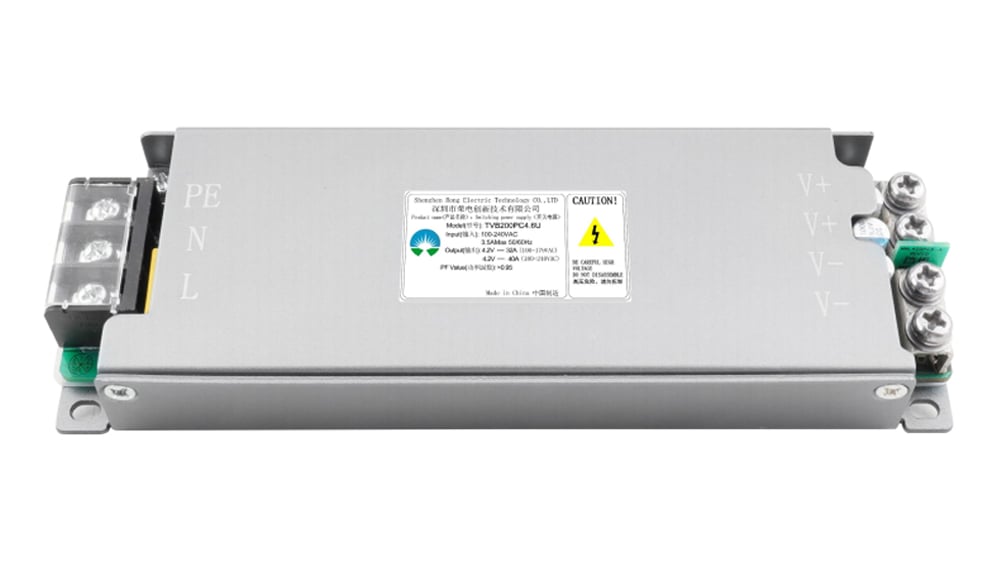
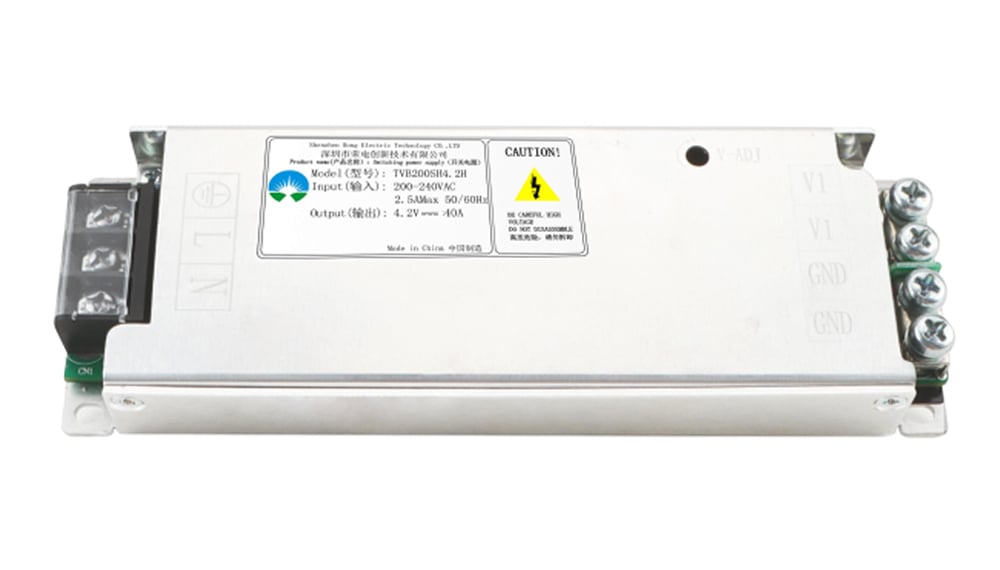
вось чаму Rong-Electric builds three closely spaced low-voltage tiers: 4.5V for standard energy-saving indoor and fine-pitch SMD cabinets, 4.6V (like the TVB200PC4.6U) for slim cabinets that need an extra 0.1V margin to offset cable resistance, and 4.2V (like the TVB200SH4.2H) for dedicated common-cathode or ultra-low-voltage designs. Always check the silkscreen next to the module’s VH4 or 4-pin power header before ordering.
02. Чытанне Rong-Electric part numbers on the jobsite
Пасля таго, як вы ведаеце, як Rong-Electric names its supplies, you’ll spot mismatches in five seconds. The number right after the series letters—200 or 300—tells you the nominal power class (roughly 200W at 40A or 300W at 60A). The letters in the middle—PC у параўнанні з H or SH—tell you the AC mains architecture. Models carrying PC include active Power Factor Correction and wide-range 90–264VAC or 100–240VAC input, so they run cleanly on 110V–120V North American circuits as well as 220V–240V European and Asian grids. Models with H (such as MDH200H4.5 or TVB200SH4.2H) are high-line units built for 190–264VAC or 200–240VAC mains only.
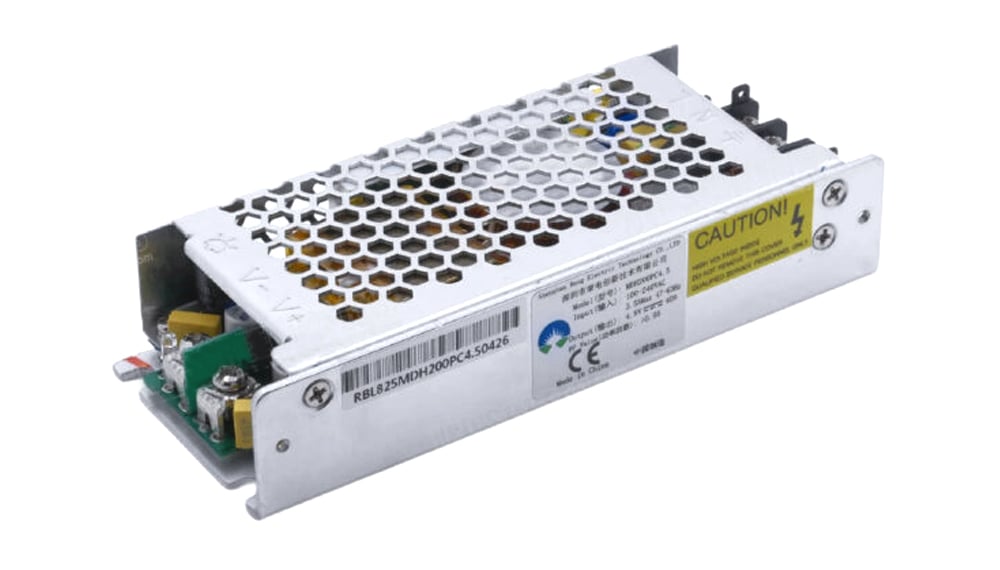
2. Rong-Electric 4.5V, 4.6V, and 4.2V model comparison
Before you order spares or spec a new cabinet build, put the six core Rong-Electric low-voltage models side by side. Even when two supplies share the exact same 4.5V 40A label, their AC input window, footprint, and cooling clearance can be completely different.
| мадэль | Выхад пастаяннага току | Дыяпазон уваходнага пераменнага току | Max AC Current / Cooling | Typical Cabinet Fit |
|---|---|---|---|---|
| МДХ200ПК4.5 | 4.5 В / 40 А (180 Вт) | 100–240VAC (47–63Hz) | 3.5A max, convection/vented | Global 120V/230V indoor & rental cabinets |
| MDH200H4.5 | 4.5 В / 40 А (180 Вт) | 200–240VAC (50/60Hz) | 3.0A max, ventilation cooling | 230V-only fixed indoor/outdoor cabinets |
| MA200PC4.5 | 4.5 В / 40 А (180 Вт) | 90–264VAC (up to 90% eff. at 230V) | 190 × 81.5 × 30 мм (7.48 × 3.21 × 1.18 цалі) | Standard 30 mm (1.18 in) slim cabinets, -30 to +60°C |
| MQ300PC4.5 | 4.5 В / 60 А (270 Вт) | 100–240VAC (50/60Hz) | 5.0A max, high-current bus | High-brightness or large 960×960 mm cabinets |
| TVB200PC4.6U | 4.6 В / 40 А (184 Вт) | 90–264 В пераменнага току | 150 × 50 × 19 мм (5.91 × 1.97 × 0.75 цалі) | Ultra-slim 19 mm (0.75 in) die-cast cabinets |
| ТВБ200Ш4.2Х | 4.2 В / 40 А (168 Вт) | 190–264 В пераменнага току | Ultra-slim high-line housing | 230V common-cathode / 4.2V low-voltage walls |
Notice how quickly this table narrows your choices. If your site runs on 110V or 120V single-phase power—common across the United States, Canada, Mexico, and Japan—you immediately rule out the MDH200H4.5 and TVB200SH4.2H. On the flip side, if you’re servicing a 230V European or Middle Eastern fixed installation that originally shipped with MDH200H4.5 units, ordering the exact H-series replacement keeps your mounting holes and BOM cost aligned.
3. MDH200PC4.5 vs MDH200H4.5: the AC input trap
The single most common mistake technicians make when ordering a replacement Rong-Electric 4.5V харчавання is treating the MDH200PC4.5 and MDH200H4.5 as interchangeable twins. They share the same 4.5V 40A DC rating and nearly identical model prefixes, so it’s easy to skim a packing list and grab the wrong one.
01. Wide-range 100–240VAC (MDH200PC4.5)
,en Rong-Electric МДХ200ПК4.5 accepts 100–240VAC at 47–63Hz with a maximum AC input current of 3.5A. It includes input undervoltage, overload, and short-circuit protection. Because it handles both 120V and 230V mains without a manual voltage toggle switch, it’s the safest pick for rental staging houses, touring LED walls, and OEM cabinet builders shipping into mixed international markets. You won’t have to worry about a crew plugging a 230V rack into a 120V hotel ballroom outlet.
02. High-line 200–240VAC only (MDH200H4.5)
,en Rong-Electric MDH200H4.5 is rated strictly for 200–240VAC at 50/60Hz with a maximum input current of 3.0A and ventilation cooling. If you connect an MDH200H4.5 to a 110V or 120V circuit, its input undervoltage protection will either keep the unit completely dead or cause unstable startup hiccups that flicker the LED modules. Reserve this model for 220V–240V regions or North American commercial sites wired specifically with 208V/240V phase-to-phase LED power distribution.
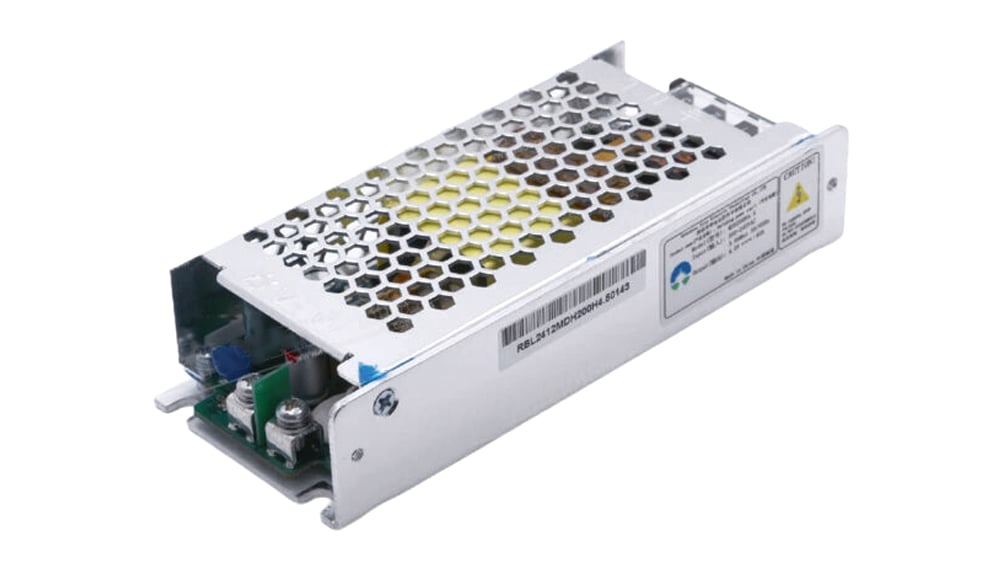
4. MA200PC4.5 vs MQ300PC4.5: 40A slim vs 60A high-load
Once you’ve locked in wide-range 100–240VAC input, the next decision is whether your cabinet belongs in the 40A class or the 60A class. This isn’t just about total wattage—it’s about thermal margin, efficiency, and how many modules share one supply.
01. MA200PC4.5: 90% efficiency and -30 to +60°C rating
,en Rong-Electric MA200PC4.5 delivers 4.5V at 40A (180W) from a 90–264VAC input inside a compact 190 × 81.5 × 30 mm (7.48 × 3.21 × 1.18 in) enclosure. Two specs stand out for field reliability: up to 90% conversion efficiency at 230VAC and an operating temperature range of -30°C to +60°C (-22°F to +140°F). That wide temperature window makes the MA200PC4.5 a strong choice for semi-outdoor retail storefronts, cold-climate lobbies, or enclosed wall-mount cabinets where ambient air climbs fast in summer.
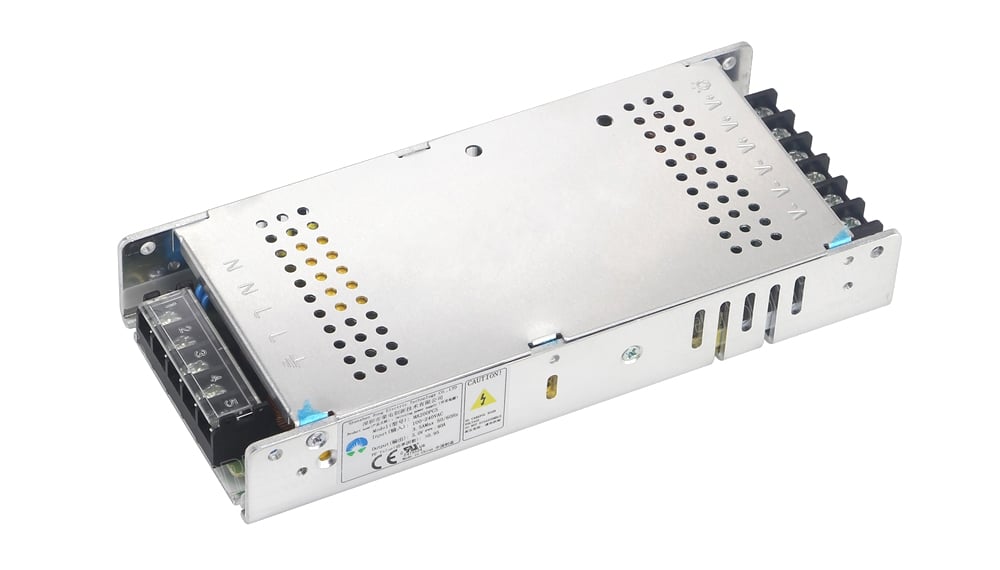
02. MQ300PC4.5: 60A capacity for dense or high-brightness cabinets
When a single cabinet holds six or eight 320×160 mm modules—or when you’re driving high-brightness window-facing indoor panels—a 40A supply starts running too close to 100% load on full white frames. Stepping up to the Rong-Electric MQ300PC4.5 gives you 4.5V at 60A (270W) on a 100–240VAC, 50/60Hz input (5.0A max AC draw) with built-in input undervoltage, overload, and short-circuit protection.
Using one 60A Rong-Electric 4.5V харчавання instead of cramming two 40A units into a mid-sized cabinet also cuts down AC jumper wiring and simplifies troubleshooting. Just make sure you split the 60A DC output across multiple terminal pairs and use thick enough wire gauge so no single connector carries more than its rated ampacity.
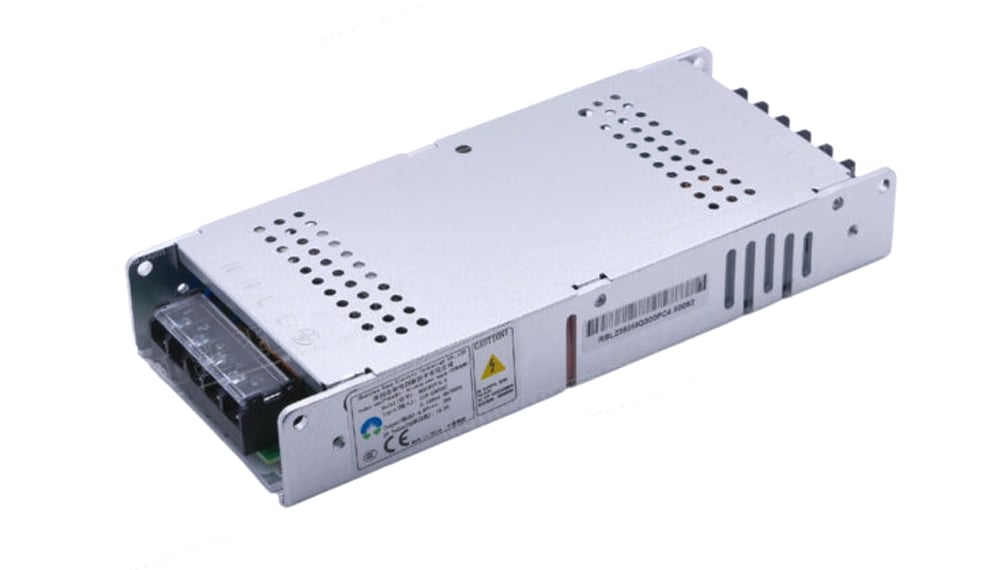
5. TVB200PC4.6U and TVB200SH4.2H for ultra-slim 19mm cabinets
Modern front-service wall-mount LED displays—especially 600×337.5 mm (16:9) and 640×480 mm die-cast aluminum cabinets—often have total cabinet depths under 35 mm (1.38 in). A standard 30 mm (1.18 in) power supply physically won’t clear the rear cover and hub board. That’s where the Rong-Electric TVB200 slimline series comes in.
01. TVB200PC4.6U: 19 mm profile with 4.6V headroom
,en Rong-Electric TVB200PC4.6U packs 4.6V / 40A (184W) and a wide 90–264VAC input into a 150 × 50 × 19 mm (5.91 × 1.97 × 0.75 in) housing. That 19 mm (0.75 in) thickness slides cleanly inside ultra-thin die-cast frames where standard supplies bottom out. The 4.6V nominal rail gives you a slight 0.1V cushion above a standard Rong-Electric 4.5V харчавання, which helps keep fine-pitch modules stable when internal power bus bars or ribbon jumpers add minor resistance. Because it’s fanless and ultra-thin, pay close attention to thermal contact with the aluminum cabinet backplate and follow output derating curves in warm rooms.
02. TVB200SH4.2H: dedicated 4.2V rail for 230V common-cathode walls
,en Rong-Electric ТВБ200Ш4.2Х outputs 4.2V at 40A (168W) from a 190–264VAC high-line input. You’ll see 4.2V rails specified on newer energy-saving indoor cabinets engineered to squeeze every last watt out of the driver stage. Never install a 4.2V supply in a cabinet rated for 4.5V or 5.0V—the blue and green LEDs may fail to reach full forward voltage at high brightness, leaving the screen with a muddy red tint. Conversely, don’t put a 5V supply into a 4.2V-only module without checking the module’s voltage tolerance first.
6. Cabinet load sizing, wire gauge, and thermal derating
Нават самы лепшы Rong-Electric 4.5V харчавання will fail early if you load it to 98% of its nameplate rating inside a sealed cabinet. Field engineers generally target a 70% to 80% maximum continuous load at full white brightness. That 20% to 30% headroom keeps electrolytic capacitors cool, absorbs inrush spikes when content cuts from black to white, and leaves room for summer ambient heat.
| Рэйтынг паставак | Nameplate DC Power | Safe 80% Continuous Target | Typical 320×160 mm Modules (25W–30W peak each) | Recommended DC Wire (per pair) |
|---|---|---|---|---|
| 4.5V / 40A (MDH200 / MA200) | 180W | 144 Вт (32 А) | 4 to 5 indoor modules | 16 AWG (1.5 mm²) short run under 0.5 m (1.6 ft) |
| 4.6V / 40A (TVB200PC4.6U) | 184W | 147 Вт (32 А) | 4 to 5 slim indoor modules | 16 AWG (1.5 mm²) or direct bus bar |
| 4.5V / 60A (MQ300PC4.5) | 270W | 216 Вт (48 А) | 6 to 8 indoor modules | Dual 14 AWG (2.5 mm²) feeds split across terminals |
01. Calculating module current accurately
Don’t guess module wattage from pixel pitch alone. Check your module datasheet for peak current at 4.5V (or peak watts per module), then multiply by the number of modules wired to that supply. For example, if a P1.86 320×160 mm indoor module peaks at 28W, five modules pull 140W—which is 31.1A at 4.5V. That lands right inside the safe 32A continuous window of a 40A Rong-Electric 4.5V харчавання like the MDH200PC4.5 or MA200PC4.5. If your cabinet holds eight of those modules (224W peak, ~49.8A), step up to the 60A MQ300PC4.5 or split the cabinet across two 40A units for redundancy.
If you’re also comparing 4.5V units against 5V or 24V industrial supplies for mixed-voltage projects, our Кіраўніцтва па памерах блокаў харчавання для святлодыёдаў walks through breaker math and 24V-to-5V distribution trade-offs in detail.
02. Mounting, airflow, and screw-terminal checks
Fanless slim supplies like the MA200PC4.5 and TVB200PC4.6U rely on conduction into the metal cabinet frame plus natural convection. Always mount the base flush against clean anodized or bare aluminum—never over a plastic insulator pad—and leave at least 15 mm to 20 mm (0.6 in to 0.8 in) of clearance around the vent slots. Before closing the cabinet, tug-test every DC crimp fork and torque the AC L/N/PE screws firmly. A loose neutral or DC negative lug creates localized resistance that melts terminal blocks long before the supply’s internal over-current protection trips.
03. Field troubleshooting a dead or flickering Rong-Electric 4.5V харчавання
When a cabinet section goes dark during commissioning, grab a digital multimeter before you unbolt the supply. First, measure the AC input terminals (L and N) under load. If you read 118VAC on an MDH200H4.5 or TVB200SH4.2H, you’ve found the problem immediately—swap it for a wide-input PC unit like the MDH200PC4.5 or MA200PC4.5. Second, disconnect the DC output harnesses from the modules and measure the open-circuit DC rail. A healthy Rong-Electric 4.5V харчавання should hold steady within ±0.05V of 4.50V DC with zero ripple whine.
If the supply reads 4.50V unloaded but drops to 0V the moment you reconnect the modules, the unit’s short-circuit or overload protection is doing its job. Disconnect one module power lead at a time until the Rong-Electric 4.5V харчавання stays latched on; the last module you unplugged usually has a shorted ceramic decoupling capacitor or pinched DC ribbon. Keeping one spare Rong-Electric 4.5V харчавання and a set of pre-crimped 16 AWG jumpers in your site tool bag turns a two-hour wall outage into a five-minute swap.
For complete turnkey cabinet assemblies where power supplies, hub cards, and modules are pre-matched and aged together at the factory, you can review standard cabinet architectures on EagerLED’s LED display catalog.
Часта задаюць пытанні
Can I replace a 5V LED power supply with a Rong-Electric 4.5V power supply?
Only if your LED modules are designed for 4.5V operation (most modern indoor SMD and fine-pitch modules built after 2020 are). Check the silkscreen on the back of the module PCB—if it says 4.5V or 4.5V–5V, a 4.5V supply will run cooler and cut power consumption. If the module strictly requires 5.0V or uses long thin power cables, dropping to 4.5V can cause dim blue/green channels or flickering at high brightness.
What is the difference between MDH200PC4.5 and MDH200H4.5?
The AC input range. The MDH200PC4.5 accepts wide-range 100–240VAC (47–63Hz) with active PFC, so it works on both 120V North American and 230V European/Asian power grids. The MDH200H4.5 is a high-line model rated strictly for 200–240VAC (50/60Hz) and will not operate properly on 110V–120V circuits.
When should I choose the 60A MQ300PC4.5 over a 40A MA200PC4.5?
Choose the MQ300PC4.5 (4.5V / 60A, 270W) whenever a single cabinet’s peak module load exceeds 144W (32A)—for instance, 960×960 mm cabinets or high-brightness storefront displays running six to eight modules per supply. If your cabinet load stays under 144W and you need a compact 30 mm (1.18 in) profile with -30 to +60°C tolerance, the 40A MA200PC4.5 is a cleaner fit.
Why does the TVB200PC4.6U output 4.6V instead of 4.5V?
The extra 0.1V compensates for minor voltage drop across compact internal power harnesses and hub-board traces inside ultra-slim 19 mm (0.75 in) die-cast cabinets. It stays safely below 5.0V to keep driver IC heat low while preventing brownouts on the farthest LED module in the chain.
Can I mix different Rong-Electric 4.5V power supply models in the same LED wall?
You can mix models across different cabinets as long as every supply delivers the exact same DC output voltage (all 4.5V, not mixing 4.2V and 4.6V) and matches your local AC mains voltage. Never wire the DC outputs of two different power supplies in parallel onto the same module bus unless the cabinet is specifically engineered with dual-PSU load-sharing diodes.
Pre-order verification checklist
Before you place an order for spare or OEM units, run through these five quick checks on your existing cabinet:
- Verify the module rail voltage: Confirm whether the PCB silkscreen calls for 4.2V, 4.5V, 4.6V, or 5.0V DC.
- Confirm site AC mains: Выберыце PC wide-input model (MDH200PC4.5, MA200PC4.5, MQ300PC4.5, or TVB200PC4.6U) for 100–120V or international touring; only pick H models for verified 200–240VAC sites.
- Measure the enclosure cavity: Check length, width, and especially thickness—19 mm (0.75 in) for TVB200 versus 30 mm (1.18 in) for MA200—plus mounting hole spacing.
- Leave 20% DC headroom: Keep peak white cabinet draw at or below 32A on 40A units and 48A on 60A units.
- Order 2% to 5% spares from the same batch: Keep at least two spare units on-site so a single power failure never sidelines a live event or retail wall.
If you’re matching a discontinued cabinet supply or aren’t sure which Rong-Electric 4.5V харчавання fits your mounting holes and hub board, send a clear photo of your old PSU label and cabinet interior to our technical team via the ledcontrollercard.com contact page and we’ll cross-reference the exact drop-in model.