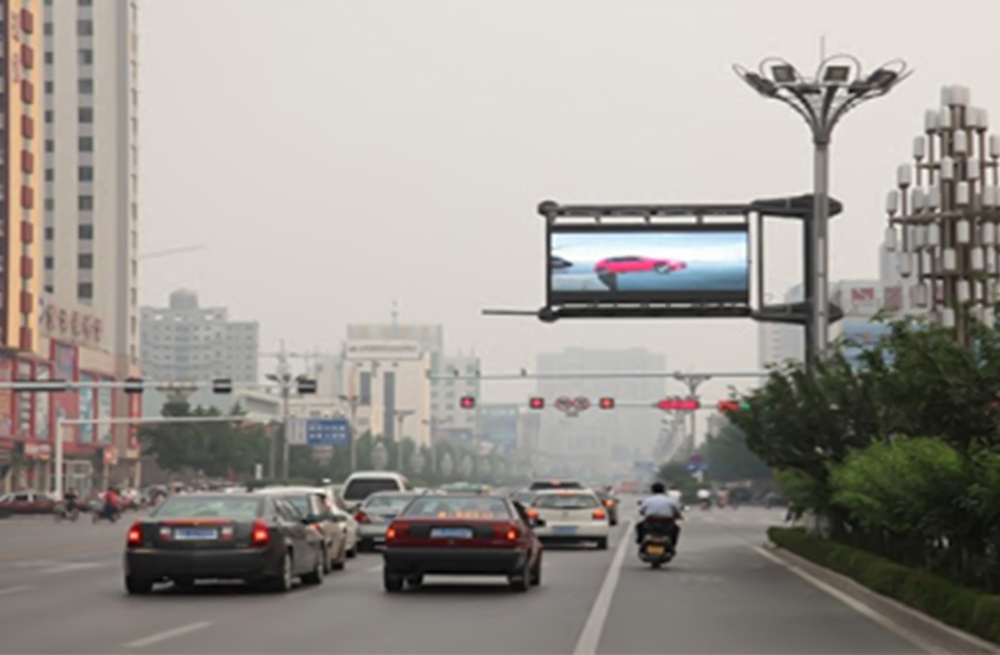
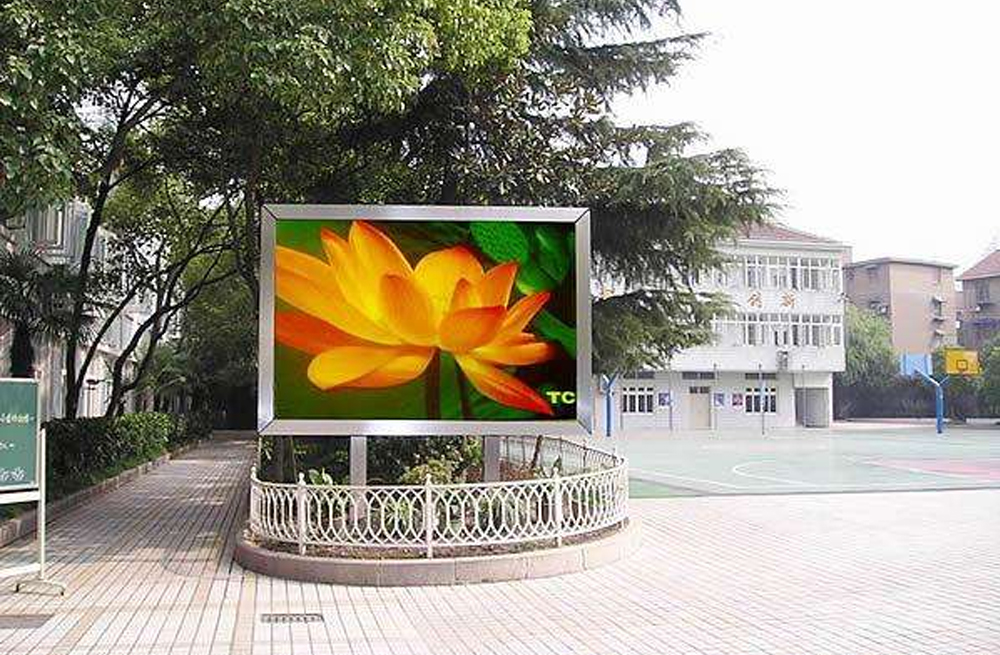
An LED display panel is a modular, direct-view screen that uses red, green, and blue light-emitting diodes to create text, images, and video. Multiple LED modules and cabinets can be joined to build a display in almost any size or aspect ratio. Commercial LED panels are used for indoor video walls, outdoor billboards, retail signs, stages, stadiums, transport information, and control rooms.
This guide explains what an LED panel means in the commercial display industry, how the screen works, the main types of LED display panels, the layers and components inside a system, and the specifications that matter when selecting one.
What Is an LED Display Panel?
An LED display panel is a section of a larger LED screen. Its front surface contains a grid of pixels, and each full-color pixel combines red, green, and blue LEDs. The control system varies the output of those three colors to reproduce the source image.
In everyday usage, “LED panel,” “LED display panel,” “LED display board,” and “LED screen panel” often describe the same direct-view display technology. A module is the smaller circuit-board assembly inside a panel or cabinet; several modules form a cabinet, and multiple cabinets form the complete screen.
Важно разграничение: a commercial direct-view LED display is not the same as a typical “LED TV.” Most LED TVs are LCD panels illuminated by an LED backlight. In a direct-view LED screen, the LEDs themselves form the visible pixels.
How Does an LED Display Panel Work?
A video source sends content to an LED controller or video processor. The sending device converts that signal into display data and distributes it to receiving cards inside the cabinets. Each receiving card drives its assigned LED modules, while power supplies convert mains electricity to the low-voltage DC power used by the modules and control electronics.
The image passes through the system in this order:
- Източник на съдържание: a computer, camera, media player, signage player, or other video source provides the image.
- Video processor or controller: it scales, crops, switches, and maps the source to the screen’s actual pixel resolution.
- Система за изпращане и получаване: display data travels to the receiving cards assigned to each cabinet.
- Driver electronics: the modules control the brightness of the red, green, and blue LEDs at a high refresh rate.
- LED pixels: the physical diodes emit light directly toward the viewer to form the final image.
LED Screen Layers and Components
A complete LED screen is a system, not just a visible panel. Its main layers and components are:
| Компонент | функция |
|---|---|
| LED модул | Contains the LEDs, driver ICs, printed circuit board, and connectors that create one section of the image. |
| Mask or protective surface | Improves contrast and helps protect the LEDs; some fine-pitch products use a protective coating. |
| Cabinet or frame | Aligns and supports the modules, receiving card, power supplies, and cables. |
| Приемаща карта и платка на хъба | Receive mapped display data and distribute control signals to the modules. |
| Захранване | Converts AC input to the stable DC voltage required by the display hardware. |
| Controller or sending device | Maps pixels and transmits display data to the cabinets. |
| Видео процесор | Handles scaling, switching, cropping, multi-window layouts, and source management when required. |
| Structure, cabling, and cooling | Keep the screen secure, connected, serviceable, and within its operating temperature range. |
What Are the Main Types of LED Display Panels?
LED display panels are classified in several ways. A single product can belong to more than one category; for example, it can be an outdoor, fixed-installation, front-service, SMD panel.
Indoor LED panels
Indoor panels generally use a finer pixel pitch because viewers stand closer to the screen. They are designed for controlled lighting and are widely used in meeting rooms, broadcast studios, retail stores, control rooms, houses of worship, and corporate lobbies.
Външни LED панели
Outdoor panels use weather-resistant cabinets, higher brightness, and components selected for temperature and moisture exposure. They are common in billboards, building signs, stadiums, roadside displays, and public information systems. An outdoor rating does not eliminate the need for correct drainage, ventilation, grounding, and structural engineering.
Fixed-installation LED panels
Fixed panels remain in one location for long-term operation. Cabinet design usually prioritizes reliability, cable management, maintenance access, and efficient use of space.
Rental and stage LED panels
Rental cabinets are designed for repeated assembly and transport. Fast locks, alignment pins, corner protection, handles, and lightweight frames help crews build and dismantle screens efficiently.
Прозрачни LED панели
Transparent displays leave open space between LED strips so that light and the view behind the screen can pass through. They are used on glass facades, windows, stages, and architectural installations where transparency matters more than the highest possible pixel density.
Flexible and curved LED panels
Flexible modules and specially shaped cabinets can form columns, curves, ribbons, and other non-flat surfaces. These projects require careful mechanical tolerances, content mapping, and viewing-angle planning.
LED Packaging Types: SMD, DIP, COB, and GOB
| Тип | Как се изгражда | Common strengths | Типична употреба |
|---|---|---|---|
| SMD | Red, green, and blue chips are packaged together and mounted on the module surface. | Wide viewing angles, good color mixing, and a broad range of pixel pitches. | Most indoor displays and many outdoor displays. |
| DIP | Separate through-hole red, green, and blue LED lamps project from the module. | High brightness and robust performance in suitable outdoor designs. | Some outdoor billboards and long-viewing-distance screens. |
| COB | LED chips are mounted directly on the board and encapsulated as a surface. | Fine pixel pitch, a smooth face, and improved resistance to handling. | Fine-pitch indoor video walls and close-viewing applications. |
| GOB | A protective glue layer covers the surface of an SMD module. | Additional protection against impact, dust, and moisture at the module face. | Rental, floor, fine-pitch, and other applications needing extra protection. |
Packaging alone does not determine image quality. Driver ICs, calibration, thermal design, LED consistency, cabinet alignment, control equipment, and manufacturing quality also affect the result.
Pixel Pitch, Resolution, and Viewing Distance
Терен Pixel is the center-to-center distance between adjacent pixels, measured in millimeters. P1.5, P2.5, P4, and P10 therefore have pitches of approximately 1.5 mm, 2.5 mm, 4 mm, and 10 mm. A smaller pitch places more pixels in the same area and supports a shorter viewing distance, but it normally increases cost and processing requirements.
Physical screen size does not determine image resolution by itself. Resolution depends on screen dimensions and pixel pitch:
Horizontal pixels = screen width in millimeters / pixel pitch
Vertical pixels = screen height in millimeters / pixel pitch
Choose pitch by considering the nearest important viewing distance, the type of content, the amount of fine text, camera use, installation size, and budget. A large display viewed from far away may not benefit from an extremely fine pitch, while a close-viewed control-room wall often does.
What Is a P10 LED Display Module?
A P10 LED дисплей модул has a nominal 10 mm pixel pitch. At that pitch, one square meter contains approximately 10,000 physical pixels. A 160 x 160 mm P10 module, for example, has a 16 x 16 pixel matrix, or 256 pixels. Always verify the dimensions, scan mode, connector layout, color format, brightness, and compatible control system on the exact model’s specification sheet.
P10 is often selected for outdoor signs and other applications viewed from a longer distance. It is not automatically the best choice for every outdoor screen; the correct pitch depends on viewing conditions and content requirements.
How to Choose an LED Display Panel
- Дефинирайте приложението. Record whether the screen is indoor or outdoor, fixed or rental, flat or curved, front-service or rear-service, and whether it will be viewed by eye, camera, or both.
- Set the viewing distance and resolution. Use the nearest important viewer and the required amount of text or image detail to select pixel pitch and calculate the screen’s native resolution.
- Match brightness to the environment. Indoor brightness needs vary with ambient light. Outdoor screens normally need substantially higher output, especially in direct sun. Excessive brightness indoors can be uncomfortable and can waste energy.
- Check refresh rate and camera performance. Broadcast, virtual production, and filmed events require suitable refresh rate, grayscale performance, scan design, and camera testing to reduce visible scan lines or flicker.
- Планирайте достъп за поддръжка. Confirm how modules, power supplies, and receiving cards will be replaced after installation. Front-service access can be essential when there is no space behind the display.
- Specify environmental protection. Review the complete product’s IP rating, operating temperature, humidity limits, ventilation, corrosion protection, and wind-loading requirements rather than relying on a single component rating.
- Confirm control compatibility. Calculate total pixels, cabinet mapping, data-load limits, cable distances, redundancy needs, video inputs, and processor output capacity.
- Compare lifetime cost. Include supporting structure, spares, power distribution, installation, calibration, maintenance access, shipping, and energy use, not only the panel price.
Common Uses of LED Display Panels
- Търговия на дребно и реклама: storefront video walls, digital billboards, shopping centers, and promotional displays.
- Corporate and education: auditoriums, lecture halls, conference rooms, command centers, and data dashboards.
- Събития и забавления: concerts, stages, exhibitions, sports venues, and live-event backdrops.
- Транспорт и обществена информация: station boards, destination signs, wayfinding, traffic messages, and emergency notices.
- Broadcast and production: studio backgrounds, on-camera displays, and virtual production walls.
- Архитектура: media facades, transparent window displays, creative shapes, and building signage.
LED Display Panel vs. LED TV Panel
| Особеност | LED дисплей с директен изглед | LED-backlit TV or monitor |
|---|---|---|
| Източник на изображение | Individual LEDs form the visible pixels. | An LCD layer forms the image and LEDs provide the backlight. |
| Размер | Modular and scalable across many cabinets. | Manufactured in a fixed panel size. |
| Типична употреба | Commercial signage, video walls, events, stadiums, and large venues. | Home entertainment, desktops, and conventional presentation rooms. |
| Разстояние за гледане | Depends strongly on pixel pitch. | Usually designed for closer viewing at a fixed resolution. |
| поддръжка | Modules and internal components can often be serviced individually. | The panel is generally replaced or repaired as one consumer device. |
Често задавани въпроси
What does LED panel mean?
In commercial displays, an LED panel is a modular section of a direct-view screen in which LEDs create the visible pixels. The term can also be used loosely for an LED-backlit LCD product, so project specifications should state “direct-view LED” when that is what is required.
What are the main LED panel types?
The most common classifications are indoor or outdoor, fixed or rental, standard or transparent, and flat or flexible. Panels can also be classified by LED packaging, including SMD, DIP, COB, and GOB.
Which LED display panel is best?
There is no single best panel. The right choice matches viewing distance, pixel pitch, brightness, environment, camera requirements, maintenance access, control capacity, and budget. A specification should be based on the complete project rather than one headline number.
What determines an LED screen’s resolution?
Native resolution is determined by the number of physical pixels across the screen. Divide the screen’s width and height in millimeters by the pixel pitch to calculate horizontal and vertical pixel counts.
Can LED display panels be repaired?
Many commercial systems are modular. Technicians can often replace an LED module, power supply, receiving card, or cable without replacing the entire screen. The exact procedure depends on front- or rear-service cabinet design.
What information is needed for an LED display quote?
Provide the installation location, screen width and height, indoor or outdoor environment, nearest viewing distance, content type, mounting method, service-access direction, video sources, and any camera or redundancy requirements.
Selecting Components for Your LED Display
A reliable project starts with compatible panels, control hardware, power, and processing capacity. Explore външни LED екрани, LED видео процесори, и LED приемни карти или контакт EagerLED with your screen size, pixel pitch, installation environment, and signal requirements.