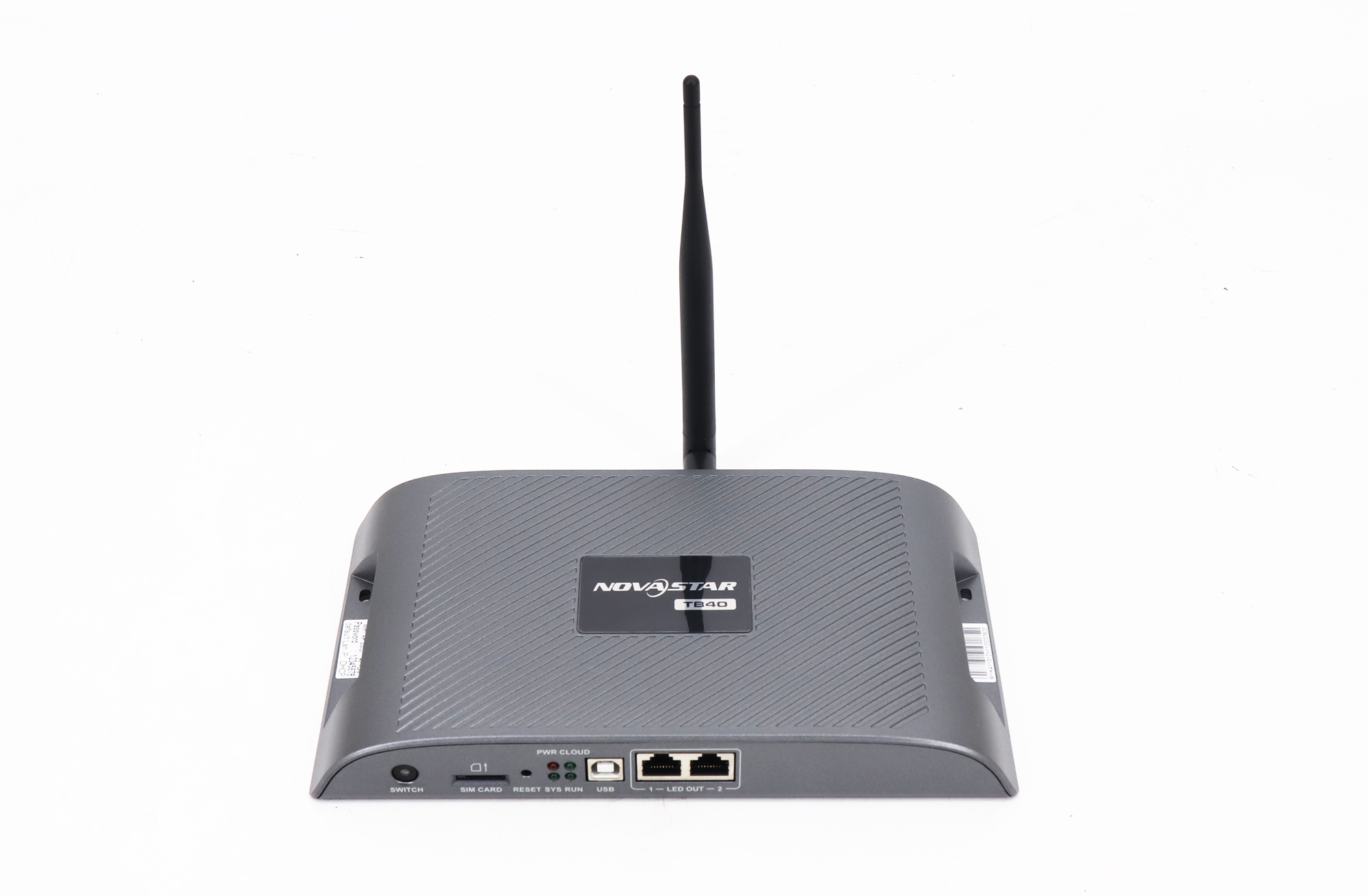
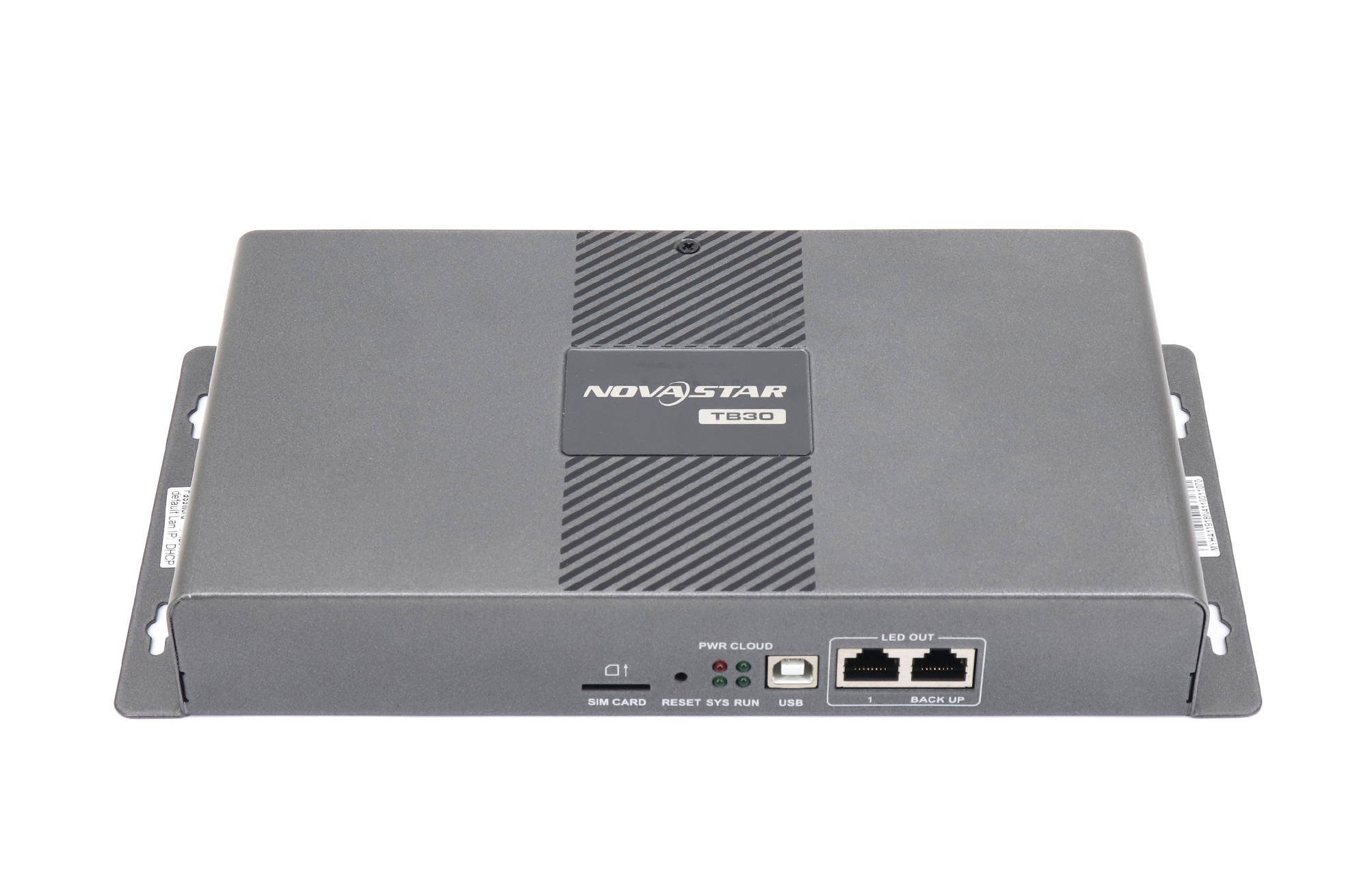
Freagairt sgiobalta: The NovaStar TB30 and the NovaStar TB40 are both Taurus-series multimedia players that combine content playback and LED sending in one box, and both are documented at up to 1,300,000 pixels of loading capacity. Capacity is no longer the deciding difference. The difference is the video input: the TB40 has an HDMI 1.3 input, an HDMI output with loop-through and a front-panel switch between synchronous and asynchronous mode, so it can display a live laptop, camera or media-player signal. The TB30 has no video input at all — it is an asynchronous player that runs the playlists you publish through ViPlex, a USB drive or the cloud, and it keeps several screens in step with NTP, GPS or RF time synchronisation.
One caveat matters before you quote either model. NovaStar’s TB30 specification V1.2.2 (29 August 2025) documented 650,000 piogsail, and NovaStar’s online Taurus comparison table still lists 0.65 million pixels for the TB30. The current TB30 specification V1.2.4 (31 July 2026) documents 1,300,000 piogsail, and the Taurus series release notes V5.1.0 (18 September 2026) explain why: after the technical upgrade, “models originally configured with one primary and one backup Ethernet port can now utilize both Ethernet ports for output, enabling a total output capacity of 1.3 million pixels.” A TB30 on current firmware can therefore drive the same pixel load as a TB40 — but an earlier unit, or one that has not been upgraded, is still a 650,000-pixel player. Confirm the specification version and firmware of the exact unit you are buying.
In one line: choose the TB30 for scheduled, remotely managed content on mains power; choose the TB40 as soon as any screen has to show a live HDMI source, or when you need a 12 V DC player that weighs 430 g instead of 1,229 g.
Air an duilleig seo
- Coimeas sònrachaidh
- Capacity: what 1.3 million pixels actually builds
- Why some sources still say 650,000 pixels
- Use cases where the TB30 is the right player
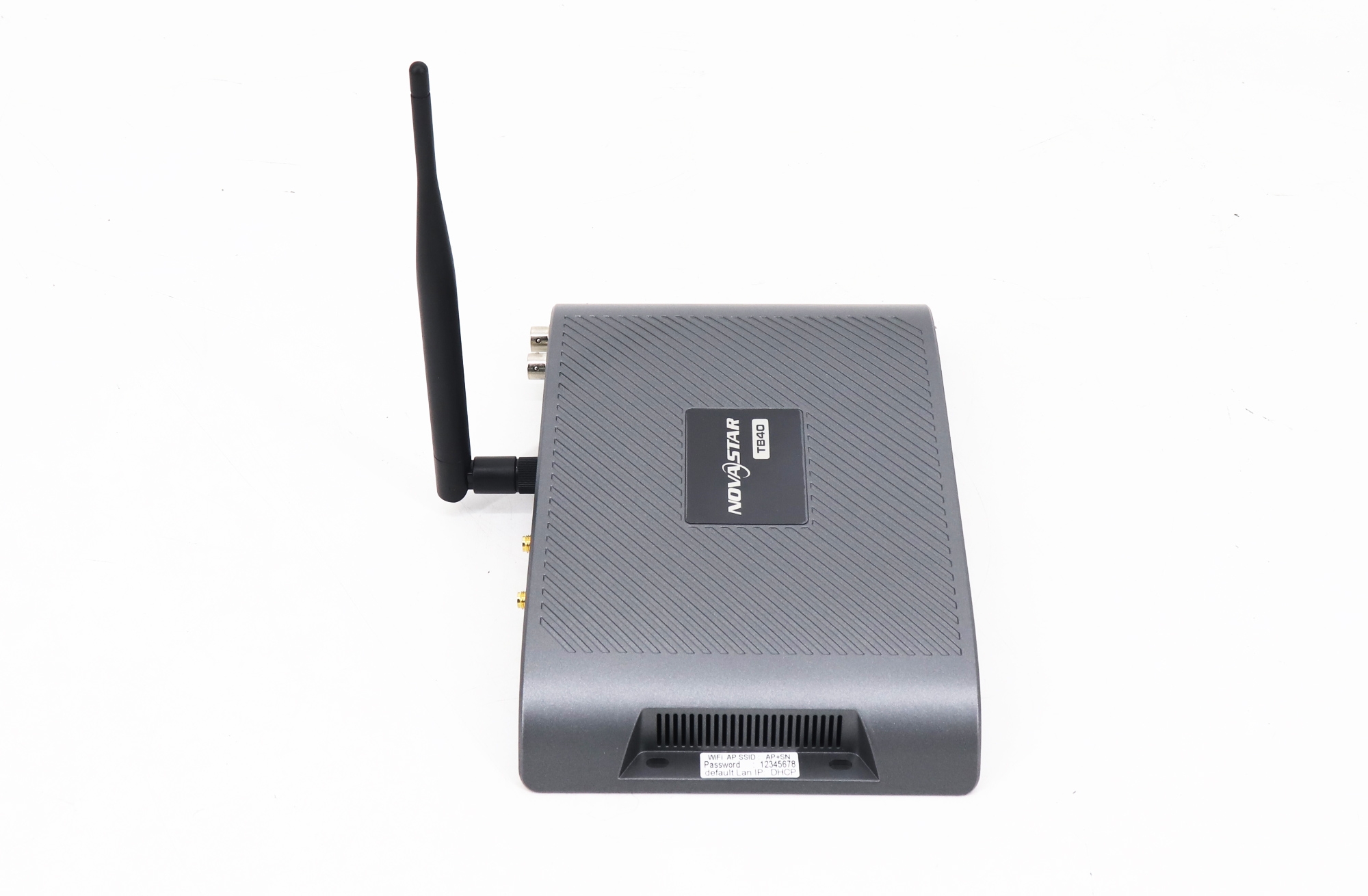
- Use cases where the TB40 is the right player
- Worked project examples
- Synchronous versus asynchronous mode in practice
- Power, weight and installation differences
- Dè am fear a bu chòir dhut a cheannach?
- Liosta-sgrùdaidh ro-cheannach
- Stòran agus modh dearbhaidh
- Ceistean Àbhaisteach
Coimeas sònrachaidh
Both players share the same processing platform, so the table below only lists the figures that change a project decision. Every value carries the document version it comes from, because the TB30 capacity figure has changed during 2025-2026.
| Notaichean | NovaStar TB30 | NovaStar TB40 |
|---|---|---|
| dreuchd | Asynchronous multimedia player with cloud publishing | Multimedia player with synchronous and asynchronous modes |
| Documented loading capacity | 1,300,000 pixels (TB30 spec V1.2.4, 31 July 2026). Earlier spec V1.2.2 (29 August 2025) and NovaStar’s online comparison table list 650,000 pixels | 1,300,000 pixels (TB40 spec V1.2.1, 20 October 2024) |
| Toraidhean Gigabit Ethernet | 2 ports, both primary by default; can be set to one primary and one backup | 2 ports, both primary by default; can be set to one primary and one backup |
| Canabhas as motha | 4096 x 4096 pixels; ultra-long screens up to 23,040 x 4096 pixels | 4096 x 4096 pixels; custom widths 512-4096 and heights 512-3680 pixels |
| Live video input | Chan eil gin | 1 x HDMI 1.3 IN, maximum 1920 x 1200 @ 60 Hz, HDCP 1.4 |
| Video output for monitoring | Chan eil gin | 1 x HDMI 1.3 OUT with HDMI loop, maximum 1920 x 1200 @ 60 Hz |
| Synchronous / asynchronous switching | Not supported – asynchronous playback only | Front-panel switch: on = synchronous, off = asynchronous |
| Sioncronachadh ioma-sgrìn | NTP; GPS with the specified 4G module; RF with the specified module | NTP; GPS with the specified 4G module; RF with the specified module |
| Ath-chluich aig an aon àm | 1 x 4K, 2 x 1080p, 5 x 720p, 6 x 480p or 6 x 360p | 1 x 4K, 2 x 1080p, 4 x 720p, 4 x 480p or 6 x 360p |
| Pròiseasaran agus cuimhne | Quad-core ARM A55 @ 1.8 GHz, 1 GB RAM, 32 GB storage, Android 11 | Quad-core ARM A55 @ 1.8 GHz, 1 GB RAM, 32 GB storage, Android 11 |
| A ’gearradh bhidio | H.264/H.265 up to 4K @ 60 Hz | H.264/H.265 up to 4K @ 60 Hz |
| Inntrigeadh cumhachd | AC 100-240 V, 50/60 Hz, 0.6 A – built-in supply with an ON/OFF switch | DC 12 V, 2 A – external power adapter |
| Maximum consumption / recommended supply | 18 W / 25 W | 18 W / 25 W |
| Fhuaime | 3.5 mm audio output, fixed 48 kHz sample rate, no audio input | Stereo audio connector, 48 kHz sample rate, OMTP headsets supported |
| USB Type-A for playback and upgrades | FAT32 and NTFS; drive capacity 2 GB to 128 GB; single file under 4 GB | Ext4 and FAT32; maximum single file 4 GB on FAT32; exFAT and FAT16 are not supported |
| lìonra | 1 Gbps Ethernet; Wi-Fi 2.4 GHz AP + STA; optional 4G module | 1 Gbps Ethernet; Wi-Fi 2.4 GHz AP + STA; optional 4G/5G module |
| Cuir-a-steach mothachaidh | 2 sensor connectors for a brightness sensor or a temperature and humidity sensor | 2 sensor connectors for a brightness sensor or a temperature and humidity sensor |
| Meudan (W x H x D) | X x 274.3 139.0 40.0 mm | X x 238.8 140.5 32.0 mm |
| cuideam lom | 1,228.9 g | 430.0 g |
| àrainneachd | -20 to +60 C, 0-80 % RH non-condensing, IP20 | -20 to +60 C, 0-80 % RH non-condensing, IP20 |
| Certifications listed on the specification | Extensive list, including NBTC, IMDA, PSB, RCM, CQC, FCC, UL, IC, KC, CE, UKCA, CB, MIC and PSE | CQC, SRRC, RoHS |
Sources for the rows above are NovaStar’s TB30 Multimedia Player Specifications V1.2.4, NovaStar’s TB40 Multimedia Player Specifications V1.2.1 and NovaStar’s online Taurus comparison table, all read on 23 September 2026. Certification requirements differ by market, so confirm the certificate set for the country you are shipping to before ordering.
Capacity: what 1.3 million pixels actually builds
Loading capacity is simply the total number of pixels on the canvas: multiply the screen width in pixels by the height in pixels. On both players the 1,300,000-pixel total is shared by two Gigabit Ethernet outputs, which works out at 650,000 piogsail gach port when the load is split evenly.
Three limits therefore apply to every project, not just one:
- Piogsail iomlan – 1,300,000 pixels on each player on current documentation.
- Per-port pixels – about 650,000 pixels on each Gigabit Ethernet output.
- Canvas edges – 4096 pixels maximum width and 4096 pixels maximum height per player. The TB30 additionally documents ultra-long-screen support up to 23,040 pixels wide.
The same arithmetic explains the old 650,000-pixel limit: when only one of the two Gigabit Ethernet ports could output and the second was a backup, the total was one port’s worth of pixels. On older TB30 firmware, plan for 650,000 pixels across the whole screen; on current firmware, plan for 1,300,000.
Typical indoor and outdoor configurations against that budget, using the nominal pixel pitch and rounding to whole pixels:
| Screen | Pixels (W x H) | Piogsail iomlan | Current TB30 or TB40 at 1.3 M | Legacy 650,000-pixel limit |
|---|---|---|---|---|
| P2.5 indoor, 3.0 x 1.5 m | 1200 x 600 | 720,000 | A 'freagairt | Chan eil e a ’freagairt |
| P2.5 indoor, 4.0 x 2.0 m | 1600 x 800 | 1,280,000 | Fits, with about 1.5 % spare | Chan eil e a ’freagairt |
| P3 outdoor, 8.0 x 4.0 m | 2667 x 1333 | 3,555,111 | Does not fit – split across two players or use a larger controller | Chan eil e a ’freagairt |
| P3.91 outdoor, 6.0 x 3.0 m | 1536 x 768 | 1,179,648 | A 'freagairt | Chan eil e a ’freagairt |
| P4 outdoor, 5.12 x 2.56 m | 1280 x 640 | 819,200 | A 'freagairt | Chan eil e a ’freagairt |
| P6.67 street furniture, 10 x 5 m | 1500 x 750 | 1,125,000 | A 'freagairt | Chan eil e a ’freagairt |
| P5 lamp-post display, 1.92 x 0.96 m | 384 x 192 | 73,728 | Fits, using a fraction of capacity | A 'freagairt |
Pixel counts are nominal: real cabinet layouts add or remove a few rows and columns, so recalculate from the actual cabinet matrix before you order. If the total lands close to 1,300,000 pixels, keep in mind that a full-screen 4K video source may not map one-to-one onto a custom canvas – see our pixel load sizing guide airson an dòigh-obrach iomlan.
Why some sources still say 650,000 pixels
Most comparison articles online – and even the AI-generated summary in Google’s results on 23 September 2026 – still describe the TB30 as a 0.65-million-pixel player against the TB40’s 1.3 million. That description matched the documentation of the previous firmware generation and is still repeated in NovaStar’s own online comparison table. The current documents tell a different story:
| sgrìobhainn | Ceann-là | TB30 capacity stated |
|---|---|---|
| NovaStar TB30 Multimedia Player Specifications V1.2.2 | 29 Lùnastal 2025 | 650,000 pixels; “one serves as primary and the other as backup” |
| NovaStar Taurus series release notes V5.1.0 | 18 t-Sultain 2026 | Players that originally had one primary and one backup Ethernet port can now use both ports for output, “enabling a total output capacity of 1.3 million pixels” |
| NovaStar TB30 Multimedia Player Specifications V1.2.4 | 31 Iuchar 2026 | 1,300,000 pixels; both Ethernet ports primary by default; ultra-long screens up to 23,040 pixels wide |
| NovaStar online Taurus comparison table | Page read 23 September 2026 | TB30 listed as 0.65 million pixels, TB50 as 1.3 million, TB60 as 2.3 million |
| NovaStar TB40 Multimedia Player Specifications V1.2.1 | 20 Dàmhair 2024 | 1,300,000 piogsail |
The practical conclusion is that the TB30’s documented capacity depends on the hardware revision and firmware of the individual unit, while the TB40’s has been 1,300,000 pixels since its 2024 specification. Treat capacity as something to verify per unit, and treat the HDMI input, the loop output and the mode switch – which appear in every TB40 document and in no TB30 document – as the permanent differences between the two models.
Use cases where the TB30 is the right player
- Retail chains and franchise signage. One playlist, many stores, updated remotely over 1 Gbps Ethernet, Wi-Fi or an optional 4G module. Multi-screen synchronisation through NTP, GPS or RF keeps every screen on the same item.
- Door-head, shelf and entrance displays. Small pixel counts that leave plenty of headroom, including on the legacy 650,000-pixel limit.
- Street furniture and lamp-post displays. The built-in 100-240 V AC supply removes an external 12 V adapter from a pole cabinet, and the ON/OFF switch makes service calls simpler.
- Distributed networks with limited technician access. Publishing, monitoring and diagnostics run through ViPlex Express, ViPlex Handy or the VNNOX cloud platform, so content changes do not require a site visit.
- Fixed installations with no live source. If the content is always pre-produced, an HDMI input is a connector that will never be used.
Use cases where the TB40 is the right player
- Any screen that shows a live source. A laptop in a meeting room, a camera feed on a shop floor, a game feed in a sports bar, or a presenter’s PC on a showroom wall. HDMI IN becomes the display source in synchronous mode.
- Mixed live and scheduled content. The front-panel switch changes between the HDMI source and the internal playlist without adding a video processor or swapping cables.
- Confidence monitoring. HDMI OUT with loop lets an operator feed a local monitor and continue the signal chain elsewhere.
- Rack, cabinet and vehicle installations. DC 12 V 2 A input suits DC-powered cabinets, and the 430 g, 32 mm-thick housing is easier to mount where depth is limited.
- Booths, roadshows and rental stocks in the 650,000 to 1,300,000-pixel band. Live input plus a documented 1.3 million-pixel capacity in a single unit reduces the number of boxes on site.
Worked project examples
Meeting-room wall, P2.5, 4.0 x 2.0 m. The canvas is 1600 x 800 = 1,280,000 pixels, which sits just inside the 1.3 million-pixel limit. Because laptops have to be presented live, this is a TB40 project: feed a 1920 x 1080 source into HDMI IN and the player scales it to the screen in synchronous mode.
Chain-store display, P3.91, 4.0 x 2.24 m. The canvas is about 1024 x 574 = 587,776 pixels, so a single TB30 covers it – and so did the older 650,000-pixel TB30. Content is a scheduled playlist published from head office, so the asynchronous workflow is all the store needs. Choose the TB40 only if the brand later wants live promotional feeds from a local laptop.
Showroom wall, P2.5, 5.0 x 2.5 m. The canvas is 2000 x 1000 = 2,000,000 pixels, which exceeds both the TB30 and the TB40. Options are to split the wall into two halves with two players, to lower the pixel density, or to move to a larger controller in the Taurus range or a VX-series processor.
Synchronous versus asynchronous mode in practice
Asynchronous mode plays the internal video source: the playlist, images, text and widgets that were published to the player. Synchronous mode plays the video that arrives on the HDMI input. The TB40 supports both, and the TB30 supports only asynchronous playback, with timing-based synchronisation between players instead of a live input.
Four constraints from the TB40 specification decide whether a live source will work in practice:
- Full-screen scaling works when the video source is between 512 and 2048 pixels wide and high, with a maximum resolution of 1920 x 1080.
- The source image is only scaled down, never up, and the source resolution must be equal to or greater than the screen resolution in both directions.
- HDMI IN and OUT are HDMI 1.3 with HDCP 1.4, up to 1920 x 1200 @ 60 Hz, and interlaced signals are not supported.
- The HDMI output is intended for loop-through and monitoring rather than as a second independent 4K output.
For a screen larger than 1920 x 1080 that has to show live 4K content, the usual architecture is a video processor feeding the player’s HDMI input, or a controller-class device in place of the player. Our guide to dè a bhios pròiseasar LED agus rianadair LED a’ dèanamh explains where that boundary sits.
Power, weight and installation differences
| Beachdachadh | TB30 | TB40 |
|---|---|---|
| cumhachd an tùs | AC 100-240 V, built-in supply and power switch | DC 12 V 2 A, external adapter |
| cuideam | 1,228.9 g | 430.0 g |
| taigheadas | 274.3 x 139.0 x 40.0 mm metal case | 238.8 x 140.5 x 32.0 mm metal case |
| USB playlist media | FAT32 or NTFS, 2-128 GB drives | Ext4 or FAT32, single files up to 4 GB |
| Cruth toradh | 3.5 mm, fixed 48 kHz | Stereo connector, 48 kHz, OMTP headsets |
| Comharran inbhe | PWR, SYS, CLOUD and RUN LEDs for power, system, cloud connection and FPGA state | Same indicator set, with two-second and half-second blink patterns described in the specification |
Both units are rated IP20 and -20 to +60 C, so outdoor cabinets still need their own weather protection and thermal design. When a TB30 is replaced by a TB40 in an existing cabinet, remember that the 12 V DC supply has to be provided; when a TB40 is replaced by a TB30, the existing 12 V wiring is no longer used.
Dè am fear a bu chòir dhut a cheannach?
| riatanas | Tagh | adhbhar |
|---|---|---|
| Scheduled playlists only, managed remotely | TB30 | Asynchronous workflow and built-in AC supply are all the project needs |
| A live laptop, camera or player feed on screen | TB40 | HDMI 1.3 IN is the synchronous source |
| Switching between live video and a playlist on site | TB40 | Front-panel mode switch, no extra hardware |
| A monitoring feed for the operator | TB40 | HDMI OUT with loop-through |
| 12 V DC cabinet or rack mounting | TB40 | DC 12 V 2 A input and 430 g housing |
| Mains-powered pole or street furniture | TB30 | Built-in 100-240 V supply and power switch |
| Ultra-wide ribbon screens | TB30 on current firmware – verify | Specification V1.2.4 documents ultra-long screens up to 23,040 pixels wide |
| Several screens playing the same content in step | An dara cuid | Both support NTP, GPS and RF time synchronisation |
| Below 650,000 pixels with no live source | Either – TB30 is often enough | Both the legacy and current capacity cover this load |
| Between 650,000 and 1,300,000 pixels | Either on current documentation | Confirm the TB30 unit’s specification version and firmware first |
Both products are listed in our store with current availability and options: NovaStar TB30 LED HD multimedia player agus Cluicheadair ioma-mheadhain LED NovaStar TB40. Both sit in the cairt smachd LED neo-shioncronach category alongside the rest of the Taurus family. Software, including ViPlex Express and ViPlex Handy, is collected on our Luchdaich a-nuas am bathar-bog NovaStar page, and the wider selection method is covered in the LED display controller guide. For controller-class installations, compare the VX1000 Pro and VX2000 Pro load and input guide an àite sin.
Watch the family in practice: NovaStar TB Series LED display multimedia player – EagerLED stiùireadh.
Stiùiridhean Taurus co-cheangailte
- NovaStar TB40 an aghaidh TB60: A’ taghadh cluicheadair Taurus — where the two-port DC player ends and the four-port AC player begins.
- NovaStar TB20 an aghaidh TB20 Plus: Dè an cluicheadair a thaghas tu? — an clas inntrigidh 650,000-piogsail le cuir a-steach HDMI beò.
- NovaStar TB10 an aghaidh TB10 Plus: Dè an cluicheadair a thaghas tu? — na cluicheadairean Taurus neo-shioncronach aig ìre inntrigidh.
- Stiùireadh meudachaidh luchdaidh piogsail rianadair LED NovaStar — mar a thionndaidheas tu raon piogsail gu buidseat luchdan mus cuir thu òrdugh a-steach.
Liosta-sgrùdaidh ro-cheannach
- Total pixel count of the finished canvas, plus the widest and tallest edges.
- The number of Gigabit Ethernet outputs the load needs – allow roughly 650,000 pixels per port.
- Whether any screen will ever show a live source. This single question selects the model.
- For live sources: input resolution, aspect ratio and whether the source can be scaled down to fit the screen.
- Power available on site: AC mains for the TB30, 12 V DC for the TB40.
- USB playlist media filesystem, especially if drives are prepared by another team.
- Whether a 4G or 5G module is needed; it is not included with either player.
- The certification set required in the destination country.
- The specification version and firmware of the individual unit offered, so the documented capacity is known before the quote is signed.
Stòran agus modh dearbhaidh
This comparison was built from primary documentation rather than from other comparison articles. Documents read on 23 September 2026:
- NovaStar TB30 Multimedia Player Specifications, document V1.2.4, 31 July 2026 (oss.novastar.tech), including the change history back to V1.0.0.
- NovaStar TB30 Multimedia Player Specifications, document V1.2.2, 29 August 2025, retained for the earlier 650,000-pixel capacity statement and the one-primary-one-backup port configuration.
- NovaStar TB40 Multimedia Player Specifications, document V1.2.1, 20 October 2024.
- NovaStar Taurus series release notes V5.1.0, 18 September 2026, which document the Ethernet output capacity change.
- NovaStar online Taurus comparison table (novastar.tech), read 23 September 2026, still listing 0.65 million pixels for the TB30.
Where the documents disagree, both values are shown with their version and date rather than choosing one silently. Capacity, port configuration and firmware behaviour should be confirmed for the specific unit before purchase, because firmware version determines whether the 1.3 million-pixel total applies.
Ceistean Àbhaisteach
What is the main difference between the NovaStar TB30 and the TB40?
The TB40 has a live HDMI 1.3 input, an HDMI output with loop-through and a front-panel switch between synchronous and asynchronous mode. The TB30 has no video input and always plays asynchronous content from internal storage, USB or the cloud. On current documentation both are rated at up to 1,300,000 pixels of loading capacity.
How many pixels can a NovaStar TB30 load?
NovaStar’s current TB30 specification V1.2.4 (31 July 2026) documents 1,300,000 pixels. Earlier documentation – TB30 specification V1.2.2 (29 August 2025) and NovaStar’s online Taurus comparison table – lists 650,000 pixels, so confirm the specification version and firmware of the unit you are buying.
How many pixels can a NovaStar TB40 load?
1,300,000 pixels across two Gigabit Ethernet outputs, which is about 650,000 pixels per port when the load is split evenly. The maximum canvas is 4096 x 4096 pixels.
Can the TB30 show live video from a laptop or camera?
No. The TB30 has no HDMI or other video input. A live source needs the TB40, or a separate video processor feeding an asynchronous player.
Can the TB40 run as an asynchronous player?
Yes. With the mode switch off, the TB40 plays the internal playlist like any asynchronous player; with the switch on, it displays the HDMI input as the synchronous source.
Do the TB30 and TB40 support 4G?
Both support an optional cellular module: the TB30 supports 4G, and the TB40 supports 4G and 5G modules. Neither ships with the module, so it has to be ordered separately.
Which player should I choose for a screen under 650,000 pixels?
If the content is scheduled and no live source is needed, the TB30 is the simpler, mains-powered option. If the screen may ever need a live HDMI source, choose the TB40 now to avoid adding a video processor later.