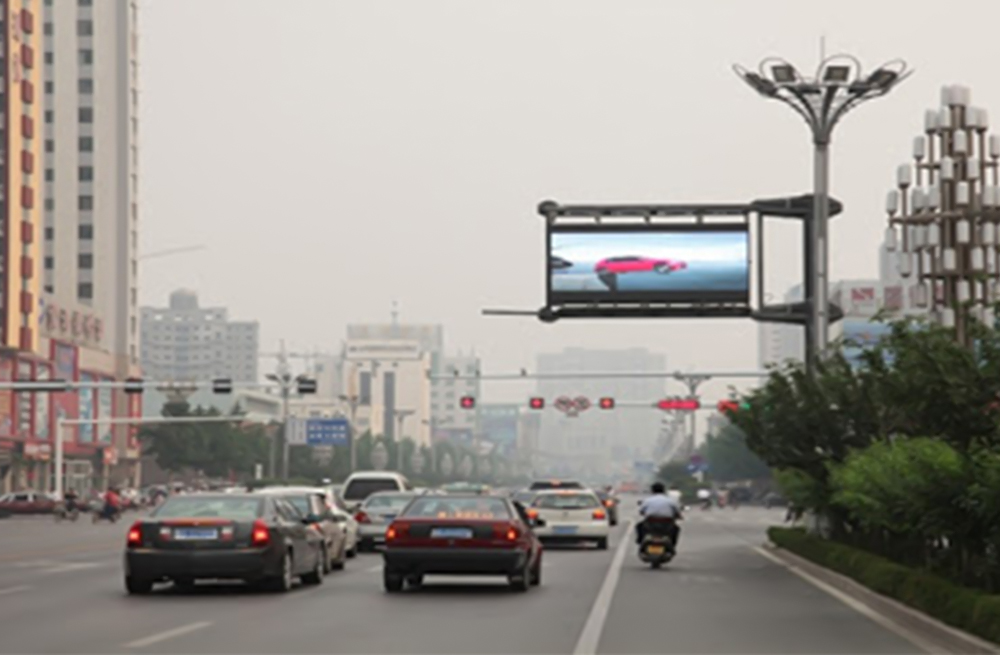
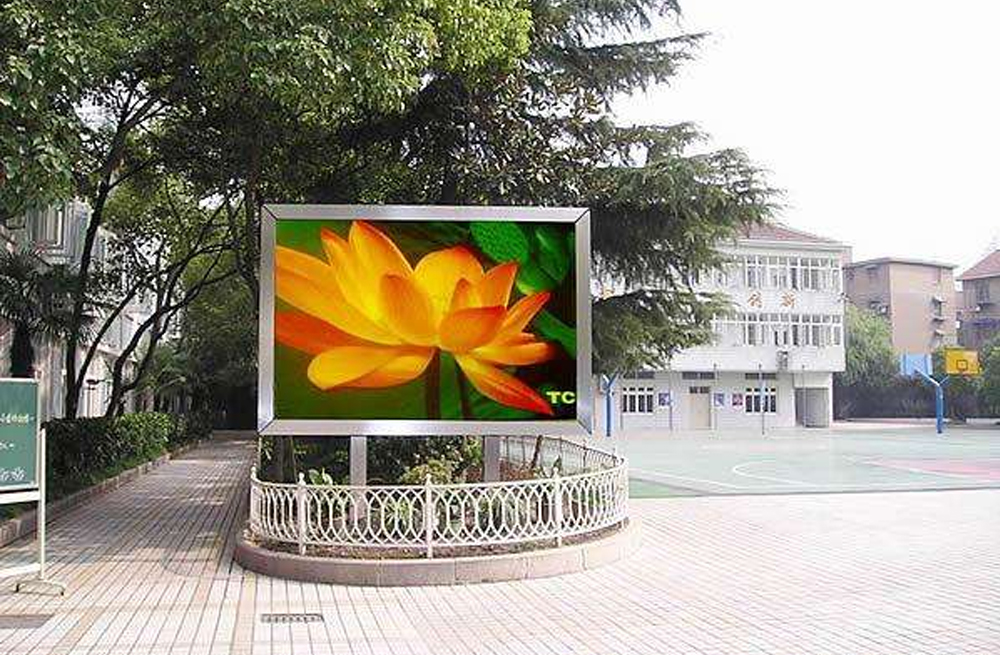
Stiùireadh airson Modúl LED Bog Sùbailte an aghaidh COB: Togalaichean Lùbte P1.25, P1.53 & P1.86 (2026)
A 'taghadh eadar a modal LED sùbailte bog and a rigid COB (Chip-on-Board) small-pitch panel comes down to geometry, touch exposure, and how tightly your installers need to wrap a column or wave wall. If you’re wrapping a 600 mm (23.6 in) round lobby pillar, a rigid COB board physically won’t bend—you need a magnetic rubber-backed soft flexible LED module with GOB (Glue-on-Board) protection. On the other hand, if you’re building a flat, high-traffic museum wall or corporate boardroom at P1.53 or P1.86 where viewers stand 1.5 m (5 ft) away, rigid COB panels deliver deeper black levels, tighter seam flatness, and higher impact resistance than any bendable PCB.
1. Soft flexible GOB vs rigid COB: how the build differs
On a spec sheet, a P1.53 modal LED sùbailte bog and a P1.53 COB module share the exact same 320×160 mm (12.6 × 6.3 in) footprint and pixel density. Pick both up on a workbench, though, and they behave like two completely different building materials.
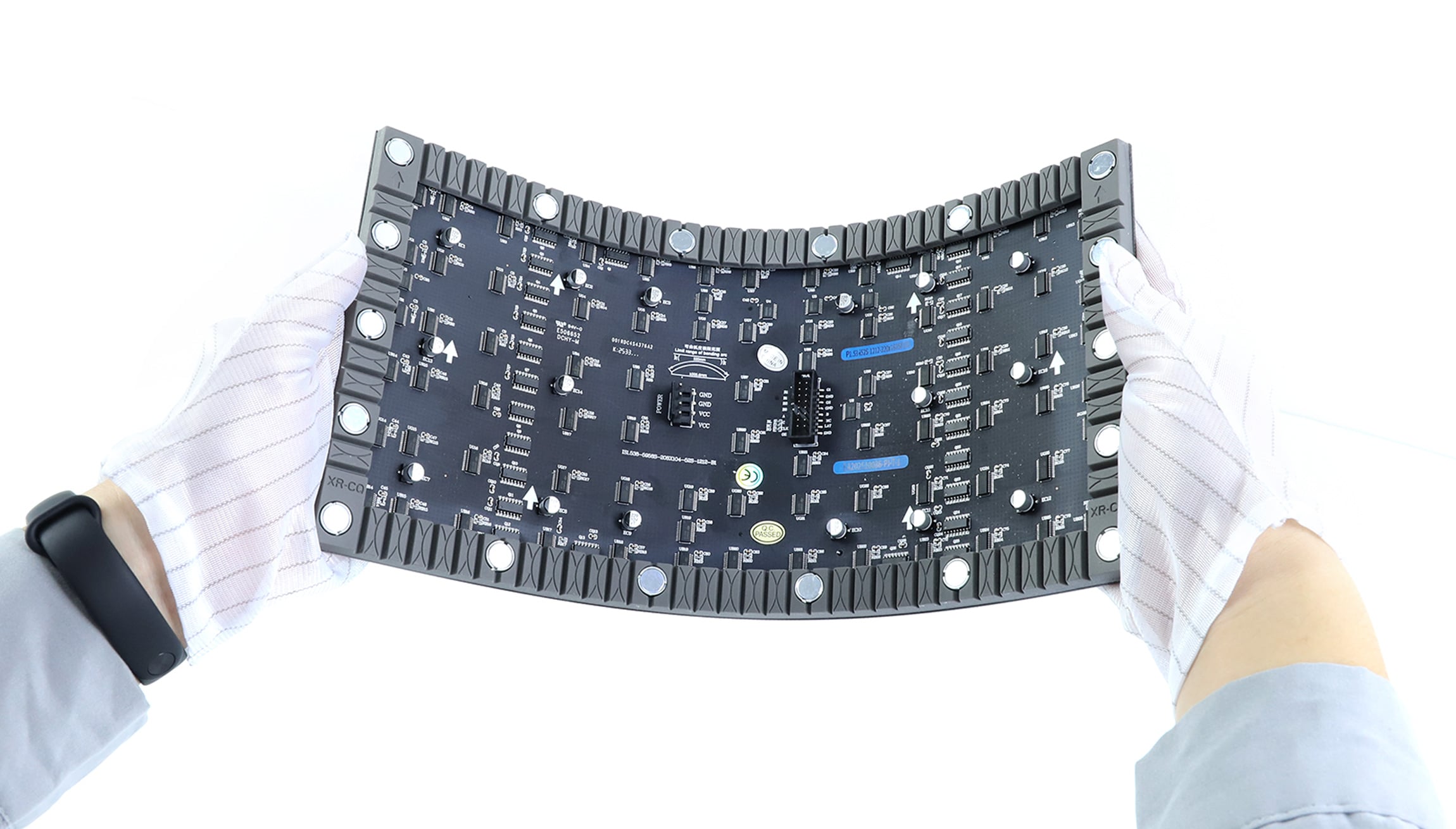
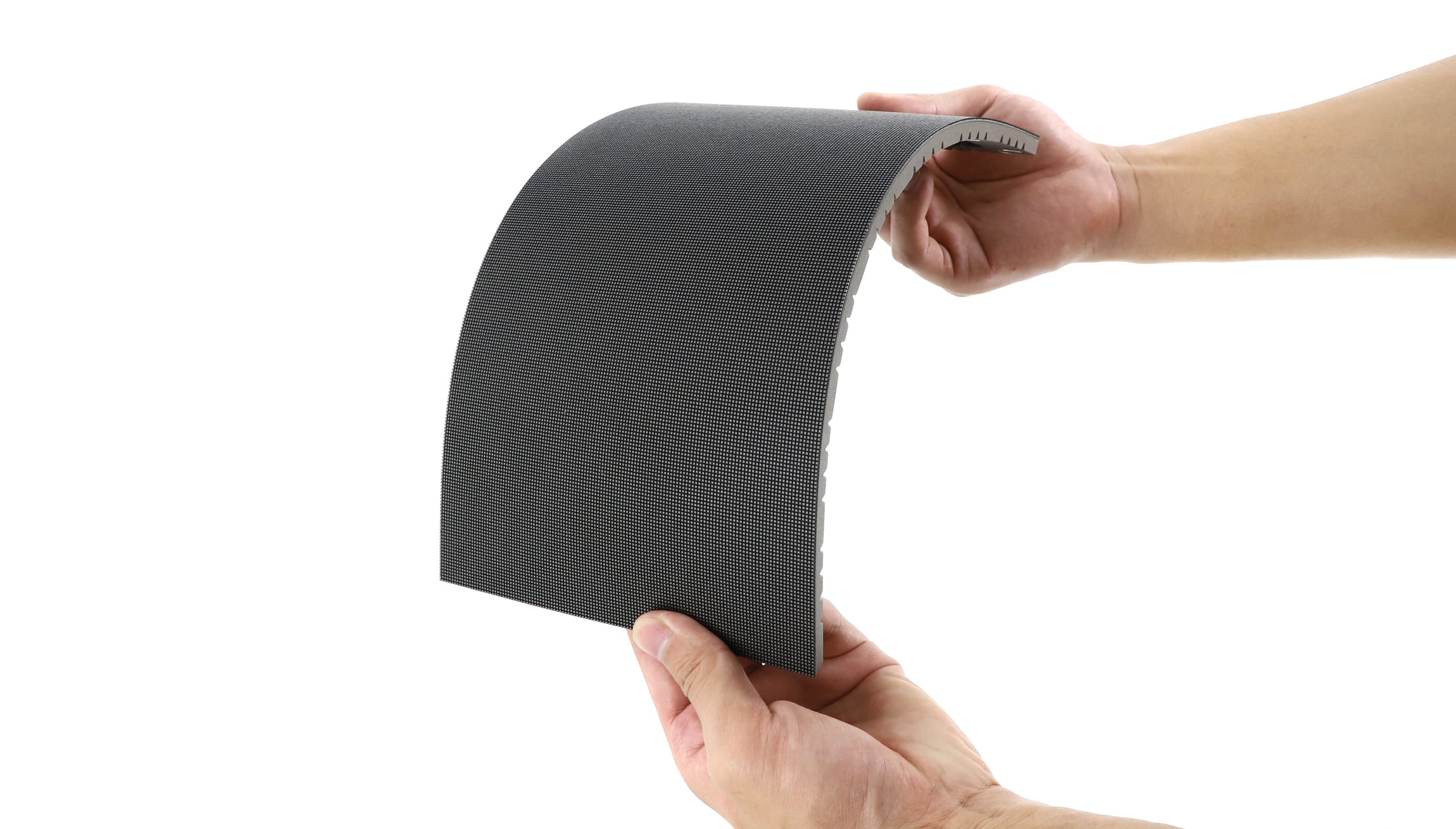
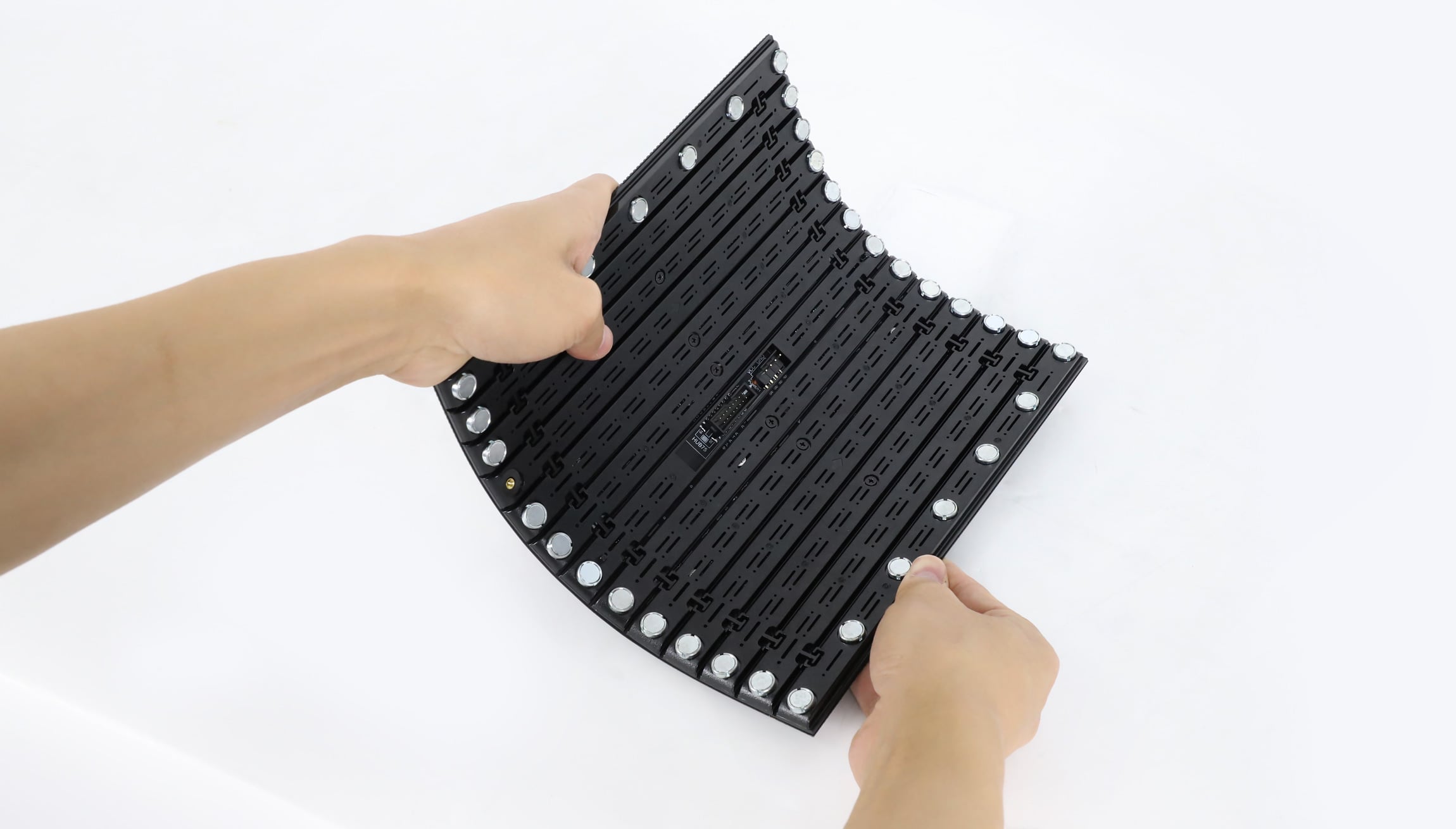
A modal LED sùbailte bog uses a thin, bendable polyimide or soft-substrate PCB bonded to a silicone rubber bottom shell studded with strong neodymium magnets. Because the PCB flexes along its horizontal or vertical axis, you can snap it directly onto a rolled steel cylinder, concave archway, or S-shaped retail ribbon without custom-angled aluminum cabinets. On fine pitches like P1.25 and P1.53, manufacturers add a clear GOB epoxy coating over the SMD1010 or SMD1212 lamps so installers don’t knock off tiny LEDs when pressing the flexible tile onto the iron frame.
A rigid COB module, by contrast, mounts bare LED chips directly onto a stiff multi-layer PCB and seals the entire face in a uniform optical resin. You can’t bend it around a pillar, but it shrugs off accidental elbow bumps, wipes clean with a microfiber cloth, and eliminates the exposed solder legs that make bare fine-pitch SMD tiles fragile during front-service maintenance.
01. Why GOB coating matters on fine-pitch flexible tiles
Anyone who has ever installed a bare-SMD P1.5 flexible column knows how stressful the last two rows are. When you flex a soft tile to match a tight curve, your thumbs naturally press against the face of the module to seat the magnets. Without GOB encapsulation, a single slip shears off three or four SMD1010 packages along the edge. GOB turns the delicate surface into a smooth, moisture-resistant skin that survives both installation handling and curious hands in shopping malls or hotel lobbies.
02. Viewing distance and curve radius trade-offs
Fine pixel pitch isn’t free, and tighter curves put real mechanical stress on copper traces. As a rule of thumb, keep your minimum viewing distance in meters roughly equal to the pixel pitch in millimeters—about 1.25 m (4.1 ft) for P1.25, 1.5 m (5 ft) for P1.53, and 1.9 m to 2.6 m (6.2 ft to 8.5 ft) for P1.95 and P2.6. Don’t force a 320×160 mm modal LED sùbailte bog into a radius tighter than the manufacturer’s rated bend limit, or the edges will lift off the steel frame and open visible dark vertical seams.
2. 320×160 mm vs 250×250 mm module comparison
Most indoor creative and fine-pitch builds standardize on two module footprints: 320×160 mm (2:1 aspect ratio) for wall-mount and fine-pitch columns, and 250×250 mm (1:1 square) for rental-style 500×500 mm or 500×1000 mm curved frames. Here is how the six core indoor flexible and COB models compare side by side.
| Modail Modail | Pitch & Package | Size (mm / in) | Surface & Form | An Iarrtas as Fheàrr a Fhreagras |
|---|---|---|---|---|
| P1.25 GOB Soft Flexible | P1.25 / SMD1010 | 320 × 160 mm (12.6 × 6.3 a-steach) | Bendable magnetic, GOB | Close-range luxury retail pillars, 1.2 m (4 ft) view |
| P1.53 GOB Soft Flexible | P1.53 / SMD1212 | 320 × 160 mm (12.6 × 6.3 a-steach) | Bendable magnetic, GOB | Hotel columns, curved reception walls, wave ceilings |
| P1.53 COB HD Rigid | P1.53 / COB | 320 × 160 mm (12.6 × 6.3 a-steach) | Rigid flat, COB resin | Boardrooms, control rooms, flat high-touch walls |
| P1.86 COB HD Rigid | P1.86 / COB | 320 × 160 mm (12.6 × 6.3 a-steach) | Rigid flat, COB resin | Showrooms, museums, budget-smart flat HD walls |
| P1.95 GOB Soft Flexible | P1.95 / GOB | 250 × 250 mm (9.84 × 9.84 a-steach) | Bendable magnetic, GOB | 500 mm-grid curved rental & exhibition booths |
| P2.6 Soft Flexible | P2.6 / SMD1515 | 250 × 250 mm (9.84 × 9.84 a-steach) | Bendable magnetic, SMD | Large-diameter columns, stage wraps, 2.5 m+ view |
Every module listed above ships with its matching signal ribbon cable (between modules) and DC power cable (between module and power supply), so you don’t have to hunt for compatible HUB75 ribbons separately. However, power supplies, receiving cards, and steel curved frames are still sized to your total screen geometry.
3. P1.25 vs P1.53 GOB 320×160 mm soft flexible modules
When a client asks for a smooth curved column in a flagship store or corporate atrium, the conversation almost always lands on P1.25 versus P1.53 in the 320×160 mm format. Both use GOB protection and magnetic attachment to curved iron cabinets, so the decision comes down to pixel density, receiving card load, and budget.
01. P1.25 GOB 320×160 mm: razor-sharp at arm’s length
Tha P1.25 SMD1010 Indoor GOB 320×160 mm soft flexible LED module packs 256 × 128 pixels into every tile (640,000 pixels per square meter). At 1.2 m (4 ft), small product text, watch dials, and architectural UI graphics look crisp without visible pixel grid lines. Because each tile carries 32,768 pixels, plan your receiving card count carefully—a standard 512×384 or 512×512 receiving card will hit its pixel ceiling much faster on P1.25 than on P1.86 or P2.6.
02. P1.53 GOB 320×160 mm: the commercial sweet spot
Tha P1.53 SMD1212 Indoor GOB 320×160 mm soft flexible LED module trims pixel density to roughly 208 × 104 pixels per tile (~422,500 pixels/m²). For most hotel lobbies, airport lounges, and curved reception backdrops where viewers stand 1.5 m to 2.5 m (5 ft to 8 ft) back, P1.53 looks virtually indistinguishable from P1.25 while cutting module cost, power draw, and receiving card count by roughly 25% to 35%.
4. P1.53 vs P1.86 COB 320×160 mm rigid HD modules
Not every fine-pitch project bends. If your wall is flat—or built from angled flat facets rather than a smooth arc—don’t pay for a bendable PCB you won’t flex. Rigid COB modules in the same 320×160 mm size give you better flatness, higher contrast under overhead office lighting, and rock-solid impact durability.
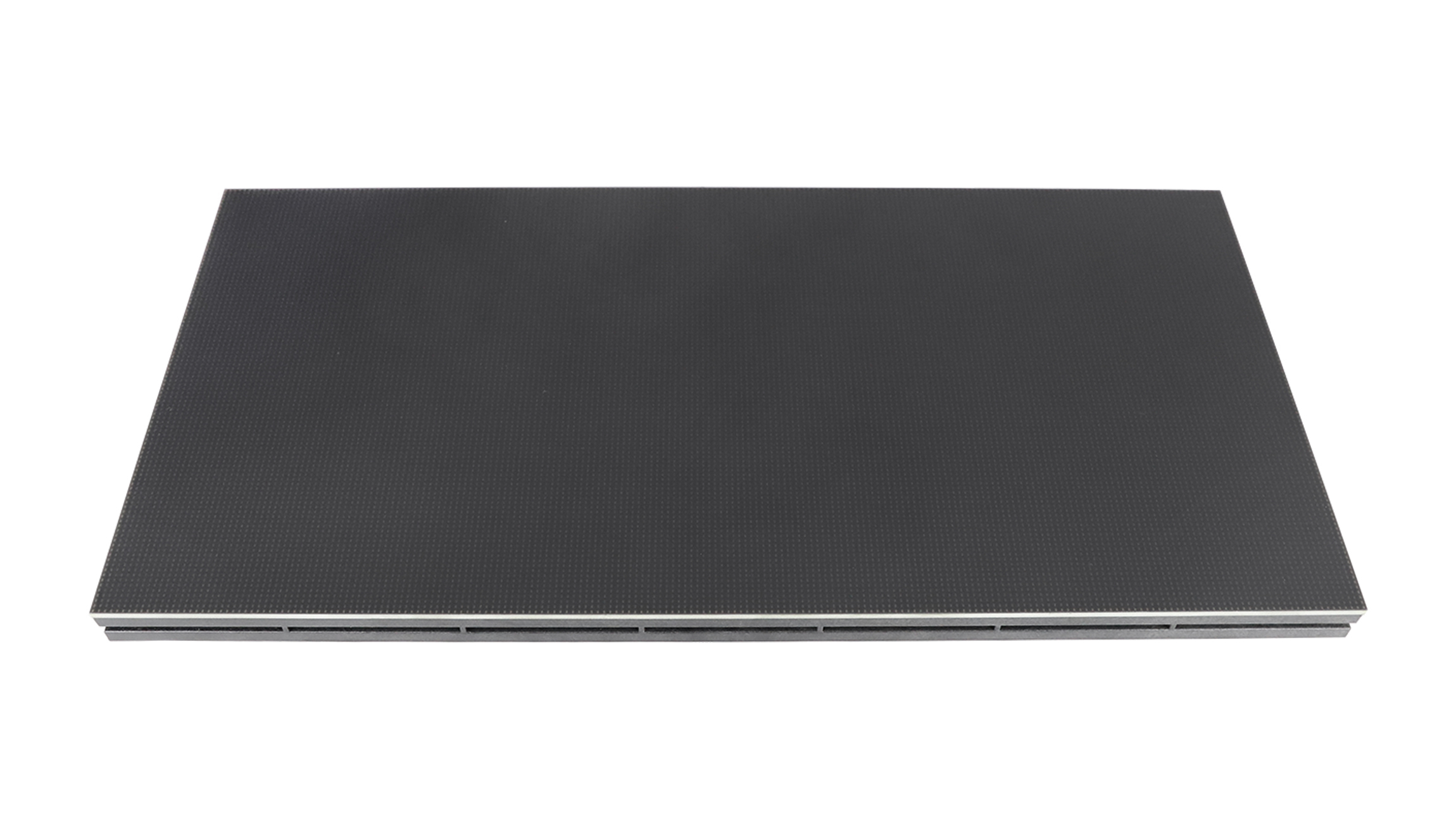
01. P1.53 COB 320×160 mm for boardrooms and control rooms
Tha Indoor P1.53 COB 320×160 mm HD LED screen module is built for flat high-definition walls where spreadsheets, camera feeds, and CAD drawings stay on screen for 12 hours a day. The matte COB surface cuts glare from ceiling downlights and makes black backgrounds look genuinely dark rather than gray. Each module undergoes a 72-hour continuous aging test before shipment to catch infant-mortality pixels early.
02. P1.86 COB 320×160 mm for wide-viewing showrooms
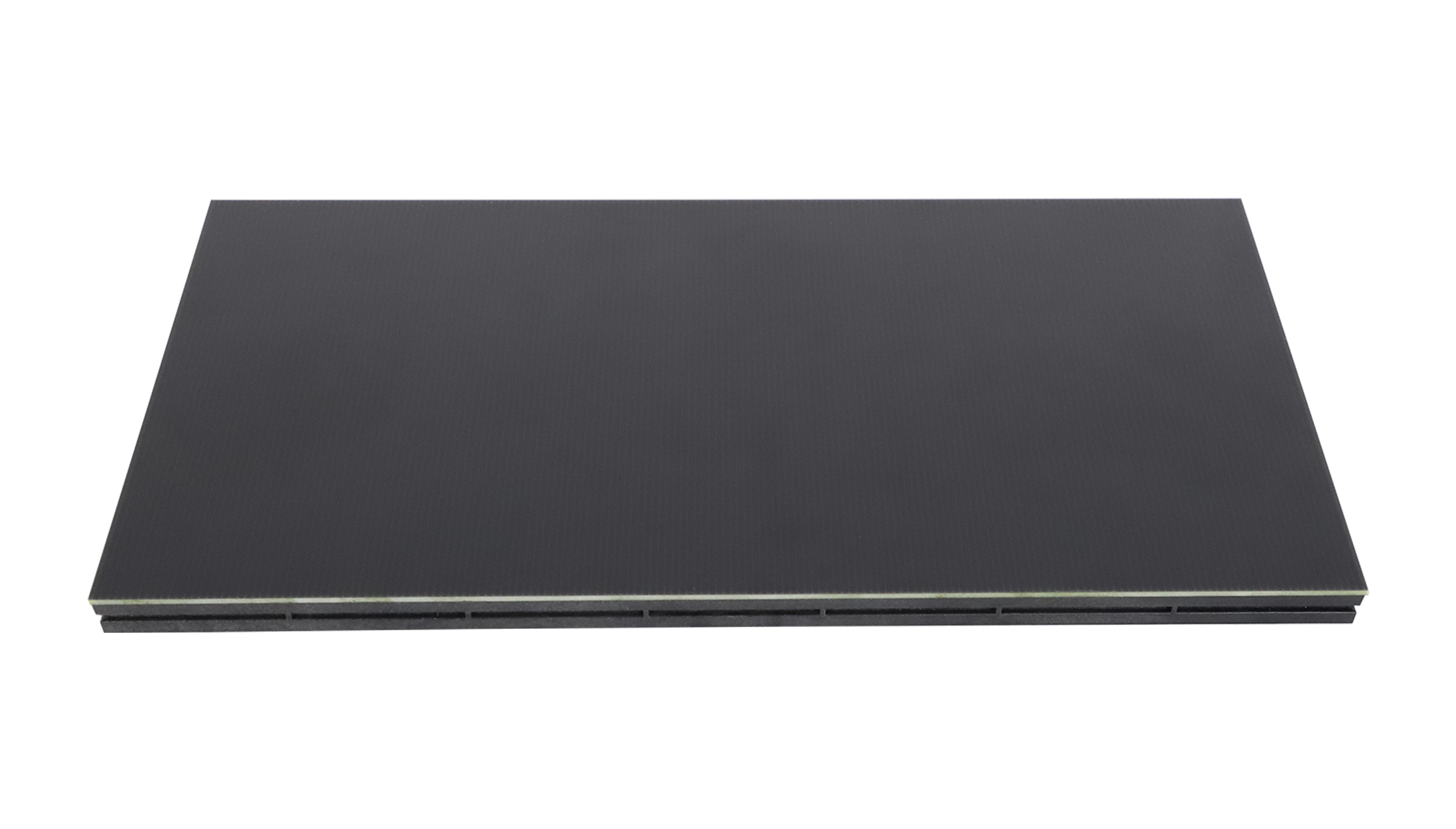
If your nearest viewer sits 2 m (6.5 ft) or farther from the wall, stepping to the P1.86 COB 320×160 mm indoor HD LED screen module gives you the same smooth, wipeable COB surface and 72-hour pre-shipment aging check at a lower cost per square meter. A 3.84 m × 2.08 m (12.6 ft × 6.8 ft) P1.86 wall hits full 1080p HD resolution cleanly without overloading a mid-tier controller.
5. P1.95 GOB and P2.6 250×250 mm soft modules for wider curves
Exhibition builders and rental houses often prefer 250×250 mm (9.84 × 9.84 in) square modules because they drop neatly into metric 500 mm, 1000 mm, and 1500 mm booth structures—and they let you build both horizontal curves and vertical wave ceilings without awkward half-tile cuts.
01. P1.95 GOB 250×250 mm for trade-show curves
Tha Indoor GOB P1.95 250×250 mm soft flexible LED module gives you 128 × 128 pixels per square tile with GOB protection on top. Because trade-show crews pack, unpack, and magnet-mount curved booth headers dozens of times a year, that GOB layer pays for itself on the very first tear-down by preventing corner LED knock-offs.

02. P2.6 SMD1515 250×250 mm for large-scale architectural wraps
When you’re wrapping a tall atrium column, shopping mall fascia, or concert stage arch viewed from 3 m to 10 m (10 ft to 33 ft) away, paying for P1.25 or P1.53 is overkill. The P2.6 SMD1515 indoor 250×250 mm soft flexible LED module (96 × 96 pixels per tile) keeps total wall weight, power draw, and processor channels manageable on big curved spans.
6. Curved iron frames, magnets, and same-batch ordering rules
Most visual defects on curved LED walls aren’t caused by bad LEDs—they’re caused by sloppy metalwork, mismatched batches, or under-spec’d power supplies. Keep these field rules locked in before fabrication starts.
| Factar Stàlaidh | Mearachd Cumanta Achaidh | Cleachdadh Innleadaireachd a thathar a’ moladh |
|---|---|---|
| Curved iron structure | Uneven welded sheet metal with 3–4 mm high spots | CNC-rolled 1.5–2.0 mm steel skin, tolerance under 1 mm (0.04 in) |
| Module batching | Ordering spares 6 months later from a new LED bin | Buy all active tiles plus 3%–5% spares in one single batch |
| Power supply rail | Overloading one 5V unit across 10 fine-pitch tiles | Use 4.5V–5V units loaded to max 80% with short 16 AWG leads |
| Mapadh cairtean a’ faighinn | Exceeding card pixel width on 256×128 P1.25 tiles | Verify HUB75 port count and per-card pixel ceiling before wiring |
01. Why you must buy same-batch modules (including spares)
LED lamps are binned by wavelength and brightness at the factory, and driver IC revisions change every few months. If you install 96 tiles of a P1.53 modal LED sùbailte bog today and order four replacement tiles six months later, those four tiles will almost certainly show a visible tint or brightness patch against the rest of the column—even after software calibration. Always order 100% of your wall plus 3% to 5% spare modules in the exact same production batch.
02. Matching power supplies and receiving cards
Curved iron structures are usually tight on rear cavity depth, especially inside narrow columns. Pair your modules with slim 4.5V or 5V supplies—check our Rong-Electric 4.5V power supply guide for 19 mm and 30 mm slim options—and verify your receiving card’s HUB75 port count. For example, if you’re driving a dense P1.25 curved wall, a 12-port or 16-port card like those covered in our NovaStar DH7512-S vs MRV328 receiving card guide keeps ribbon lengths short inside the column.
03. Front-service maintenance, cleaning, and ribbon routing
Because curved columns and wall-mounted COB screens rarely have rear walkways, almost all service happens from the front using a vacuum suction tool. On a magnetic flexible column, pull the tile straight outward along the curve normal rather than prying from one corner with a metal screwdriver—prying bends the silicone backing and can crack copper traces along the edge of the PCB. Before seating a replacement tile, check that the HUB75 signal ribbon isn’t pinched between a magnet standoff and the steel sheet.
Keep ribbon lengths as short as your layout allows, ideally under 350 mm (13.8 in) between the receiving card and the first tile. Long, unshielded 16-pin ribbons pick up switching noise from nearby 4.5V or 5V power supplies, which shows up as faint horizontal ghosting or random pixel sparkle on dark gray scenes. Route DC power leads along one side of the internal strut and HUB75 signal cables along the opposite side so they cross at 90-degree angles whenever possible.
Cleaning is another place where COB and GOB earn their keep. On bare SMD tiles, wiping dust off the face with a cloth snags micro-lamps and leaves dead pixels behind. Both GOB-coated flexible tiles and rigid COB panels can be dusted with a soft anti-static brush or wiped lightly with a damp microfiber cloth (never harsh ammonia or alcohol solvents that cloud optical epoxy). Schedule a quick quarterly inspection on public-facing columns to verify that all magnets sit flush and no ventilation louvers at the top or bottom of the column have filled with lint.
04. Calculating column circumference without awkward gaps
Before your metal shop rolls a single sheet of steel, do the circumference math from the module width outward—never the other way around. For a 360-degree cylinder wrapped with 320×160 mm tiles mounted horizontally, multiply 320 mm by an integer number of tiles (for example, 10 tiles = 3,200 mm circumference, which equals a finished outer diameter of roughly 1,018 mm / 40.1 in). Subtract twice the module thickness (typically 8 mm to 10 mm per side) to get the exact steel drum diameter your fabricator should roll. If you try to wrap an arbitrary architectural pillar without adjusting the steel cladding diameter, you’ll end up with a 70 mm vertical gap that no software mapping can hide.
For 250×250 mm square modules on an exhibition arch or curved fascia, the same rule applies: design your arc length in exact multiples of 250 mm (9.84 in) so every seam lands cleanly on a tile edge and every receiving card maps an even pixel grid.
If your project needs a complete factory-rolled curved cabinet or turnkey cylindrical display rather than bare modules, you can explore pre-assembled creative LED structures on EagerLED’s creative display lineup.
Ceistean Àbhaisteach
What is the difference between a soft flexible LED module and a COB LED module?
A soft flexible LED module uses a bendable PCB and magnetic silicone rubber frame so it can wrap around curved columns, arches, and wave walls, often with a protective GOB coating on fine pitches. A COB LED module uses a rigid PCB with bare LED chips sealed in optical resin—it cannot bend, but it offers superior flatness, contrast, and impact durability for flat indoor walls.
Can I bend a soft flexible LED module into a tight 360-degree cylinder?
Yes, as long as your cylinder diameter stays above the module’s minimum bend radius (typically a curve radius of 300 mm to 500 mm / 11.8 in to 19.7 in depending on pitch and tile width) and your CNC-rolled iron structure is smooth enough for all rear magnets to seat flush.
Why should I choose GOB on P1.25, P1.53, or P1.95 flexible modules?
GOB (Glue-on-Board) encapsulates the tiny SMD1010 or SMD1212 LEDs under a clear protective layer. It stops installers from accidentally knocking off edge pixels when pressing flexible tiles onto magnetic steel frames, and it protects public-facing columns from dust, moisture, and accidental touches.
What parts are included when I order these 320×160 mm or 250×250 mm modules?
Each module includes the LED module itself, the signal ribbon cable connecting between modules, and the DC power cable connecting the module to the power supply. Power supplies, receiving cards, sending controllers, and curved steel frames are ordered separately based on your screen dimensions.
Why do I have to buy spare soft flexible LED modules in the same batch?
Modules from different production batches use slightly different LED wavelength bins and PCB/IC revisions. Mixing batches on one screen creates noticeable brightness or color patches, so buying your active tiles and 3%–5% spares together guarantees a uniform wall from day one through future maintenance.
Curved and fine-pitch module spec checklist
Before you lock in your module order and steel fabrication drawings, confirm these five details:
- Flat vs curved surface: Pick rigid P1.53 or P1.86 COB for flat walls; pick a magnetic modal LED sùbailte bog (P1.25 GOB, P1.53 GOB, P1.95 GOB, or P2.6) for columns, concave curves, and wave ceilings.
- Viewing distance match: Match pixel pitch in millimeters to your closest viewer distance in meters (1.25 m for P1.25, 1.5 m for P1.53, 2.0 m+ for P1.86/P1.95/P2.6).
- Grid size alignment: Use 320×160 mm tiles for architectural wall builds and 250×250 mm tiles for 500 mm-grid exhibition and rental frames.
- Single-batch spares: Include 3% to 5% extra modules on the same purchase order so future replacements match color and brightness.
- Control & power budget: Count total pixels per receiving card and leave 20% headroom on your 4.5V/5V power supplies.
Need help calculating exact tile counts, receiving card quantities, or bend radius for a curved column? Share your column diameter, wall height, and viewing distance through the duilleag conaltraidh ledcontrollercard.com and our engineers will map out the full parts list for your build.