Kystar KSV8C: video processing and LED sending in one unit
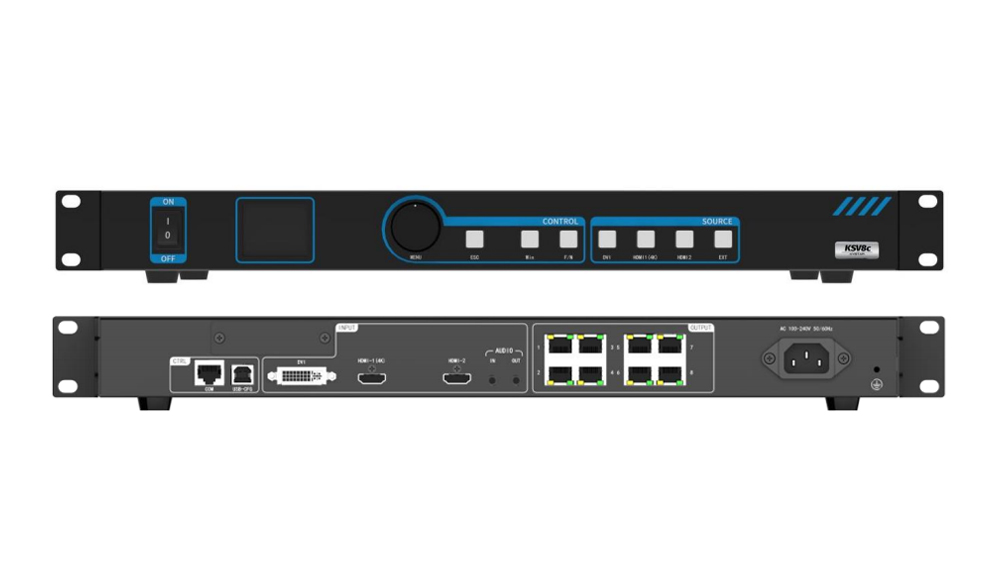
The Kystar KSV8C is a 2-in-1 LED video controller with eight Gigabit Ethernet outputs and a maximum LED load of 5.2 million pixels. It processes three digital input sources and sends the resulting image to the LED receiving system, making it suitable for small-pitch presentation displays and multi-source LED walls.
For projects comparing a Kystar LED controller or video processor, start with the screen pixel count, source interfaces and picture layout. The KSV8C supports one HDMI 1.4, one HDMI 1.3 and one DVI-D input, with up to three pictures arranged on the display.
Verified specifications
| Specification | Details |
|---|---|
| LED outputs | 8 Gigabit Ethernet ports |
| Total LED pixel load | Up to 5,200,000 pixels |
| Load per port | Up to 650,000 pixels at 8-bit output |
| Maximum output dimensions | Width up to 8,180 pixels; height up to 4,090 pixels, subject to total and per-port limits |
| Digital inputs | 1 × HDMI 1.4, 1 × HDMI 1.3, 1 × DVI-D |
| HDMI 1.4 input | 3840 × 2160 at 30Hz or 3840 × 1080 at 60Hz |
| HDMI 1.3 and DVI input | Up to 2048 × 1152 at 60Hz |
| Picture layout | Up to three pictures with adjustable positions |
| Audio | 3.5mm audio input and output; 48kHz sampling |
| Configuration | COM and USB-CFG interfaces; EDID management |
Setup tools for presentations and LED walls
- Flexible layouts: position three pictures for presentations, monitoring views or multi-source content.
- Source fitting: customize EDID and crop unwanted borders to fit the incoming signal to the intended display area.
- Screen commissioning: use built-in solid-color, gradient and scanning-line test patterns when checking the display.
- Operator control: apply black screen or freeze, lock the keys against accidental changes, and adjust output brightness and contrast.
Resolution, wiring and compatibility limits
A supported input resolution is different from the LED output pixel capacity. A 3840 × 2160 source contains 8,294,400 pixels, which exceeds the KSV8C’s 5.2-million-pixel LED load. The HDMI 1.4 input can accept this signal at 30Hz, but that does not make the controller capable of driving a full native 3840 × 2160 LED canvas.
For a pixel-budget example, 3200 × 1600 equals 5,120,000 pixels and fits below the stated total limit. Actual configuration must also keep every port within its capacity and match the cabinet dimensions, receiving-card arrangement, output settings and cable routing. The maximum width and height are separate limits; they cannot both be used at their maximum values simultaneously.
Confirm the required receiving cards, firmware and signal timings before ordering. The referenced KSV8C document shows Ethernet outputs; verify the exact hardware revision before specifying optical accessories. For a larger Ethernet output budget, compare the 12-port Kystar KSV12C using its own specifications.
Frequently asked questions
Does KSV8C support 4K input at 60Hz?
The documented HDMI 1.4 limits are 3840 × 2160 at 30Hz or 3840 × 1080 at 60Hz. Full 3840 × 2160 at 60Hz is not listed.
Does the KSV8C need a separate LED sending box?
Video processing and LED sending are integrated into this unit. A compatible receiving-card system is still required at the LED display.
How many LED pixels can each output carry?
The specification lists up to 650,000 pixels per Ethernet output at 8-bit output, with up to 5.2 million pixels across the unit.
Conclusion
The KSV8C is a practical choice for an LED wall requiring three digital sources, flexible picture layouts and eight Ethernet outputs. Select it by the 5.2-million-pixel LED budget and documented source timings, then verify the receiving system and port mapping. See the official Kystar controller series and the exact-model specification below.
Download Specification:
Kystar KSV8C 2-in-1 LED Display Video Controller Specification(Chinese)