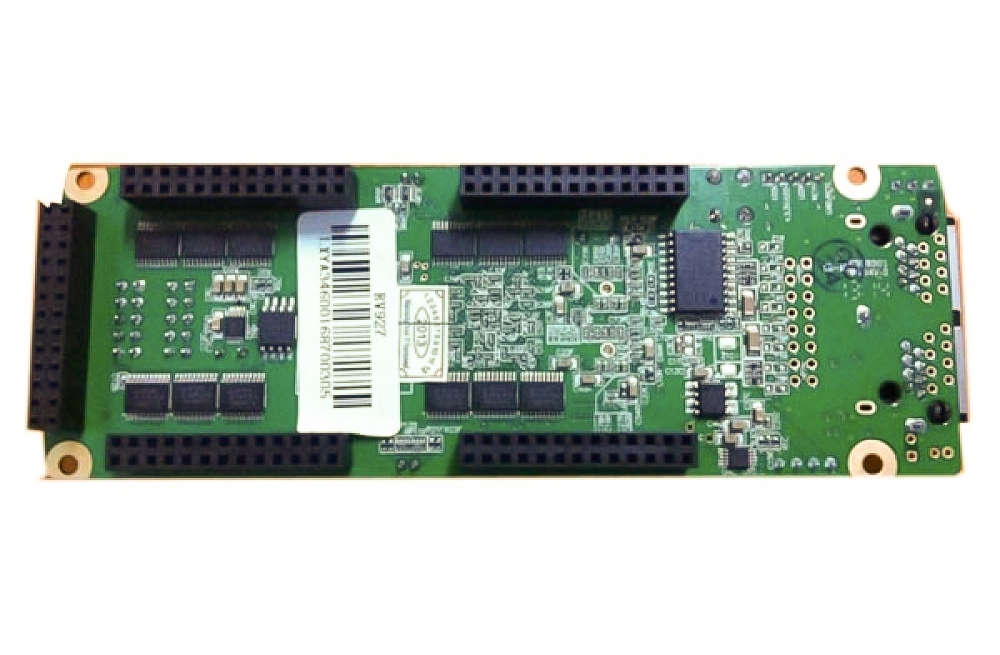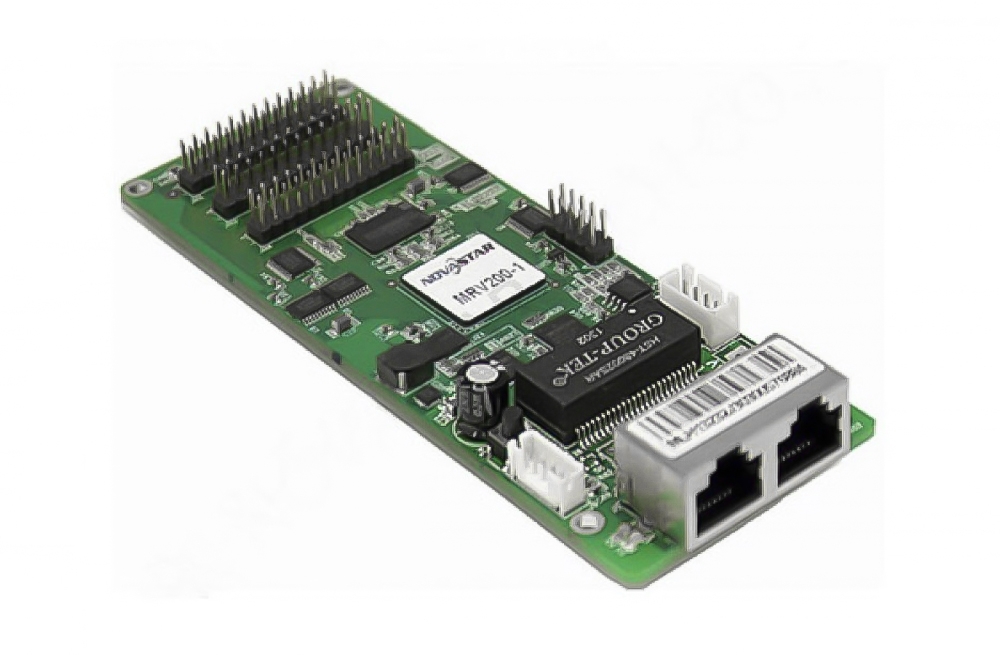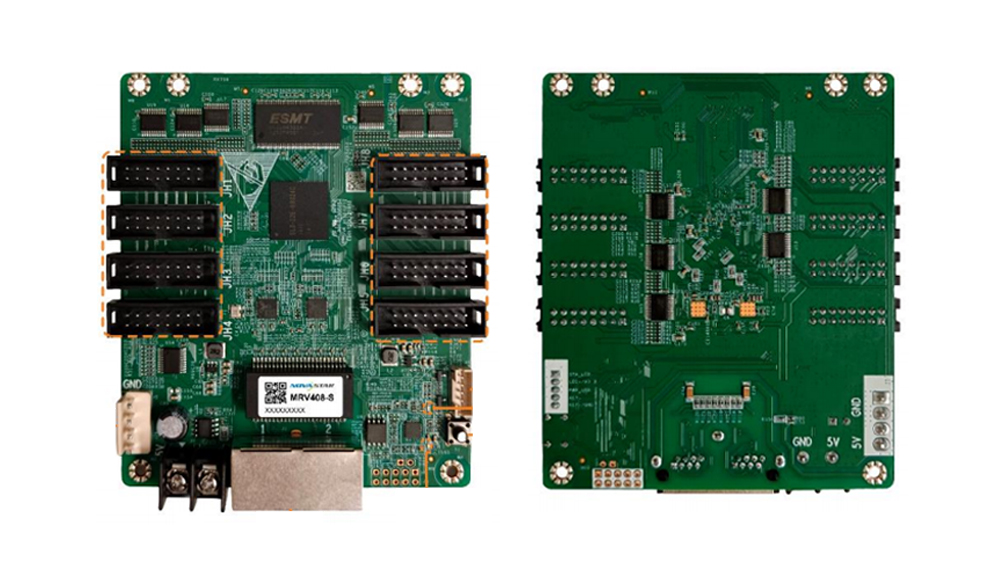
NovaStar MRV408-S LED Receiving Card Overview
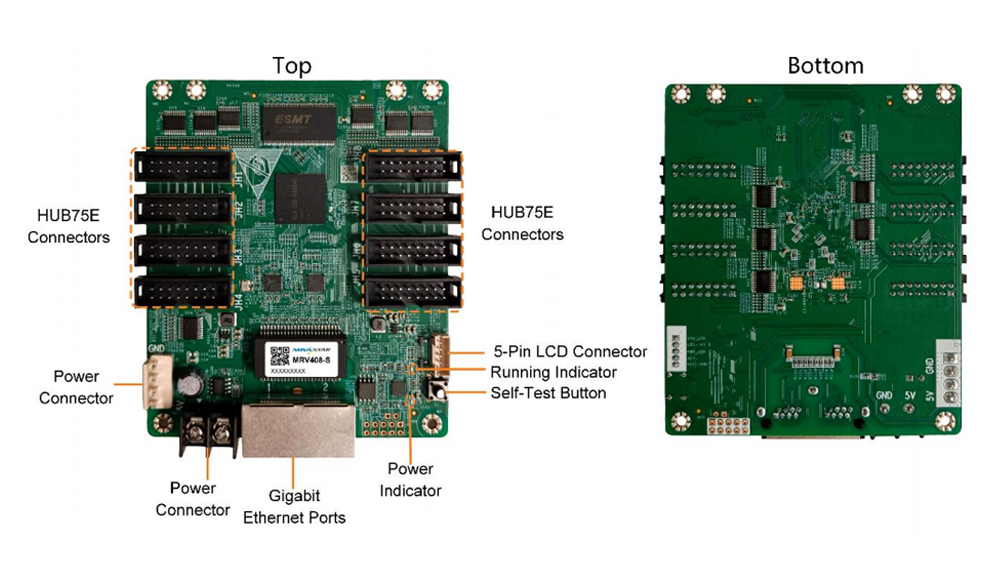
The NovaStar MRV408-S is an LED receiving card for cabinet-level module control. It provides 8 standard HUB75E connectors and up to 16 groups of parallel RGB data. Its Gigabit Ethernet ports connect to a sending card and cascade other receiving cards; either Ethernet connector can serve as an input or output.
For buyers planning a new cabinet or replacing a receiver, the key checks are the module driver IC, cabinet pixel dimensions, HUB75E wiring and controller configuration. The MRV408-S combines pixel-level calibration, cabinet diagnostics and backup functions, but advanced features depend on the complete display system.
MRV408-S Specifications and Loading Capacity
| Parameter | Specification |
|---|---|
| Module connectors | 8 × standard HUB75E |
| Parallel RGB data | Up to 16 groups |
| Maximum load with PWM driver IC | 512 × 512 pixels at 60 Hz, 8-bit video source |
| Maximum load with common driver IC | 512 × 384 pixels at 60 Hz, 8-bit video source |
| Input voltage | DC 3.8 V to 5.5 V |
| Rated current | 0.4 A at 4.2 V |
| Rated power consumption | 1.68 W; actual consumption varies with settings and operating conditions |
| Card dimensions | 91.6 × 107.5 × 19.3 mm |
| Net weight | 73.7 g for the receiving card only |
| Operating environment | −20°C to +70°C; 10% to 90% RH, non-condensing |
Loading note: The two resolution limits apply to different driver IC types. Do not treat 512 × 512 as a universal capacity for every module. Confirm the driver IC, scan configuration and cabinet layout before choosing the number of receiving cards.
Display Quality and Image Adjustment
- Color management: Supports Rec.709, DCI-P3, Rec.2020 and custom color gamuts.
- 18bit+: Improves grayscale performance at low brightness for smoother tonal transitions.
- Pixel-level brightness and chroma calibration: Works with NovaStar’s calibration system to reduce differences between pixels. Calibration coefficients can be uploaded, read back, saved to hardware and erased, with fast or stable upload options.
- Seam and batch correction: Dark or bright line adjustment helps correct module or cabinet seams. Multi-batch adjustment reduces brightness and chroma differences between production batches.
- Independent RGB gamma: Requires NovaLCT and a controller supporting the function to adjust red, green and blue gamma individually.
Low Latency, 3D and Rotation Requirements
Low latency is enabled by default. The specified one-frame latency at the receiving-card end applies only to modules using driver ICs with built-in RAM; it is not an end-to-end system latency guarantee. For 3D output, use a controller that supports 3D.
The card supports rotation in 90° steps: 0°, 90°, 180° and 270°. Rotation at arbitrary angles requires the dedicated MCTRL R5 controller and SmartLCT software. Check these dependencies before selecting the card for a rotated or 3D display.
Cabinet Diagnostics and Backup Features
Data group mapping helps locate each data group inside the cabinet. Mapping 2.0 identifies controller ports and receiving cards visually and supports cabinet resolution mapping from 36 × 20 pixels. A stored image can be configured for startup, Ethernet disconnection or loss of video input.
- Monitoring: Read card temperature and voltage without additional peripherals. A cabinet LCD connected through the 5-pin LCD connector can display temperature, voltage and runtime information.
- Link diagnostics: Bit error detection and Ethernet disconnection monitoring help identify communication problems.
- Readback: Save receiving-card firmware and configuration parameters to a local computer for maintenance.
- Loop backup: Primary and backup connections between the controller and receiving cards form a redundant loop to maintain the image when a line fault occurs.
- Dual backups: Configuration parameters are stored in application and factory areas, and two firmware copies support recovery from an abnormal program update.
Selection and Installation Checklist
- Record the LED module model, driver IC, scan mode, cabinet resolution and HUB75E pin assignment. Match these details before ordering a replacement card.
- Check the 91.6 × 107.5 × 19.3 mm card size against mounting space and connector clearance. Use the dimensional drawing in the specification for installation planning.
- Provide a supply within DC 3.8–5.5 V and verify polarity. The rated 1.68 W figure describes the receiving card, not the power demand of the LED modules.
- Confirm controller, firmware and software support for the required calibration, gamma, rotation, redundancy or 3D functions. Back up the existing cabinet configuration before replacement.
- Validate one cabinet’s mapping, colors and module connections before applying the configuration to the complete screen.
Browse our LED receiving cards or contact us with your module and cabinet details for selection assistance.
Product Image
Download the MRV408-S Specification
NovaStar MRV408-S LED Receiving Card Specification — manufacturer specification V1.0.0, released September 18, 2026. Refer to this document for connector pin definitions, indicator states and dimensional drawings.
Frequently Asked Questions
What is the maximum resolution of the NovaStar MRV408-S?
With an 8-bit source at 60 Hz, the maximum is 512 × 512 pixels using PWM driver ICs, or 512 × 384 pixels using common driver ICs. Check the module driver IC before applying either limit.
How many HUB75E connectors does the MRV408-S have?
It has 8 standard HUB75E connectors and supports up to 16 parallel RGB data groups. Module wiring and pin assignments must match the receiving card.
What power supply does the MRV408-S require?
The input range is DC 3.8 V to 5.5 V. Rated current is 0.4 A at 4.2 V, and rated card power consumption is 1.68 W. Size the LED module supply separately.
Does the MRV408-S support low latency and 3D?
Yes, subject to system requirements. One-frame receiving-card latency requires driver ICs with built-in RAM. 3D output requires a controller supporting 3D.
Can I replace another receiving card with an MRV408-S directly?
Do not assume a direct replacement from the connector appearance alone. Compare the exact model, module driver IC, pinout, scan configuration, cabinet resolution, mounting dimensions and controller support, and retain a backup of the original configuration.
Conclusion
The NovaStar MRV408-S is a receiving-card option for LED cabinets needing 8 HUB75E connectors, up to 16 parallel RGB data groups, calibration tools and maintenance diagnostics. Choose it by the verified module and cabinet requirements, apply the correct driver-IC-dependent load limit, and confirm the supporting hardware and software for advanced functions.