لنډ ځواب: The NovaStar TB40 and TB60 are both third-generation Taurus series multimedia players that combine playback and LED sending in one box, and both run the same quad-core ARM A55 processor, Android 11, 1 GB RAM and 32 GB of internal storage. What separates them is output hardware. The TB40 drives up to 1,300,000 pixels through two Gigabit Ethernet outputs and runs from a 12 V DC adapter. The TB60 drives up to 2,300,000 pixels through four Gigabit Ethernet outputs and runs from an internal 100–240 V power supply. Pick the TB40 for screens that fit inside 1.3 million pixels, and the TB60 when the pixel count, the number of output ports or the power design makes the TB40 too tight.
کليدي لارې
- Same brain, different muscle. Identical CPU, operating system, memory and 4K decoding; the real differences are loading capacity, LED output ports, power supply, size and weight.
- د پکسل بار: TB40 up to 1,300,000 pixels, TB60 up to 2,300,000 pixels. Both cap a single screen at 4096 × 4096 pixels. Ultra-long-screen support up to 23,040 × 4096 pixels is documented for the TB60 (specification V1.2.5); the TB40 specification V1.2.1 does not list an ultra-long mode and limits custom resolutions to 512–4096 pixels wide and 512–3680 pixels high.
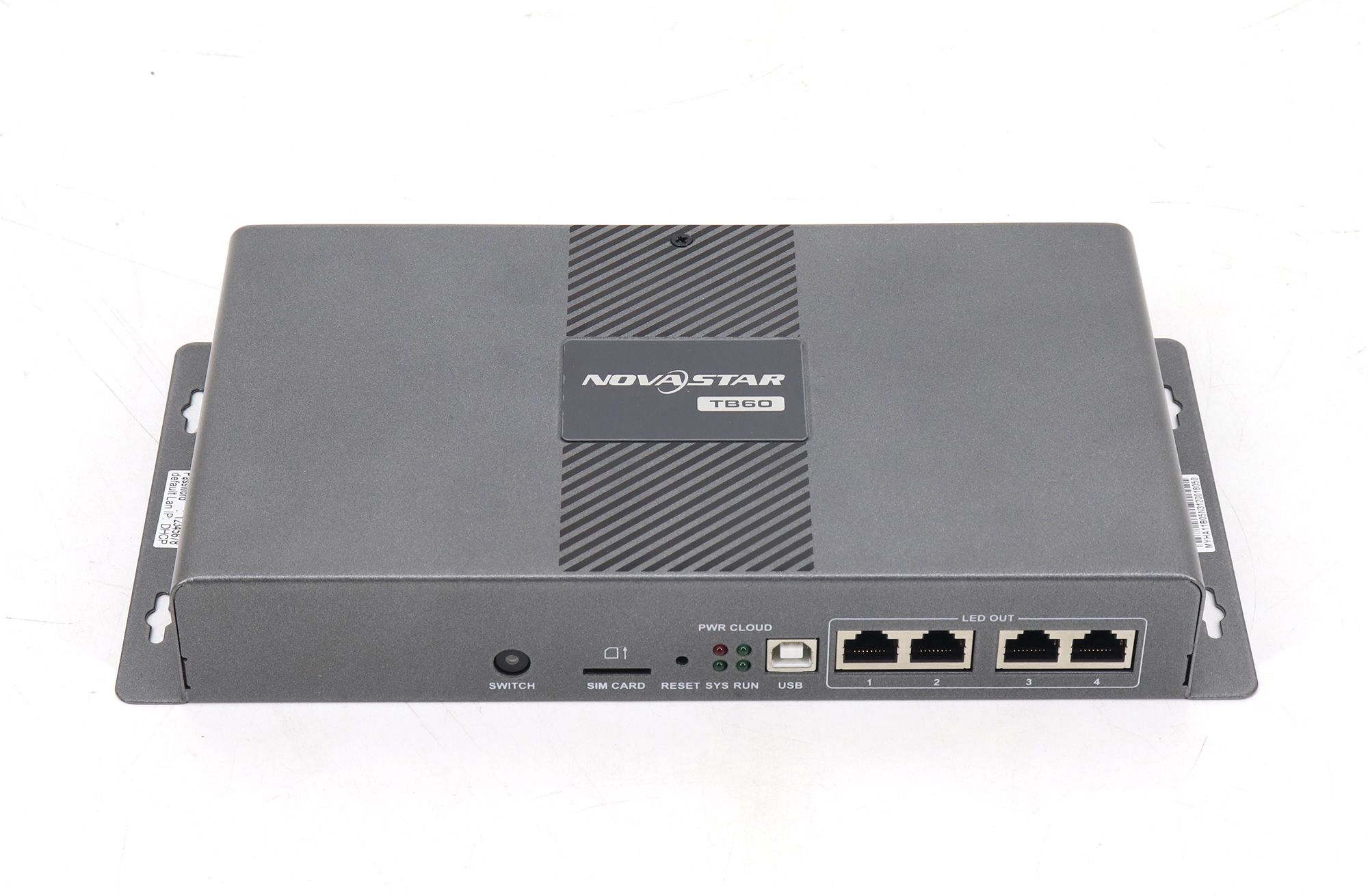
- بندرونه: TB40 has 2 Gigabit Ethernet LED outputs (usable as 1 primary + 1 backup); TB60 has 4 (usable as 2 primary + 2 backup).
- د بريښنا: TB40 uses an external DC 12 V, 2 A adapter; TB60 has an internal 100–240 V power supply with an ON/OFF switch.
- Careful with “4K”: both players decode 4K from internal storage, but the HDMI 1.3 input and loop output top out at 1920×1200@60Hz. A 4K live HDMI feed is a processor job, not a Taurus player job.
فهرست
- TB40 vs TB60 at a glance
- What the TB40 and TB60 share
- The four differences that decide the model
- Pixel budget: which screen size fits which player
- How to choose: TB40 or TB60?
- دوه کار شوي مثالونه
- Mistakes buyers make with Taurus players
- Running the player: modes, software and options
- FAQs
- سرچینې او تایید
TB40 vs TB60 at a glance
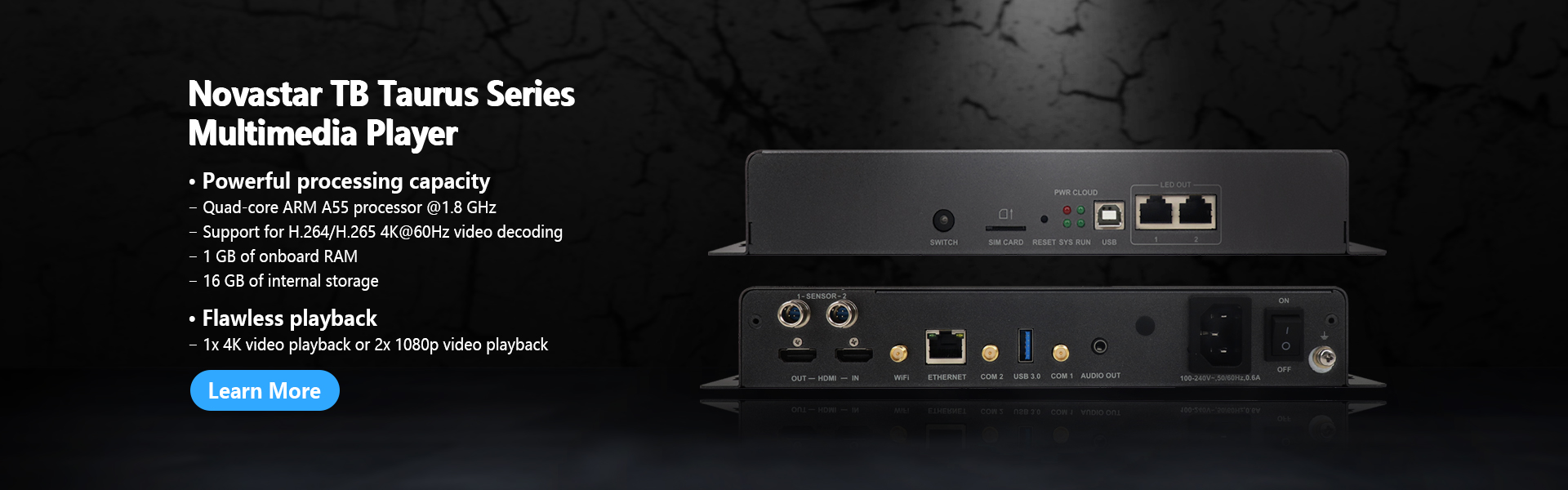
The table below follows NovaStar’s official specification documents for both models (V1.2.5, released 2026-08-31).
| د ځانګړتیاوو | نووا سټار TB40 | نووا سټار TB60 |
|---|---|---|
| Series and generation | Taurus series, third generation | Taurus series, third generation |
| د ظرفیت لوړول | تر ۲،۶۰۰،۰۰۰ پېکسل پورې | تر ۲،۶۰۰،۰۰۰ پېکسل پورې |
| اعظمي پلنوالی × لوړوالی | 4096،4096 × XNUMX،XNUMX پېکسل | 4096،4096 × XNUMX،XNUMX پېکسل |
| د الټرا اوږد سکرین ملاتړ | Not listed in the TB40 specification V1.2.1 (custom resolutions 512–4096 wide, 512–3680 high) | Up to 23,040 × 4096 pixels (specification V1.2.5) |
| د ګیګابایټ ایترنیټ LED محصولات | 2 (both primary by default; can be set as 1 primary + 1 backup) | 4 (all four primary by default; can be set as 2 primary + 2 backup) |
| HDMI input and loop output | HDMI 1.3, up to 1920×1200@60Hz, custom EDID 512–4096 | HDMI 1.3, up to 1920×1200@60Hz, custom EDID 512–4096 |
| پروسسر | کواډ کور ARM A55 @ 1.8 GHz | کواډ کور ARM A55 @ 1.8 GHz |
| یادښت او ذخیره | 1 GB رام، 32 GB داخلي ذخیره | 1 GB رام، 32 GB داخلي ذخیره |
| Video decoding and playback | 4K decoding; 1×4K, 2×1080p, 5×720p, 6×480p or 6×360p videos | 4K decoding; 1×4K, 2×1080p, 5×720p, 6×480p or 6×360p videos |
| چليز غونډال | Android 11 | Android 11 |
| Control and network ports | 1× Gigabit Ethernet, 1× USB 3.0 Type-A, 1× USB Type-B, Wi-Fi 2.4 GHz AP + Sta, optional 4G module | 1× Gigabit Ethernet, 1× USB 3.0 Type-A, 1× USB Type-B, Wi-Fi 2.4 GHz AP + Sta, optional 4G module |
| د وخت همغږي کول | NTP; GPS or RF with the optional module installed | NTP; GPS or RF with the optional module installed |
| د بریښنا د وتنی | DC 12 V, 2 A through an external adapter | 100–240 V~, 50/60 Hz, 0.6 A through an internal power supply, with ON/OFF switch |
| د بریښنا اعظمي مصرف | 18 W (25 W recommended supply) | 18 W (25 W recommended supply) |
| ډډې | 238.8 × 140.5 × 32.0 ملیون | 274.3 × 139.0 × 40.0 ملیون |
| خالص وزن | 459.7 g | 1230.4 g |
| عادي حرارت | X20. C to + 60. C ته | X20. C to + 60. C ته |
| د IP درجه | IP20 | IP20 |
What the TB40 and TB60 share
Because the two players share a platform, a project rarely fails on processing power. Both offer:
- The same processing platform: quad-core ARM A55 at 1.8 GHz, 1 GB RAM and 32 GB of internal storage, running Android 11.
- The same decoding profile: 4K H.265 or H.264 playback, with simultaneous playback of 1×4K, 2×1080p, 5×720p, 6×480p or 6×360p video.
- Synchronous and asynchronous modes with a front-panel SWITCH button: internal storage drives scheduled content, HDMI drives live content.
- Multi-screen synchronous playback using NTP, plus GPS or RF time synchronization when the matching module is fitted.
- Wi-Fi AP and Wi-Fi Sta at the same time, an independent Gigabit control port, USB 3.0 playback, and 2 sensor ports for brightness or temperature and humidity sensors.
- The same HDMI ceiling: HDMI 1.3 input and loop output at a maximum of 1920×1200@60Hz, with HDMI source scaling and custom EDID from 512 to 4096 pixels.
- The same environment rating: IP20, –20°C to +60°C, 18 W maximum consumption with a 25 W recommended supply.
If you already accept the Taurus workflow, choosing between the two models is therefore an output-side decision: how many pixels, how many ports, and how the box is powered.
The four differences that decide the model
1. Loading capacity: 1.3 million vs 2.3 million pixels
This is the headline number. A TB40 covers LED walls up to 1,300,000 pixels; a TB60 covers up to 2,300,000 pixels. The pixel ceiling is independent of the video content: a wall with 1.8 million pixels needs the TB60 even if it only ever shows 1080p clips, because the sender must address every pixel on the screen.
A quick sanity check before you order: multiply the wall width in cabinets by the pixels per cabinet to get the real load, then compare it with the limit. If the result sits within 10–15% of 1.3 million, the TB60 is the safer choice, because long screens often grow during site measurement.
2. LED output ports: 2 vs 4 Gigabit Ethernet
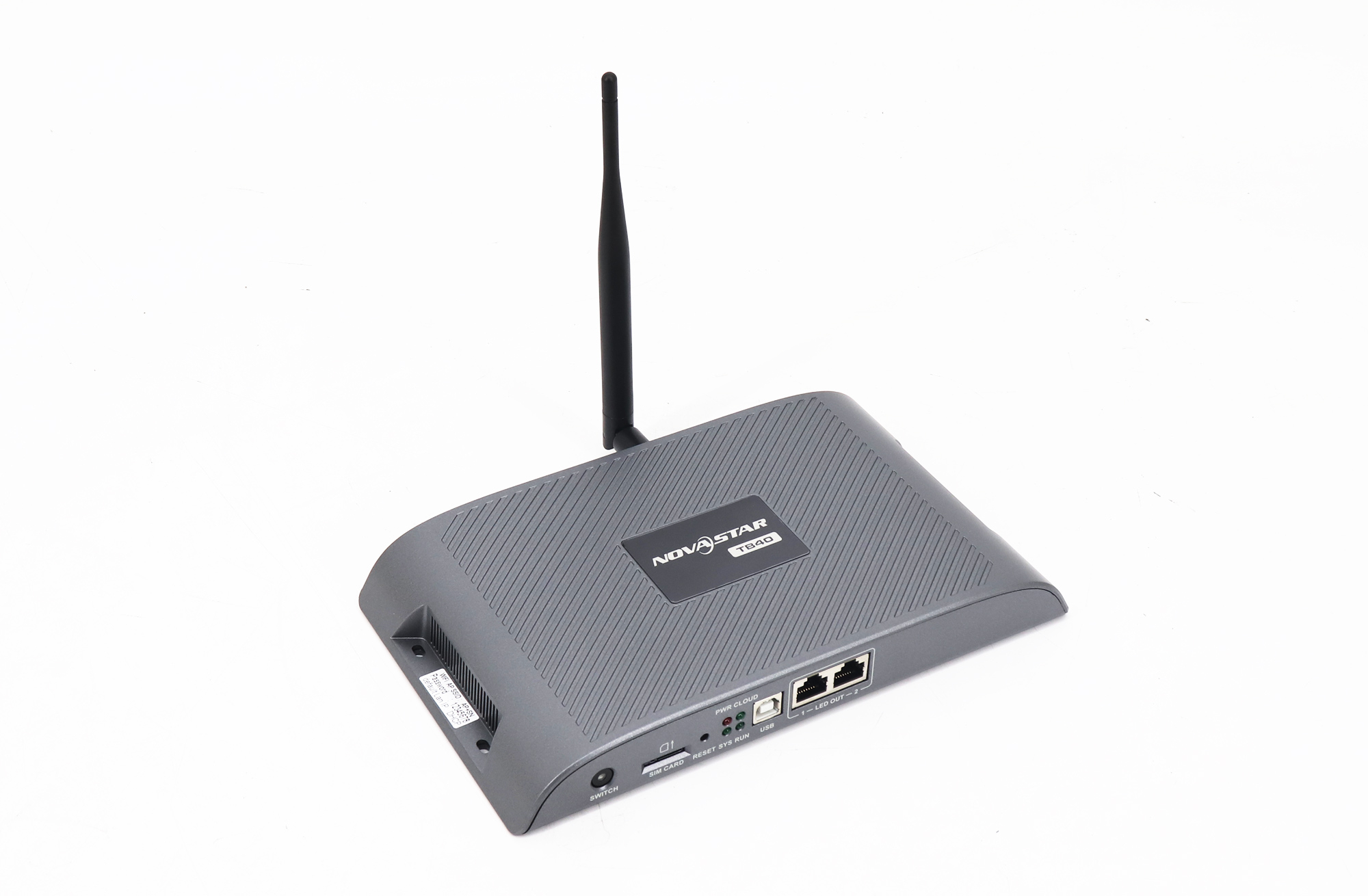
The TB40 has two Gigabit Ethernet LED outputs, both primary by default, and the pair can be reconfigured as 1 primary + 1 backup. The TB60 has four, all primary by default, and can be set as 2 primary + 2 backup. Port count matters in three situations:
- Wide cabinets: more ports let you split the screen into shorter data runs, which reduces the risk of a single long chain failing.
- بې ځایه کیدل: the TB60 can protect half of the screen at a time, while the TB40 protects one data path.
- Future growth: spare ports give you room to add cabinets without changing the sender.
In practice the port layout, not the headline capacity, is what usually blocks a design. Plan the cabinet-to-port mapping before purchase, and confirm each port’s share of the load in the configuration software. Our NovaStar LED controller pixel load guide walks through that sizing calculation.
3. Power supply: external 12 V adapter vs internal mains supply
The TB40 takes DC 12 V, 2 A from an external adapter; the TB60 takes 100–240 V~, 50/60 Hz, 0.6 A into an internal power supply and has an ON/OFF switch. Both are rated at a maximum of 18 W with a 25 W recommended supply.
The consequence is mechanical, not electrical. The TB40 needs somewhere to place a power brick and a socket for it, which suits door head signs, shelf displays, retail fixtures and lamp-post cabinets. The TB60 takes mains directly into the box, which is simpler for large fixed installations, chain store signage and outdoor cabinets where an external brick is awkward or a service point already has mains. The trade-off is size and weight: 459.7 g in a 32 mm case for the TB40 against 1230.4 g in a 40 mm case for the TB60.
4. Certification coverage
Certification lists differ between the two documents. The TB40 V1.2.5 list covers CQC, SRRC, RoHS, CE, RCM, FCC, IC and CB. The TB60 V1.2.5 list adds regional marks including UL, KC, PSE, UKCA, NBTC, IMDA, PSB, MIC, SIRIM and ICASA. If your project country requires a specific mark, check it per model rather than assuming the family is interchangeable.
Pixel budget: which screen size fits which player
Pixel pitch determines how many pixels each square metre of LED screen contains, so the loading capacity converts into a maximum screen area. The following table uses the standard pitch values and treats the player limit as the constraint.
| pixel جګوالی | په هر مربع متر کې پکسلونه (تقریبا) | Max area with TB40 (1.3M pixels) | Max area with TB60 (2.3M pixels) |
|---|---|---|---|
| P2.5 | 160,000 | ≈۶۵ مربع متره | ≈۶۵ مربع متره |
| P3 | 111,111 | ≈۶۵ مربع متره | ≈۶۵ مربع متره |
| P3.91 | 65,536 | ≈۶۵ مربع متره | ≈۶۵ مربع متره |
| P4 | 62,500 | ≈۶۵ مربع متره | ≈۶۵ مربع متره |
| P5 | 40,000 | ≈۶۵ مربع متره | ≈۶۵ مربع متره |
| P6.67 | 22,500 | ≈۶۵ مربع متره | ≈۶۵ مربع متره |
| P10 | 10,000 | ≈۶۵ مربع متره | ≈۶۵ مربع متره |
These figures are the theoretical maximums from the pixel limits alone. Real projects also have to satisfy the maximum width (4096 pixels on the TB40; the TB60 adds an ultra-long mode up to 23,040 pixels wide), the way cabinets map onto individual ports, the receiving cards in use and the scan mode of the modules. Treat the table as a first filter, then confirm the final design in NovaStar’s configuration software before ordering.
How to choose: TB40 or TB60?
| TB40 غوره کړئ کله چې… | TB60 غوره کړئ کله چې… |
|---|---|
| The screen stays at or below about 1.2 million pixels, leaving headroom under the 1.3 million limit | The screen is between roughly 1.3 million and 2.3 million pixels |
| Two Gigabit outputs are enough for the cabinet layout, with 1 + 1 backup | You need four outputs, or 2 + 2 backup across a large screen |
| An external 12 V adapter fits the fixture, cabinet or door head design | You want mains straight into the box, with an ON/OFF switch and no adapter tray |
| Weight and depth matter: 459.7 g and 32 mm of case depth | You can accept 1230.4 g and 40 mm of case depth for the internal supply |
| The destination country is covered by the TB40 certification list | The project needs a regional mark listed on the TB60 documentation |
| Applications: retail signs, shelf and door head displays, lamp-post cabinets, small fixed screens | Applications: large fixed walls, chain store signage, transport and outdoor advertising cabinets |
If the project needs a genuine 4K live input, neither player is the right front end: use a video processor such as the VX600 Pro or VX1000 Pro and compare their input and load behaviour in our د VX1000 Pro په وړاندې د VX2000 Pro لارښود او VX600 Pro vs VX1000 Pro comparison, then feed the player at up to 1920×1200@60Hz.
دوه کار شوي مثالونه
Example 1 — 6 m × 3.5 m outdoor wall at P3.91. The area is 21 m², and at 65,536 pixels per m² the screen needs roughly 1,376,000 pixels. That is above the TB40 ceiling and comfortably inside the TB60, so the TB60 is the correct sender, and four outputs also give a cleaner cabinet split.
مثال ۱ — په P4 کې ۵ متره × ۳ متره پرچون دیوال. The area is 12 m², or about 750,000 pixels. A TB40 covers it with roughly 550,000 pixels of headroom, and two outputs are normally enough for a wall this size, so the TB40 is the economical choice.
Then verify the pixel count from the actual cabinet grid rather than from the nominal screen size, and confirm the design in the configuration software. Sending cards, hub cards and receiving cards in the chain matter just as much as the player; our د کارتونو لیږل او د کارتونو ترلاسه کول ranges cover those components, and bench testing the whole purchase before installation catches mismatched parts early.
Mistakes buyers make with Taurus players
- Reading “4K” as 4K HDMI input. Both players decode 4K files, but the HDMI input and loop output are limited to 1920×1200@60Hz. Plan a processor upstream if the source is genuinely 4K.
- د سکرین اندازه کول د پکسل دقیق حد ته. A wall designed at 1,290,000 pixels leaves almost nothing for late changes. Headroom is cheaper than replacing a sender during commissioning.
- Forgetting that synchronous playback halves the video count. NovaStar’s own documentation notes that enabling synchronous multi-screen playback halves the number of videos that can play simultaneously within the decoding capability.
- Assuming audio is included. Audio output requires a NovaStar multifunction card to be connected for the embed/de-embed path; order it with the player if the site needs sound.
- Planning GPS or 4G without ordering the module. Both players ship without the 4G module, and GPS or RF time synchronization requires the specified module to be installed. Network priority is wired, then Wi-Fi, then 4G.
- Ignoring the power design. A 12 V adapter needs space and a socket; an internal mains supply needs mains at the box. This decision is usually made by the cabinet, not by the player specification.
Running the player: modes, software and options
Both models publish content and control screens from a computer, phone or tablet, and both can be managed remotely through NovaStar’s cloud platform. Publishing from a PC or phone uses the ViPlex family, while screen configuration work is done with NovaStar’s control software. The official Taurus series downloads include the Taurus Series Multimedia Players Quick Start Guide (3rd Generation), the ViPlex Handy user manual and the ViPlex Express asynchronous mode manual.
زموږ د نووا سټار سافټویر ډاونلوډ پاڼه collects NovaLCT, VMP and firmware links in one place, and the RCFG and RCFGX configuration files guide explains the parameter files you may need when a screen moves between controllers. If you are producing the content that will run on the player, see our guide to د LED سکرینونو لپاره د موادو تولید.
د هارډویر او د هغې د پورټونو د بصري لید لپاره، زموږ په یوټیوب چینل کې د نووا سټار TB لړۍ LED ډسپلې ملټي میډیا پلیر وګورئ:
د نووا سټار ټي بي لړۍ ایل ای ډي ډسپلې ملټي میډیا پلیر - EagerLED ویډیو لارښود. د نصبولو او ترتیب کولو نورې ویډیوګانې په کې دي EagerLED يوټيوب چينل.
Readers comparing the wider Taurus family may also want our sister-site articles: the د نووا سټار TB30 او TB50 پرتله کول on the same product line, and the د نووا سټار ملټي میډیا پلیر لارښود covering TB10 to TB60. Inside this site, see how the players sit next to controllers in TB50 vs VX16s vs H9, MCTRL700 vs VX16S vs TB50 او د LED پروسیسر او د LED کنټرولر څه کوي؟.
FAQs
What is the difference between the NovaStar TB40 and the TB60?
The TB40 supports up to 1,300,000 pixels through two Gigabit Ethernet LED outputs and is powered by an external DC 12 V, 2 A adapter. The TB60 supports up to 2,300,000 pixels through four Gigabit Ethernet outputs and has an internal 100–240 V power supply with an ON/OFF switch. Processor, Android 11 operating system, 1 GB RAM, 32 GB storage, 4K decoding and HDMI 1.3 input are the same on both.
How many pixels can each player drive?
The TB40 drives up to 1,300,000 pixels and the TB60 up to 2,300,000 pixels, with a standard maximum screen of 4096 × 4096 pixels on both. The TB60 additionally documents ultra-long screens up to 23,040 × 4096 pixels. The practical limit for a specific wall also depends on how its cabinets map to the output ports.
Do the TB40 and TB60 both play 4K video?
Yes. Both decode 4K content, including H.265/HEVC up to 4096 × 2304 pixels at 60fps and H.264 at 30fps, and both can play one 4K video, two 1080p videos, five 720p videos, six 480p videos or six 360p videos at a time.
Can I feed a 4K HDMI signal into the TB40 or TB60?
No. The HDMI 1.3 input and loop output on both players support a maximum of 1920×1200@60Hz, although custom EDID is supported from 512 to 4096 pixels. If the install needs live 4K input, process it first with a NovaStar VX series video processor and send the player a signal within its HDMI limit.
Does the TB60 need an external power adapter?
No. The TB60 accepts 100–240 V~, 50/60 Hz, 0.6 A directly and includes an ON/OFF switch. The TB40 does need an external DC 12 V, 2 A adapter. Both draw a maximum of 18 W, and NovaStar recommends a 25 W supply.
Which player should I choose for a large outdoor screen?
Calculate the pixel count first: area in square metres multiplied by pixels per square metre for the chosen pitch. A 6 m × 3.5 m P3.91 wall needs about 1.38 million pixels, which requires the TB60, while a 4 m × 3 m P4 wall needs about 750,000 pixels and suits the TB40. Confirm the result in NovaStar’s configuration software before ordering.
Do the TB40 and TB60 support 4G and GPS?
Both support 4G communication and GPS or RF time synchronization, but the 4G module is not included and GPS or RF synchronization requires the specified module. Connection priority is wired network first, then Wi-Fi, then 4G.
What software do I need to run a TB40 or TB60?
Content publishing and remote control use NovaStar’s ViPlex tools and the VNNOX cloud platform, with NovaLCT and related utilities for screen configuration. The Taurus Series Multimedia Players Quick Start Guide, ViPlex Handy manual and ViPlex Express manual are all published in NovaStar’s download library, and we collect the software entries on our د نووا سټار سافټویر ډاونلوډ پاڼه.
Do the TB40 and TB60 cost the same?
No. They are priced per order, and the TB60 carries more hardware — two additional Gigabit output channels and an internal power supply — so expect a higher figure for the TB60. Request a current quote for the exact configuration instead of relying on reseller listings, which often mix hardware revisions.
Related Taurus guides
- د نووا سټار TB30 او TB40 ترمنځ توپیر: ظرفیت او د کارولو قضیې — documented pixel capacity, HDMI live input, power and mounting, with pixel-budget examples.
- د نووا سټار TB20 vs TB20 Plus: کوم لوبغاړی غوره کړئ؟ — the 650,000-pixel entry class with live HDMI input.
- د نووا سټار TB10 vs TB10 Plus: کوم لوبغاړی غوره کړئ؟ — the entry-level asynchronous Taurus players.
- NovaStar LED controller pixel load sizing guide — how to turn pixel pitch into a load budget before you order.
سرچینې او تایید
په دې مقاله کې مشخصات د نووا سټار رسمي اسناد تعقیبوي، کوم چې باید د هر امر لپاره د واک په توګه وګڼل شي:
- د نووا سټار TB40 ملټي میډیا پلیر مشخصات، V1.2.5 (خپور شوی 2026-08-31)
- د نووا سټار TB60 ملټي میډیا پلیر مشخصات، V1.2.5 (خپور شوی 2026-08-31)
- NovaStar Taurus series product comparison page (TB10 Plus / TB20 Plus / TB30 / TB50 / TB60)
- Taurus Series Multimedia Players Quick Start Guide (3rd Generation), V1.0.2
- NovaStar ViPlex Handy and ViPlex Express user manuals
Two cautions when you compare sources. First, older listings and reseller pages sometimes quote different storage or capacity figures for the same model number; the V1.2.5 documents dated 2026-08-31 are the current reference, so confirm the hardware revision with your supplier. Second, the TB30 and TB50 are separate models with their own capacity limits — do not transfer TB40 or TB60 numbers to them.
Buying the right Taurus player is mostly arithmetic plus one mechanical decision. Send us your screen size, pixel pitch, cabinet layout and power arrangement, and we will confirm whether a TB40، یو TB60 or a different د نووا سټار کنټرولر matches the load. If you are still comparing the family, the TB50 او TB30 pages show how those two models are specified, and our TB10 Taurus series page covers the entry model.