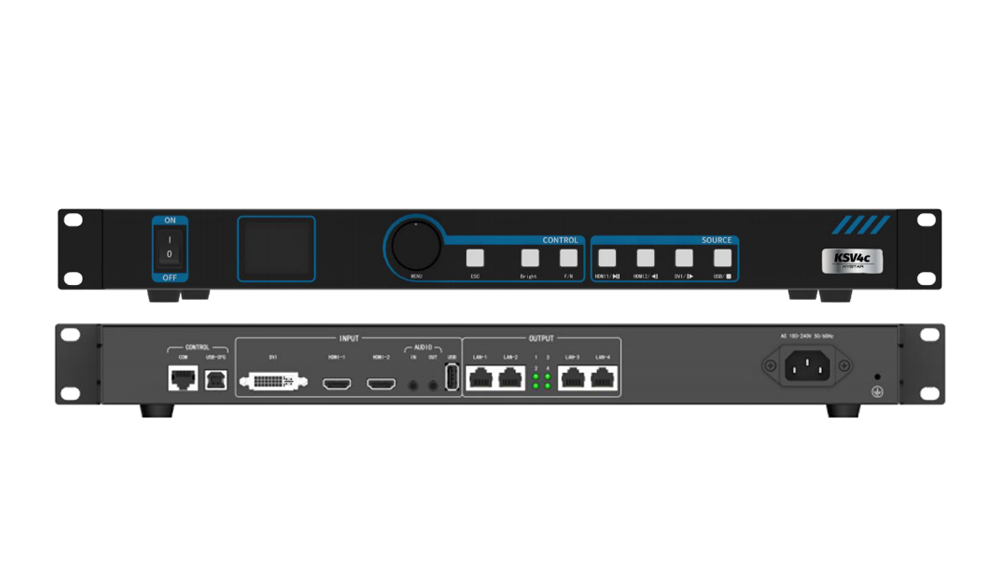
Kystar KSV4C: video processor, LED sender and USB player
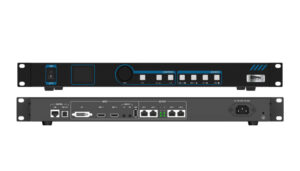
The Kystar KSV4C is a 3-in-1 LED display video controller that integrates live video processing, LED sending and offline USB playback. It has four Gigabit Ethernet outputs with a maximum load of 2.6 million LED pixels. Two HDMI 1.3 inputs and one DVI-D input connect external sources, while a USB port provides playback from a storage drive.
This combination suits an LED display used for both live presentations and prepared media. It consolidates source processing and sending into one device while retaining screen-setup tools such as EDID management, cropping and built-in test patterns.
Hardware specifications
| Specification | Details |
|---|---|
| Integrated functions | Video processor, LED sending card and offline USB player |
| LED outputs | 4 Gigabit Ethernet ports |
| Total LED load | Up to 2,600,000 pixels |
| Per-port load | Up to 650,000 pixels at 8-bit output |
| Output width / height limits | Up to 4,096 pixels wide or 2,048 pixels high, subject to pixel-load limits |
| Live inputs | 2 × HDMI 1.3; 1 × DVI-D |
| HDMI / DVI input timing | Up to 2048 × 1152 at 60Hz |
| USB media playback | Videos and images from a USB drive; up to 1920 × 1080 at 60Hz |
| Audio | 3.5mm input and output; 48kHz sampling |
| Control | COM and USB-CFG interfaces |
Live input and offline playback workflows
Use HDMI or DVI for a computer or other compatible live source. Use USB playback when the screen needs locally stored videos or images. The USB playback port and USB-CFG configuration connection have different purposes: the former reads a media drive, while the latter connects a PC for device control.
- Fit the incoming image: manage EDID and crop unwanted borders or source regions.
- Check the LED display: use solid-color, gradient and scanning-line patterns during setup.
- Control operation: freeze the displayed image, lock the keys, and adjust brightness and contrast.
- Plan cable mapping: use the supported flexible routing while keeping each output within its capacity.
Capacity and compatibility checks
A 1920 × 1080 LED canvas contains 2,073,600 pixels, below the KSV4C total limit. This arithmetic is a capacity example; cabinet layout and receiving-card mapping must still satisfy the 650,000-pixel limit per port at 8-bit output. Maximum width and height are separate constraints, and do not describe a 4096 × 2048 screen that can be fully loaded.
The documented HDMI and DVI inputs reach 2048 × 1152 at 60Hz. The KSV4C specification does not list a 3840 × 2160 input. USB playback supports up to 1920 × 1080 at 60Hz; select media with compatible encoding and drive format, and confirm the supported file details for the supplied firmware before deployment.
Verify the receiving-card model, firmware, cabinet arrangement and source timings before ordering. The retained document shows Ethernet outputs, so confirm the actual hardware revision before specifying fiber accessories. For a controller with documented HDMI 1.4 input and a larger LED budget, compare the Kystar KSV6C; its functions and capacity should be assessed separately.
Frequently asked questions
What does 3-in-1 mean for KSV4C?
It combines video processing, LED sending and offline USB media playback in one controller. The LED screen still requires a compatible receiving-card system.
Can KSV4C play content without a connected computer?
Yes. Its USB playback function reads supported videos and images from a USB drive. The format, codec and resolution must match the device’s playback requirements.
Is KSV4C a 4K input controller?
The model-specific specification lists HDMI/DVI input up to 2048 × 1152 at 60Hz and USB playback up to 1920 × 1080 at 60Hz. A full 4K input is not listed.
Conclusion
KSV4C provides four-port LED sending, live digital inputs and USB offline playback for a display within the 2.6-million-pixel budget. Choose it by the media workflow and input limits, then confirm the receiving system and cable mapping. Consult the official Kystar controller series and preserved exact-model specification below.