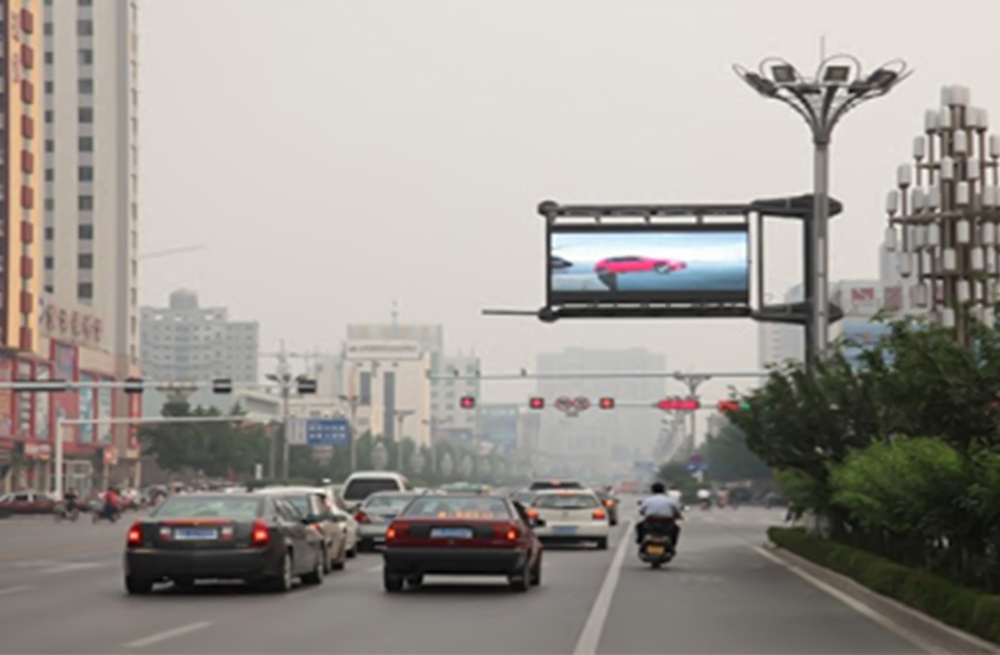
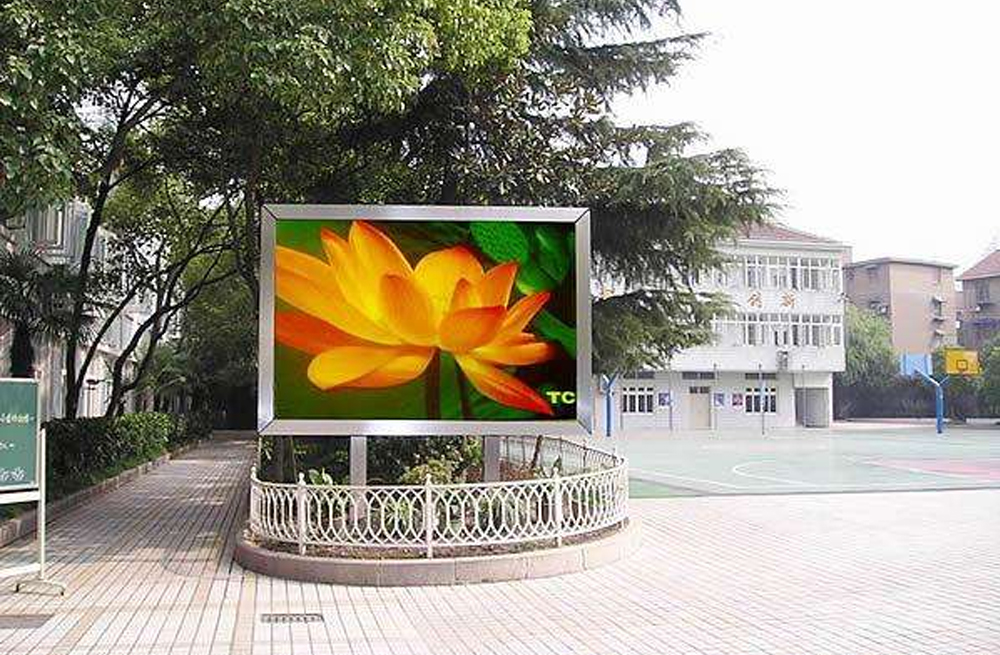
An outdoor LED display board is a weather-resistant digital screen built from modular LED panels. It presents bright, changeable text, images, and video in locations where conventional printed signs or indoor displays may be difficult to see. Businesses, transport operators, stadiums, schools, hospitals, and public agencies use outdoor LED boards for advertising, wayfinding, live information, and emergency messages.
This guide explains how an outdoor LED display board works, its main benefits and applications, and the specifications you should compare before buying one.
What Is an Outdoor LED Display Board?
An outdoor LED display board, also called an outdoor LED board or outdoor digital display board, uses many light-emitting diodes to create a large, self-illuminated image. The LEDs are mounted on modules; multiple modules form cabinets, and multiple cabinets form the complete screen.
Unlike a printed billboard, the content can be updated remotely and scheduled by time, date, or audience. Unlike a typical indoor television or LCD screen, a purpose-built outdoor display uses higher brightness, weather-resistant cabinets, thermal management, and components designed for longer viewing distances.
How Does an Outdoor LED Board Work?
A complete system combines the display hardware with control and power components:
- LED modules create the pixels and determine pixel pitch, resolution, and viewing distance.
- Cabinets and masks align the modules, protect the electronics, and reduce reflections.
- Power supplies convert incoming AC power to the low-voltage DC power required by the modules.
- Sending and receiving cards distribute image data across the screen. See our LED receiving cards and related control components.
- A controller or video processor scales and routes content from a media player, computer, camera, or other source. Compare available LED video processors.
- Software and connectivity allow local or remote content publishing, monitoring, scheduling, and diagnostics.
The control system maps each part of the image to the correct pixels. Because the LEDs emit their own light, the screen can remain visible in daylight when brightness and contrast are correctly specified.
Benefits of Outdoor LED Display Boards
- High visibility: Outdoor LED displays can deliver the brightness and contrast needed for daylight viewing and long-distance communication.
- Flexible content: Operators can replace a message in minutes, schedule campaigns, show real-time data, or divide the screen into multiple content zones.
- Motion and color: Video, animation, and vivid graphics attract more attention than a static sign when used with clear creative design.
- Efficient use of one location: A single board can rotate several messages instead of requiring separate printed installations.
- Modular service: Technicians can often replace an individual module, power supply, or receiving card instead of replacing the entire display.
- Long service potential: Correct brightness management, ventilation, waterproofing, and preventive maintenance help an outdoor LED board operate reliably for years.
Actual energy use and lifetime depend on screen area, average brightness, content, ambient temperature, power design, and operating hours. Ask suppliers for maximum and typical power consumption rather than relying on one headline figure.
Common Uses
- Retail and roadside advertising: Promotions, brand campaigns, store directions, and time-sensitive offers.
- Stadiums and events: Live video, scores, replays, sponsor content, and audience information.
- Transport: Arrival times, route changes, platform information, traffic guidance, and safety alerts.
- Corporate and public spaces: Announcements, visitor guidance, public-service messages, and emergency communication.
- Schools, hospitals, and campuses: Schedules, notices, wayfinding, and operational updates.
- Building facades and landmarks: Large-format media displays and architectural communication.
Outdoor LED Board vs. Other Display Options
| Option | Best for | Main strength | Main limitation |
|---|---|---|---|
| Outdoor LED display board | Large, bright, frequently updated content | Daylight visibility, scale, and dynamic media | Higher initial cost and technical installation |
| Printed billboard | Long-running static campaigns | Simple operation and low power use | Each content change requires printing and installation |
| Outdoor LCD | Close viewing and smaller enclosures | Fine detail at short distance | Size, heat, brightness, and bezel constraints |
| Projection | Temporary nighttime events | Flexible image size | Ambient light and weather can reduce visibility |
Key Specifications to Compare
| Specification | What it means | Buying guidance |
|---|---|---|
| Pixel pitch | Distance in millimeters between adjacent pixels | Smaller pitch provides more detail at a shorter viewing distance but usually costs more. As a practical starting point, a P6 display is often considered from about 6 m away, while P10 suits longer-distance viewing; confirm with a viewing test. |
| Brightness | Light output measured in nits (cd/m²) | Full-sun locations commonly require about 5,000-8,000 nits. Higher is not automatically better: use automatic brightness control to protect image quality, power use, and nighttime comfort. |
| Ingress protection | Resistance to dust and water | For an exposed outdoor screen, the front is commonly specified at IP65 or higher. Rear protection depends on the cabinet design and installation. Verify the rating of the complete enclosure and the test standard, not only one module. |
| Refresh rate | How often the image is redrawn | A higher refresh rate reduces visible scan lines and flicker on camera. For broadcast or frequent filming, 3,840 Hz is a common target; confirm performance with the intended camera settings. |
| Viewing angle | Range over which the image remains readable | Match horizontal and vertical viewing angles to traffic direction, mounting height, and audience position. |
| Power consumption | Maximum and average electrical demand | Use both figures to size circuits, cooling, backup power, and operating budgets. Review our LED power supply options when planning replacements or system parts. |
| Service access | Whether components are maintained from the front or rear | Front service helps when there is little space behind a wall-mounted screen; rear service can be convenient where a maintenance corridor is available. |
| Control system | Hardware and software that process and distribute content | Confirm supported resolution, input formats, redundancy, remote monitoring, scheduling, and compatibility with spare parts. |
IP codes are defined by IEC 60529. The International Electrotechnical Commission’s IP rating overview explains what the two digits represent.
How to Choose the Right Outdoor LED Display Board
- Define the communication goal. Decide whether the screen will show advertising, live video, text alerts, scores, or a mixture of formats.
- Measure the viewing conditions. Record the nearest and typical viewing distances, traffic speed, viewing angles, ambient light, and permitted screen size.
- Choose pixel pitch by real viewing distance. Do not pay for a finer pitch than the audience can see, but avoid a pitch that makes text and logos look coarse.
- Confirm environmental requirements. Consider rain, dust, salt air, wind, temperature range, direct sun, drainage, ventilation, lightning protection, and structural loading.
- Calculate content resolution. Cabinet dimensions, pixel pitch, and total screen size determine the native pixel canvas. Prepare content for that exact resolution.
- Plan control and redundancy. Confirm video inputs, remote publishing, sensors, monitoring, spare receiving cards, backup data paths, and power redundancy where downtime is costly.
- Compare total cost of ownership. Include structure, installation, electrical work, permits, connectivity, maintenance access, spare modules, power consumption, and warranty support.
Installation and Maintenance Checklist
- Use a qualified structural and electrical team and follow local permits, wind-load rules, grounding, and electrical codes.
- Provide drainage, ventilation, heat management, surge protection, and safe maintenance access.
- Calibrate brightness and color across cabinets; enable a light sensor or brightness schedule where appropriate.
- Keep matching spare modules, receiving cards, power supplies, and cables from the same production batch when possible.
- Inspect seals, fans, filters, fasteners, cables, and cabinet interiors on a documented schedule.
- Monitor temperature, voltage, communication status, and pixel faults so small issues can be corrected early.
Frequently Asked Questions
What is the difference between an outdoor LED board and an indoor LED display?
An outdoor LED board normally requires higher brightness, stronger weather protection, more robust cabinets, and environmental controls. Indoor displays often prioritize finer pixel pitch and close viewing. An indoor panel should not be installed outdoors unless the complete system is specifically engineered and certified for that environment.
Which pixel pitch is best for an outdoor LED display board?
The best pitch depends mainly on the closest important viewing distance and the detail in the content. P4-P6 can suit closer viewing, while P8-P10 and larger pitches often suit longer-distance roadside or building applications. Request a sample or viewing demonstration before final approval.
How bright should an outdoor LED board be?
Many full-sun applications use approximately 5,000-8,000 nits, but orientation, shade, local rules, and operating hours matter. Automatic brightness adjustment is important because a screen that is suitable at noon may be uncomfortably bright at night.
What IP rating is recommended for an outdoor LED sign board?
IP65 on the exposed front is a common baseline because it indicates dust-tight construction and protection against water jets. The required rear rating varies by cabinet and shelter. Always verify the rating of the installed enclosure, connectors, cable entries, and ventilation design.
Can content be updated remotely?
Yes. With a compatible asynchronous controller, media player, software platform, and network connection, operators can schedule and update content remotely. Confirm user permissions, offline playback, monitoring, and recovery behavior before deployment.
How long does an outdoor LED display last?
Manufacturers often publish LED lifetime estimates, but useful screen life depends on brightness settings, heat, humidity, power quality, maintenance, and the definition used for end of life. Ask for brightness-depreciation criteria, warranty terms, and a spare-parts plan instead of relying on a single lifetime number.
Final Buying Advice
The best outdoor LED display board is not simply the brightest screen or the model with the smallest pixel pitch. It is the system that matches the real viewing distance, environment, content, control workflow, maintenance access, and operating budget.
Explore our outdoor LED display screens and compatible components. For help matching an outdoor LED board with a controller, processor, receiving card, or power supply, contact our team with your screen dimensions, pixel pitch, cabinet layout, input sources, and installation conditions.