Quick answer: The NovaStar VX400, NovaStar H2, and NovaStar VX4S serve different LED display requirements. The VX400 is a compact all-in-one controller for screens up to 2.6 million pixels, the H2 is a modular video wall splicer and LED control platform for larger multi-screen systems, and the VX4S is a legacy all-in-one controller with broad input support and a 2.3-million-pixel capacity. They are alternatives for different project scales, not three devices that every LED system needs.
This comparison explains the role, capacity, inputs, best applications, and current availability of each model so integrators, rental teams, and buyers can choose the right NovaStar LED video controller.
NovaStar VX400 vs H2 vs VX4S at a Glance
| Model | Device type | Maximum LED capacity | Best suited to | Product status |
|---|---|---|---|---|
| NovaStar VX400 | All-in-one video controller | 2.6 million pixels; 4 Gigabit Ethernet outputs | Compact fixed installations, events, and single-screen systems | Discontinued; VX400 Pro is the recommended successor |
| NovaStar H2 | Modular video splicer and LED control platform | Up to 20.8 million pixels with the specified H-Series sending-card configuration | Control rooms, fine-pitch LED walls, multi-screen systems, and large installations | Configurable H-Series platform |
| NovaStar VX4S | All-in-one video controller | 2.3 million pixels | Legacy rental, stage, broadcast, and fixed-installation systems | Discontinued |
Important: H2 capacity and connector counts depend on the installed input and output cards. Always confirm the exact card configuration, firmware, receiving cards, screen resolution, and redundancy requirements before ordering.
What Is the Main Difference?
The main difference is system scale and architecture. The VX400 and VX4S combine video processing and LED sending functions in a compact chassis. The H2 uses a modular, card-based design that can be configured for more inputs, more outputs, larger pixel loads, and multi-screen management.
- Choose the VX400 when a compact controller with modern digital inputs, two layers, fiber connectivity, and up to 2.6 million pixels fits the project.
- Choose the H2 when the project needs modular I/O, 4K workflows, multiple screens, hot-swappable cards, centralized control, or substantially higher capacity.
- Keep or replace a VX4S based on system compatibility. It remains useful in existing systems that depend on VGA, CVBS, DVI, HDMI, DisplayPort, or SDI sources, but it is no longer in production.
Related comparison: choosing between the two VX entry models instead? See NovaStar VX400 vs VX400 Pro: Key Differences for the full specification breakdown.
NovaStar VX400: Compact All-in-One LED Control
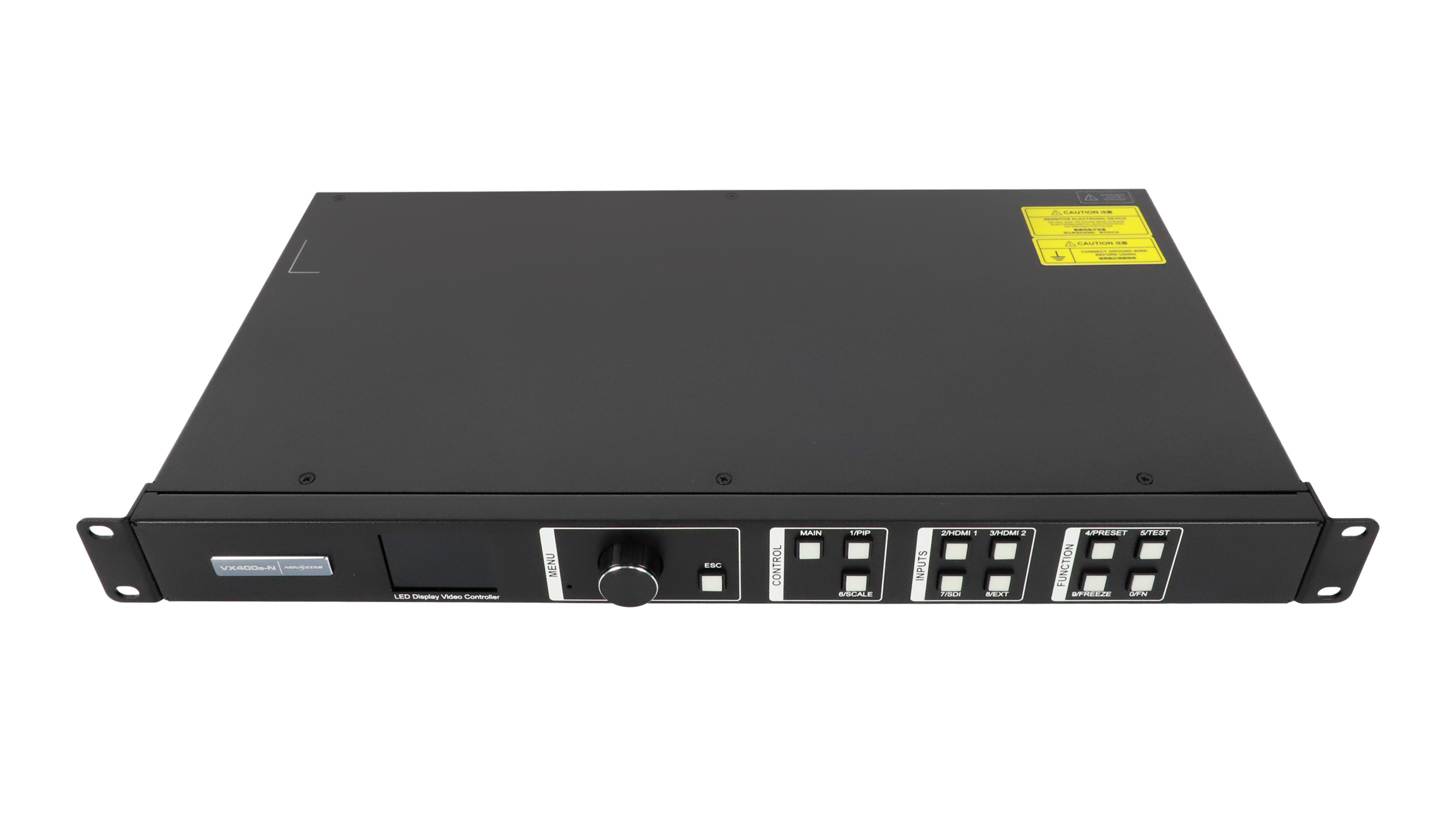
The NovaStar VX400 combines video processing and LED display control in one unit. It is designed for projects that need a compact controller without a separate external video processor.
Key VX400 Specifications
- Input connections: two HDMI 1.3 inputs, including one HDMI input with loop-through; one DVI input with loop-through; one 3G-SDI input with loop-through; and one self-adaptive optical port.
- LED outputs: four Gigabit Ethernet ports and two fiber outputs.
- Loading capacity: up to 2.6 million pixels, with a maximum width of 10,240 pixels or maximum height of 8,192 pixels.
- Video composition: two layers with adjustable size, position, and priority.
- Monitoring: one HDMI 1.3 output for monitoring or video output.
- Low latency: delay can be reduced to 20 lines when both low-latency mode and bypass mode are enabled.
- Synchronization: an internal input source can be used as the sync source across cascaded units.
When Is the VX400 the Right Choice?
The VX400 fits small and medium LED screens where four Ethernet outputs provide enough capacity. Typical uses include conference rooms, retail displays, houses of worship, exhibition booths, and event screens. Its layer control and loop-through connections are useful when operators need picture-in-picture layouts or signal distribution without a larger modular system.
The VX400 is no longer in production. For a new project, compare the required ports and pixel load with the NovaStar VX400 Pro rather than specifying an unavailable legacy model.
NovaStar H2: Modular Video Splicing for Large LED Walls
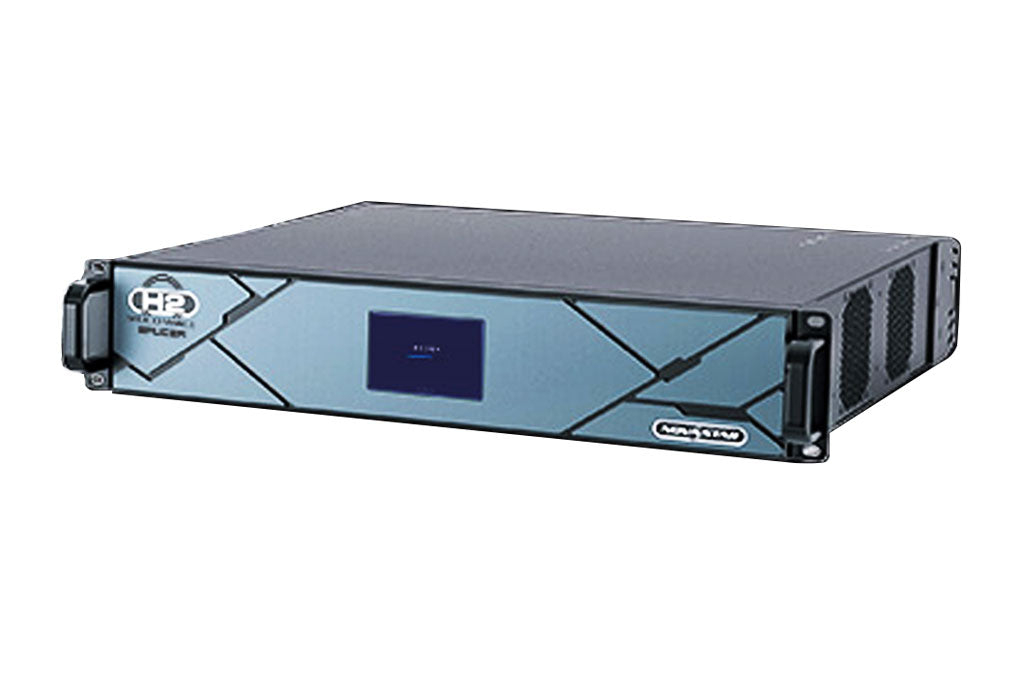
The NovaStar H2 is not a receiving card. It is the two-rack-unit model in the NovaStar H-Series modular video splicer family. It can operate as an integrated video processing and LED control system or as a dedicated video splicer, depending on the cards installed.
Key H2 Specifications and Capabilities
- Modular architecture: input and output cards can be selected for the project and are hot-swappable without stopping unaffected cards.
- Maximum channels: the H2 platform supports up to 16 input channels and up to 8 output channels, depending on card selection.
- Maximum LED load: up to 20.8 million pixels with the specified H_16xRJ45 + 2xFiber sending-card configuration.
- Flexible sources: card options support common HDMI, DVI, DisplayPort, and IP inputs.
- High-resolution workflow: support for 4K video input and output and 10-bit source processing.
- Multi-screen control: independent output resolutions, irregular rectangular layouts, source naming, EDID management, background and OSD settings, and input preview.
- Synchronized output: frame synchronization keeps output images aligned to reduce tearing, dropped frames, and visible joins across a large canvas.
- Operations and resilience: browser-based multi-user control, online firmware updates, input/output status monitoring, fiber transmission, and a dual-power backup design.
When Is the H2 the Right Choice?
Choose the H2 for a fine-pitch LED wall, command center, broadcast control room, virtual production environment, enterprise lobby, or other project that exceeds the capacity or I/O flexibility of a compact controller. It is also the stronger choice when the system requires multiple canvases, many sources, long-distance fiber links, serviceable I/O cards, or redundancy.
Because the H2 is configurable, a complete quotation should identify the chassis, every input card, every output or sending card, required fiber modules, backup strategy, and the final LED pixel map. The chassis name alone does not define a complete system.
NovaStar VX4S: A Versatile Legacy LED Controller
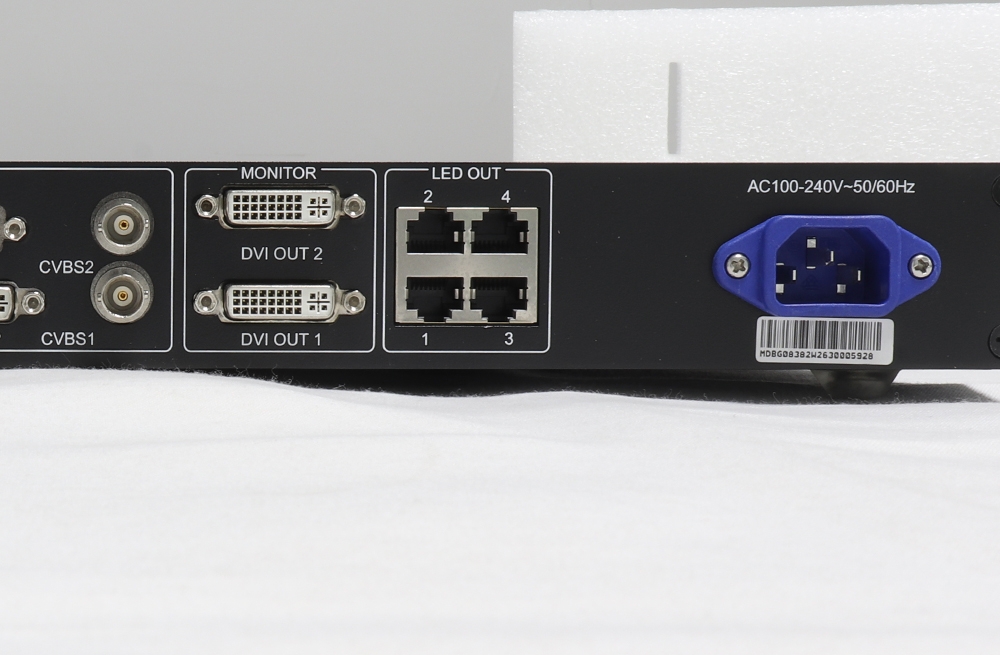
The NovaStar VX4S is an all-in-one LED display controller with integrated scaling, switching, and sending functions. Its wide range of legacy and digital inputs made it a common choice for rental, staging, broadcast, and permanent LED installations.
Key VX4S Specifications and Capabilities
- Inputs: two CVBS, two VGA, one DVI, one HDMI, one DisplayPort, and one SDI input.
- Input resolution: up to 1920 x 1200 at 60 Hz.
- Loading capacity: up to 2.3 million pixels.
- Source presentation: seamless high-speed switching, fade-in/fade-out transitions, and adjustable picture-in-picture size and position.
- Image processing: support for 8-bit and 10-bit sources, white-balance calibration, color-gamut mapping, and NovaStar G4 image processing.
- Operation: front-panel LCD, knob-based control, smart screen configuration, and computer-based system configuration when needed.
- Large-screen expansion: multiple controllers can be combined when one unit cannot cover the required pixel load.
When Does the VX4S Still Make Sense?
The VX4S can still make sense as a like-for-like replacement or spare for an existing system whose source devices and receiving-card configuration are already validated. Its analog inputs are particularly relevant to older AV systems. For a new installation, however, a current NovaStar controller is usually a better long-term choice because the VX4S has been discontinued.
Which NovaStar Controller Should You Choose?
Choose by Screen Resolution and Pixel Load
Calculate the total physical pixel count first: screen width in pixels x screen height in pixels. Add operational margin and verify how the pixels will be distributed across Ethernet or fiber outputs. A controller’s total capacity does not override per-port loading rules or practical cabling limits.
- Up to 2.3 million pixels in an existing VX4S-based system: the VX4S may remain serviceable.
- Up to 2.6 million pixels with four Ethernet outputs and newer digital connectivity: the VX400 architecture is the closer fit, although new projects should evaluate the VX400 Pro.
- Beyond compact-controller capacity, or when many sources and screens are required: configure an H2 or a larger H-Series chassis.
Choose by Input Format
The source list can decide the model before pixel capacity does. The VX4S supports older CVBS and VGA sources. The VX400 focuses on HDMI, DVI, 3G-SDI, and optical connectivity. The H2 supports a broader modular workflow, but the exact interfaces depend on the installed cards.
Choose by Workflow and Reliability
For simple single-screen playback, an all-in-one controller is easier to deploy. For control rooms and multi-screen environments, the H2 provides the modularity, synchronized outputs, monitoring, and redundancy options that complex systems need. Rental teams should also consider setup time, spare-unit availability, familiar operator workflows, and the cost of migrating saved configurations.
Do the VX400, H2, and VX4S Work Together?
They can be integrated into a broader AV system when a design specifically requires it, but they are not normally installed as a three-device signal chain. The VX400 and VX4S already combine processing and LED sending functions. The H2 can perform large-scale splicing and, with the appropriate output cards, LED control. In most projects, the engineering task is to select the right primary architecture and design backup paths, not to stack all three products.
Procurement Checklist
Before selecting an LED video controller, document the following:
- Total canvas resolution and the pixel dimensions of each screen.
- Required source types, resolutions, frame rates, bit depth, and HDCP behavior.
- Number of independent screens, windows, layers, and presets.
- Maximum cable distance and whether fiber transmission is required.
- Receiving-card model, NovaLCT compatibility, and approved firmware versions.
- Latency, synchronization, genlock, or camera-shooting requirements.
- Primary and backup signal paths, power redundancy, and spare hardware.
- Current product availability and an upgrade path for discontinued equipment.
Frequently Asked Questions
Is the NovaStar H2 a receiving card?
No. The H2 is a modular video wall splicer and LED control platform. Receiving cards are installed inside LED cabinets and perform a different function.
Which model supports the largest LED screen?
The H2 supports the highest total capacity in this comparison. With the specified H-Series sending-card configuration, it can load up to 20.8 million pixels. Actual capacity depends on the installed cards and output design.
What is the pixel capacity of the NovaStar VX400?
The VX400 can drive up to 2.6 million pixels through four Gigabit Ethernet outputs, with a maximum width of 10,240 pixels or a maximum height of 8,192 pixels.
What is the pixel capacity of the NovaStar VX4S?
The VX4S supports up to 2.3 million pixels. Multi-controller systems can cover larger canvases, but synchronization, cabling, and configuration must be engineered correctly.
Are the NovaStar VX400 and VX4S still in production?
No. Both product pages identify these models as discontinued. The VX400 Pro is the recommended successor to the VX400. A replacement for a VX4S should be selected by matching the required inputs, pixel load, receiving-card compatibility, and workflow.
Which model is best for a control room?
The H2 is generally the best fit because its modular I/O, multi-screen management, synchronized outputs, monitoring, and redundancy options are designed for larger and more complex environments.
Conclusion
The best choice depends on scale, source formats, and lifecycle requirements. The NovaStar VX400 is a compact 2.6-million-pixel all-in-one design, the NovaStar H2 is a modular platform for larger and more demanding video walls, and the NovaStar VX4S is a versatile but discontinued 2.3-million-pixel controller for legacy systems. For new projects, prioritize a current model that meets the required pixel load and connectors; for existing systems, verify compatibility before replacing any controller.
Browse more LED video processors, or contact our team with your screen resolution, source list, and system diagram for a configuration check.