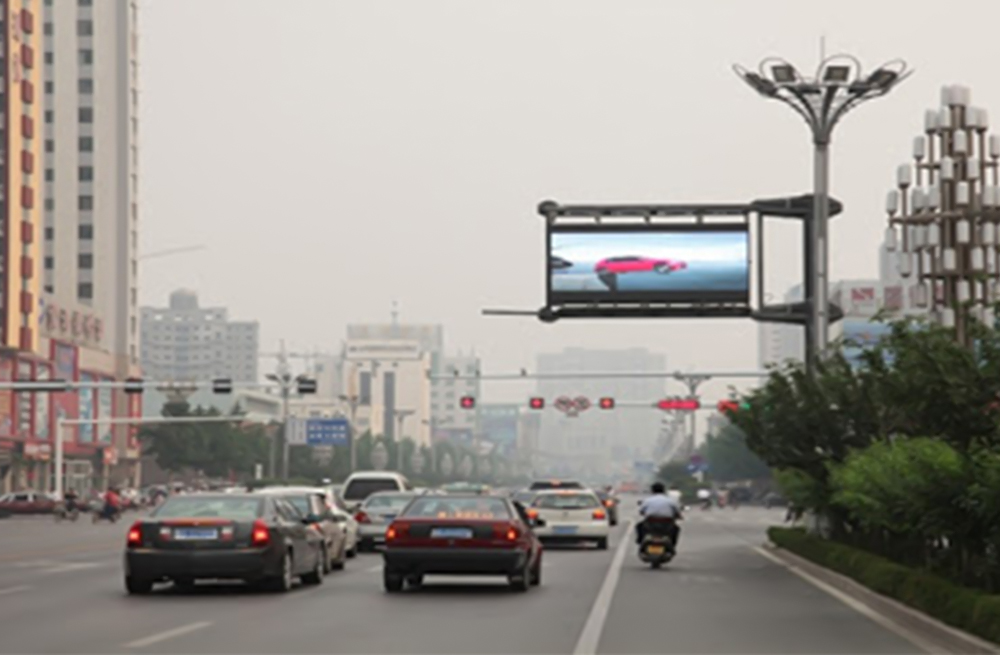
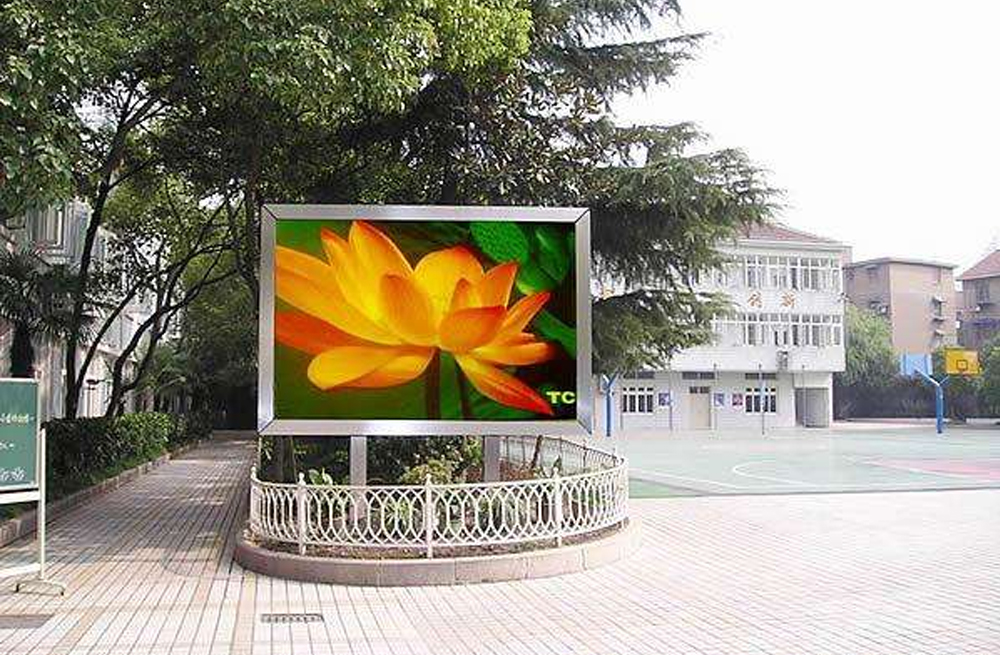
TCC160 4K decoding describes the controller’s ability to process supported video files. It does not mean that one TCC160 can drive an LED screen with a 4K pixel matrix. NovaStar’s archived specification separates media decoding from LED loading capacity, and the output limits depend on the driver IC and connection arrangement.
For a distributor checking a customer’s small signage order, keep the source-video dimensions and the physical LED pixel matrix in separate quotation fields. The first tells you about the content to decode; the second tells you what the controller must drive. Confusing them can produce a convincing product description and an unsuitable parts list.
What TCC160 4K decoding actually describes
A decoder reads a supported compressed media stream and produces pictures for the playback system. The LED output then presents the required image on the configured screen. These are different tasks, with different limits. A larger source file does not add physical pixels to the LED modules or increase the controller’s documented output capacity.
The technical basis here is NovaStar’s TCC160 Asynchronous Full-Color LED Display Control Card Specifications, version V1.0.1, dated September 4, 2024. Its performance section describes hardware decoding and alternative video-playback workloads. Its inputs-and-outputs section gives separate pixel-capacity and dimensional conditions. Read both sections when assessing the customer’s request.
TCC160 4K decoding can therefore be relevant when a customer supplies a high-resolution media file for a smaller sign. However, the file still has to meet the documented decoding conditions, and the screen layout must fit the output requirements. Accepting the file and displaying its intended content correctly are two observations to record separately.
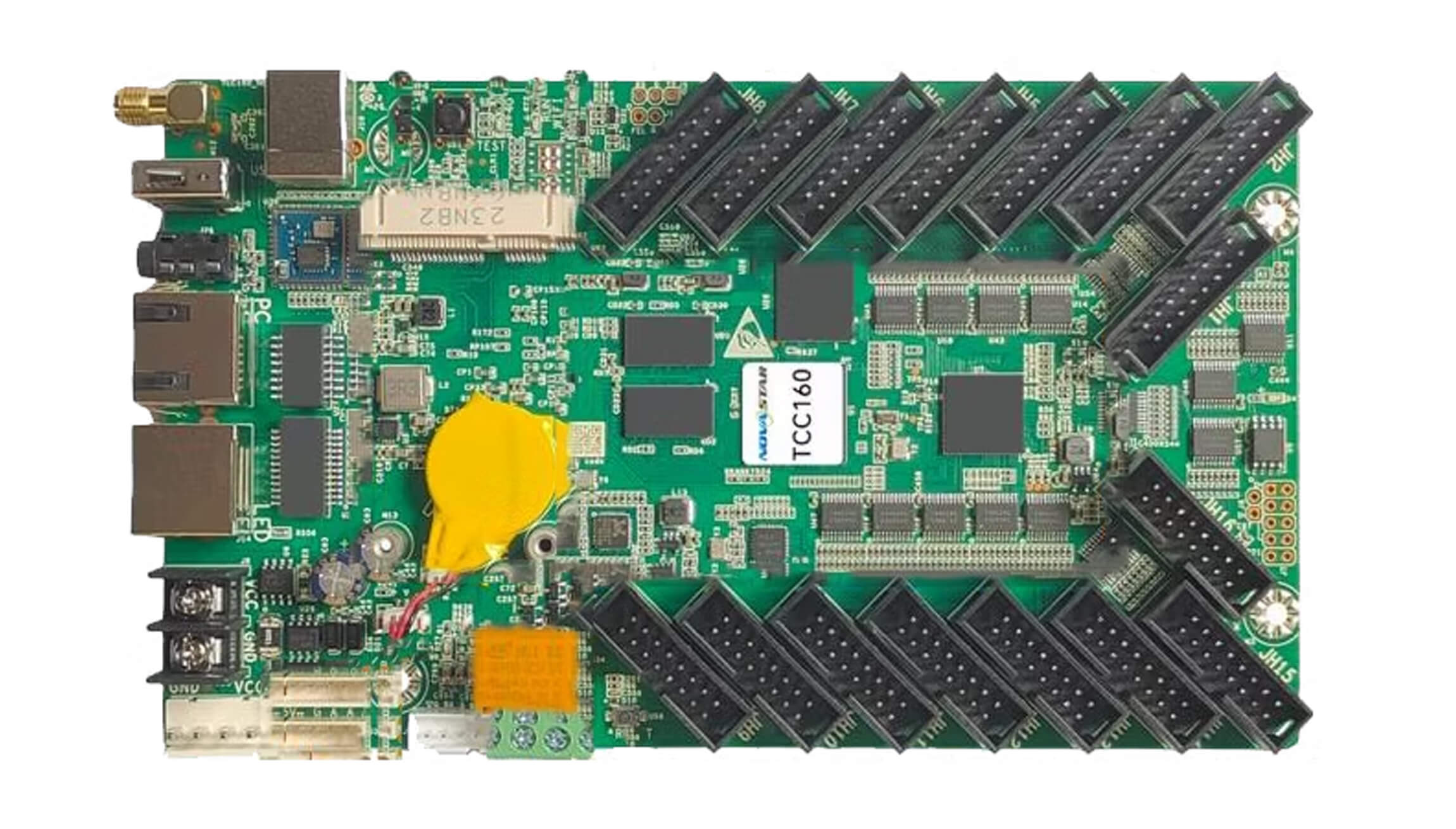
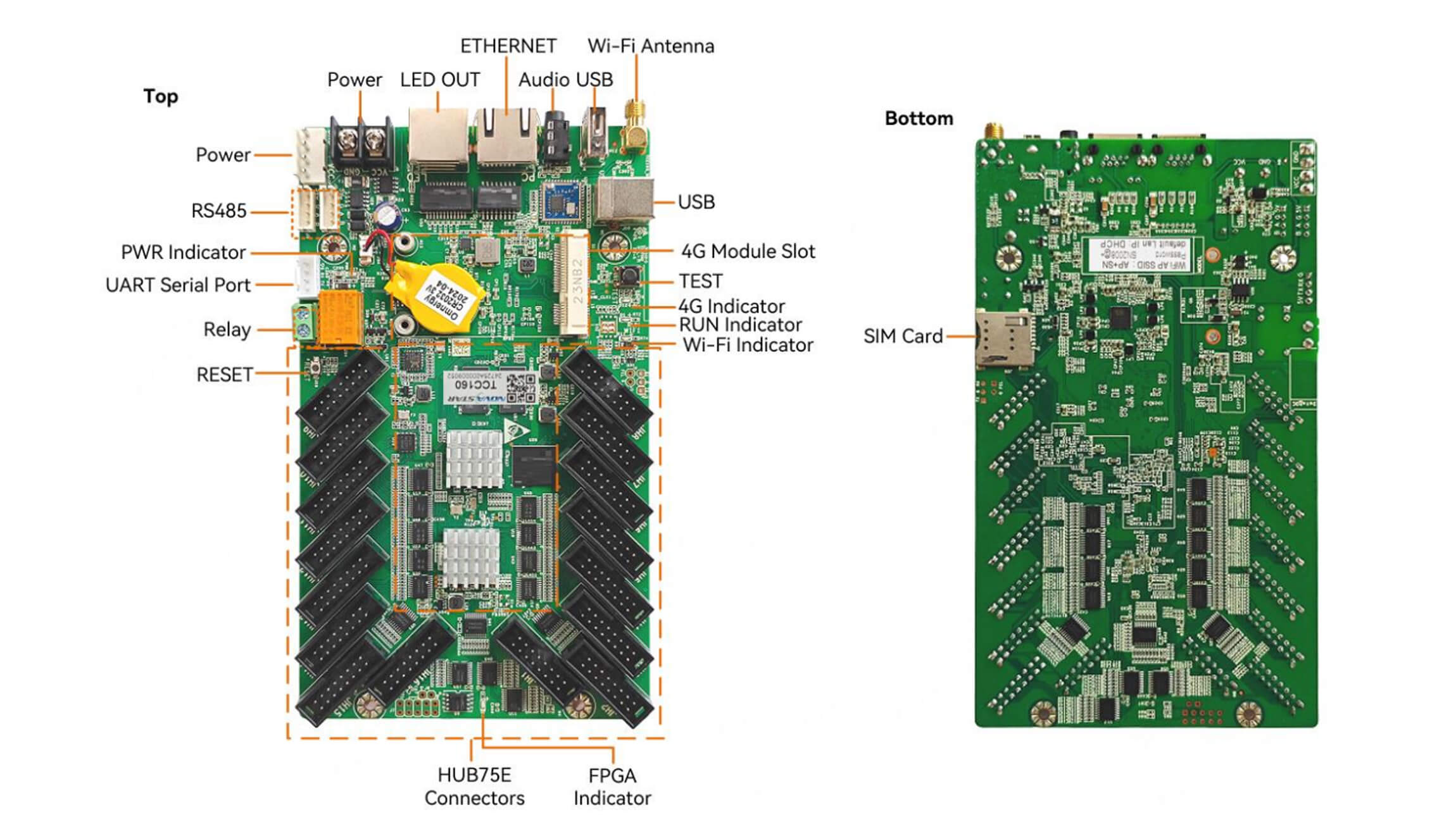
The TCC160 product page identifies an integrated asynchronous controller with local HUB75E connections. Use its model identification and the matching technical document as the starting point for a quotation, rather than transferring the limits from another player in the same product family.
Compare two pixel counts before quoting
As an arithmetic example, a UHD source measuring 3840 × 2160 contains 8,294,400 pixels per frame. That calculation describes the source picture. It does not establish an LED output capacity for this card, even if the file is otherwise compatible with TCC160 4K decoding.
Now consider a hypothetical LED sign measuring 768 × 256 pixels. Its physical matrix contains 196,608 pixels. That number is below the specification’s stated 260,000-pixel condition for the ordinary maximum-width-or-height case, and both dimensions are below 2048. These arithmetic checks alone do not approve the sign: the driver IC, scan configuration, connections and applicable loading conditions still need confirmation.
This distinction also affects content design. A source prepared for a wide screen may contain text that becomes too small when fitted to a lower-resolution sign. Ask the customer which text and details must remain legible. Then assess the layout at the actual LED pixel matrix, rather than approving it solely because a high-resolution master file opens successfully.
TCC160 4K decoding should appear in the media requirements section of the quote. Put the confirmed LED matrix, module arrangement and receiving arrangement in the output section. If the customer’s specification says only “4K screen,” clarify whether they mean the supplied video, the physical display resolution or a marketing description before selecting hardware.
Why the headline output figures need conditions
The archived specification contains several output statements. It lists 512 × 512 at 60 Hz for PWM driver ICs and 512 × 384 at 60 Hz for general driver ICs. It separately states a maximum width or height of 2048 pixels with capacity not exceeding 260,000 pixels. Those statements should remain attached to their stated conditions.
There is an arithmetic difference to resolve near the limit: 512 × 512 equals 262,144, which is slightly above 260,000. Do not silently round the rectangle down or use it to waive the separately stated condition. For a design close to these figures, ask the supplier for written confirmation against the actual driver IC, firmware and configuration. This article does not resolve that document ambiguity on the manufacturer’s behalf.
The same document describes cascaded and ultra-long-screen arrangements with different limits. Those are configuration-specific statements, not extra capacity to add to every standalone card. A quotation needs to identify which arrangement it proposes and the hardware required for that arrangement. TCC160 4K decoding remains a separate media characteristic throughout that discussion.
A quotation record that separates the decisions
Use the following record when a customer combines a high-resolution content requirement with a small LED sign. Each row answers a different question. A complete answer in one row does not substitute for the others.
| Decision | Information to record | Reason for keeping it separate |
|---|---|---|
| Source media | Frame dimensions, codec, frame rate, bitrate and intended simultaneous videos | A supported source resolution does not prove every media export is compatible |
| Physical LED matrix | Module pixel dimensions, module count across and down, and total screen pixels | Cabinet size in millimeters does not directly state the pixel matrix |
| Output arrangement | Direct HUB75E connection or the specified cascaded arrangement, with driver IC details | Capacity statements depend on the applicable configuration |
| Acceptance material | Exact media sample, screen layout and expected legibility | A generic demonstration video may omit the customer’s difficult content |
For a repeat order, preserve the approved record with the original sample file. When the customer later changes the video export or adds another playback window, compare the new requirement with that record. This makes it possible to identify what changed without claiming that the new combination was covered by the earlier acceptance.
If the requested LED matrix exceeds the confirmed arrangement, investigate a suitable control system through the store’s asynchronous LED controller category. Evaluate the replacement against its own output and decoding limits. A higher number in a product name or a newer advertisement is not evidence of a particular configuration’s capacity.
Multiple videos change TCC160 4K decoding requirements
TCC160 4K decoding is part of a shared playback workload. The V1.0.1 specification describes alternative workloads such as one 4K video or several videos at lower resolutions. These alternatives are not a shopping list of workloads to add together. If the layout contains multiple independently decoded files, submit the complete layout for review.
The specification also states that enabling synchronous playback halves decoding capability. For a synchronized installation, do not copy an unsynchronized headline workload into the acceptance requirement. Ask the supplier to confirm the proposed files and layout with the intended synchronization mode enabled. Avoid converting the statement into an undocumented number of 4K streams.
TCC160 4K decoding also says nothing by itself about live HDMI input. This asynchronous controller’s file-playback ability should not be presented as evidence of a live-video connector or a guaranteed live-production delay. If the customer needs cameras or a presenter’s computer on screen, describe that input requirement explicitly and review the proposed signal path.
Frequently asked questions
Does 32 GB of internal storage determine LED pixel capacity?
No. Storage describes space for software and media, while loading capacity describes the LED output. A larger stored file or more available storage does not increase the physical matrix that a confirmed control arrangement can drive.
Does having sixteen HUB75E connectors multiply the published capacity sixteen times?
No. Connector count is not an independent capacity multiplier. The outputs form part of the controller’s specified arrangement. Confirm how the actual modules connect and how the applicable total load is distributed before approving the parts list.
Can a still-image specification replace the video decoding check?
No. Still-image formats and compressed video streams have different requirements. An image opening at a particular resolution does not establish a video’s supported codec, frame rate or simultaneous playback workload. Review the actual media type the customer will use.
Clarify the source and the screen in one inquiry
To review TCC160 4K decoding for an order, provide the source video’s export details and the physical LED matrix as separate items. Add module and driver IC identification, the proposed output arrangement, and whether synchronized playback is required. Where the design approaches a published limit, ask for the exact document revision and written configuration confirmation.
Send these details through the EagerLED controller inquiry page. Include a representative content sample when arranging the compatibility review through the agreed channel. A configuration-specific answer gives your sales and installation teams a usable basis for the order, without treating a decoder headline as a promise of a 4K LED canvas.