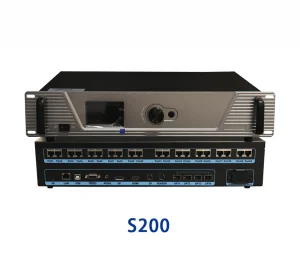
Kystar KSV2C: two-port LED control with USB playback
The Kystar KSV2C combines a video processor, LED sending card and offline media player in one unit. It drives up to 1.3 million LED pixels through two Gigabit Ethernet outputs. Two HDMI 1.3 inputs and one DVI-D input connect live sources, while USB playback supplies supported videos and images from a storage drive.
This Kystar LED controller suits a display whose pixel count and cabinet mapping fit the two-port budget. It is useful where the same screen needs a live computer source for presentations and locally stored media for routine playback.
Verified KSV2C specifications
| Specification | Details |
|---|---|
| Integrated functions | Video processor, LED sender and offline USB player |
| Ethernet outputs | 2 Gigabit ports |
| Total LED capacity | Up to 1,300,000 pixels |
| Per-port capacity | Up to 650,000 pixels at 8-bit output |
| Maximum output dimensions | Width up to 4,096 pixels; height up to 2,048 pixels, within pixel-budget and port limits |
| Live source connections | 2 × HDMI 1.3; 1 × DVI-D |
| HDMI / DVI timing | Up to 2048 × 1152 at 60Hz |
| USB playback | Supported videos and images; up to 1920 × 1080 at 60Hz |
| Audio | 3.5mm audio input and output; 48kHz sampling |
| Configuration interfaces | COM and USB-CFG |
Use live sources or locally stored content
Connect a compatible computer or other digital source to HDMI or DVI for live operation. For offline playback, insert a USB drive containing supported media. The USB media port is distinct from USB-CFG, which connects a PC for configuration. Confirm file encoding, resolution and drive format against the supplied firmware before preparing a playback library.
- EDID setup: read, modify or customize the display information presented to the source.
- Image fitting: crop source regions and remove unwanted borders.
- Display checks: use solid-color, gradient and scanning-line test patterns.
- Operator controls: freeze the image, lock the keys and adjust output brightness and contrast.
- Flexible wiring: configure cable routing while respecting each Ethernet output’s pixel limit.
Input resolution is different from LED output load
The ability to read 1920 × 1080 USB media does not mean KSV2C can drive a native 1920 × 1080 LED screen. Such a screen has 2,073,600 pixels, above this model’s 1.3-million-pixel output capacity. Similarly, the HDMI/DVI source timing is an input specification, not an increase in the LED load.
For a capacity example, a 1600 × 800 LED canvas contains 1,280,000 pixels. Two equal 800 × 800 areas contain 640,000 pixels each, within the stated per-port limit at 8-bit output. Actual feasibility depends on cabinet geometry, receiving-card mapping and output settings. The maximum width and maximum height cannot both be used at once to create a fully loaded maximum-size rectangle.
Check the exact receiving-card model, firmware, source timing and cable layout before ordering. The referenced KSV2C specification shows Ethernet outputs; verify the supplied hardware revision before specifying optical accessories. For more LED output capacity with USB playback, compare the four-port Kystar KSV4C using its own specifications.
Frequently asked questions
What does KSV2C integrate?
Video processing, LED sending and offline USB playback are integrated in one controller. Compatible receiving cards are still needed at the LED display.
Can KSV2C load a full native 1080p LED wall?
No. A 1920 × 1080 LED wall exceeds its 1.3-million-pixel output budget, even though 1080p USB media is supported.
Does KSV2C accept 4K video input?
The model-specific document lists HDMI/DVI input up to 2048 × 1152 at 60Hz. A 3840 × 2160 input is not listed.
Conclusion
Choose KSV2C for a display within the 1.3-million-pixel budget that needs live HDMI/DVI sources and offline USB playback. Plan the screen and both output ports first, then confirm the receiving system and media requirements. See the official Kystar controller series and the preserved KSV2C specification below.