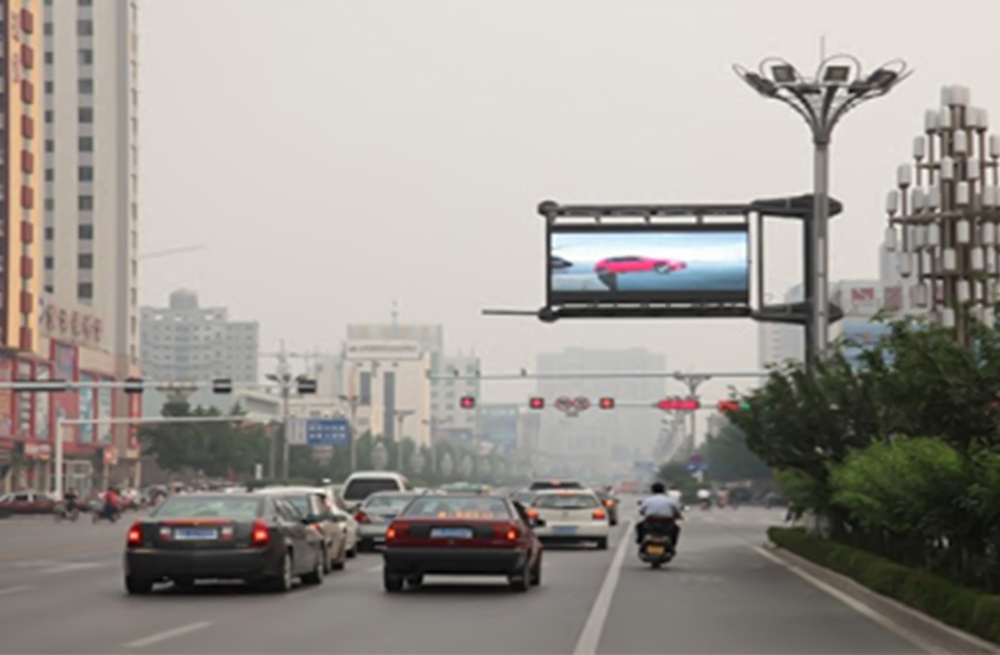
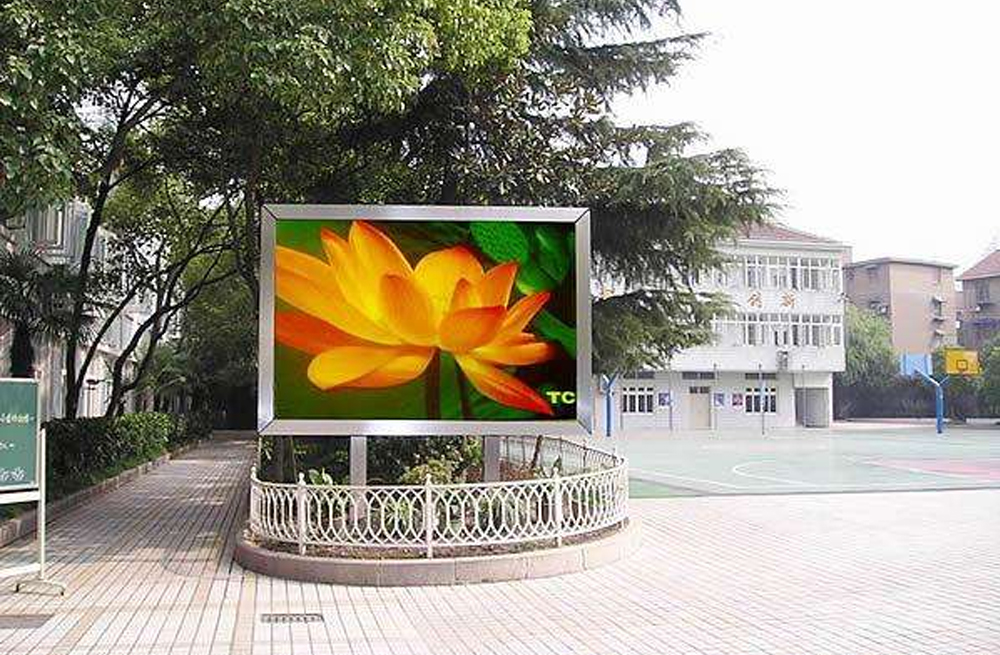
Short answer: Indoor and outdoor LED display screens both deliver bright, dynamic advertising, but they are engineered for different environments. Indoor displays prioritize fine pixel pitch, close viewing, accurate color, and quiet operation. Outdoor displays prioritize high brightness, weather resistance, long-distance visibility, and durable cabinets. The best choice depends on viewing distance, ambient light, installation conditions, content, and total operating cost.
For retailers, event venues, transport hubs, stadiums, and public spaces, LED displays can replace static signs with scheduled video, live information, promotions, and branded content. This guide explains the practical differences between indoor and outdoor LED display screens, the role of the LED control system, and the specifications buyers should compare before choosing a solution.
Indoor vs Outdoor LED Display Screens: Quick Comparison
| Factor | Indoor LED Display | Outdoor LED Display |
|---|---|---|
| Typical use | Retail stores, malls, showrooms, conference rooms, stages, airports | Billboards, building facades, stadiums, roadside signs, public squares |
| Brightness | Often about 600-1,500 nits, depending on ambient light | Often about 4,000-8,000+ nits for daylight visibility |
| Pixel pitch | Usually finer for close viewing, commonly P1.2-P4 | Usually larger for longer viewing distances, commonly P4-P10+ |
| Weather protection | Designed for controlled indoor environments | Sealed against rain and dust; the required IP rating depends on exposure |
| Cabinet priorities | Slim profile, low noise, front service, visual refinement | Structural strength, cooling, drainage, corrosion resistance |
| Content design | Detailed text and high-resolution visuals | Large type, bold contrast, short messages, simple motion |
These ranges are typical planning references, not universal limits. Always confirm the manufacturer’s specifications and local installation requirements for a specific project.
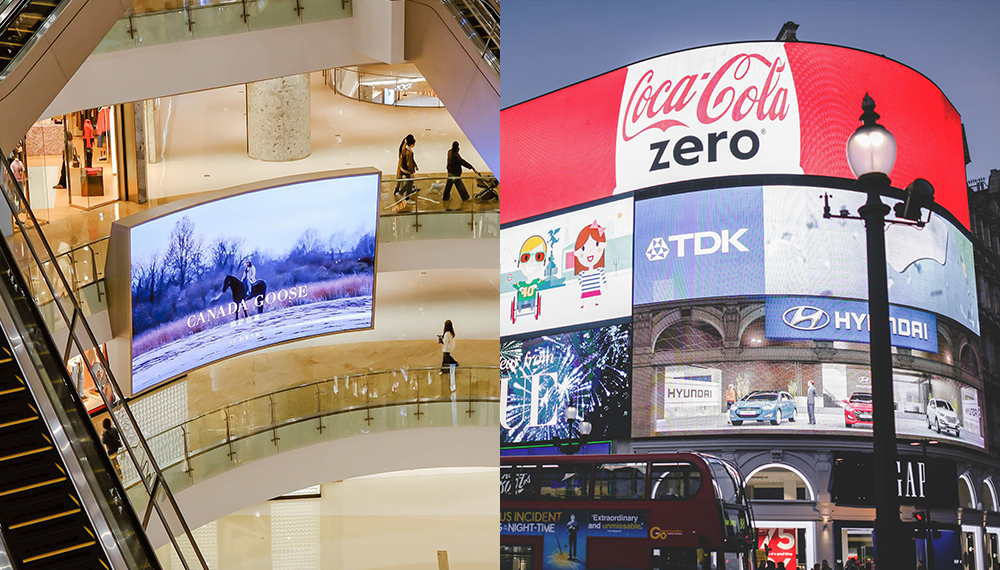
Why LED Display Screens Are Effective for Promotion
An LED display screen is a modular video display made from light-emitting diodes. Multiple LED modules form cabinets, and multiple cabinets form a screen of almost any practical size or aspect ratio. A control system receives the video or data source, processes it, and distributes the correct image information to each section of the display.
Compared with printed signs, an LED screen can change campaigns without replacing physical graphics. Operators can schedule promotions by time of day, update prices or announcements, show live feeds, and reuse the same display for advertising, information, and entertainment. This flexibility is especially valuable where messages change frequently or where several advertisers share one screen.
- High visual impact: Motion, color, and brightness attract attention in busy locations.
- Fast content updates: Campaigns can be changed remotely without printing or installation delays.
- Flexible formats: Modular construction supports conventional screens, ribbons, columns, corners, and custom dimensions.
- Scalable operation: One content workflow can manage a single display or a network of displays.
- Long-term utility: Replaceable modules, power supplies, and control components can simplify maintenance and extend service life.
Indoor LED Displays: Best Uses and Priorities
Indoor LED displays are designed for shorter viewing distances and controlled lighting. They are widely used for retail promotions, digital menus, corporate presentations, exhibition booths, broadcast backgrounds, control rooms, shopping centers, airports, and indoor event stages.
Pixel pitch is often the first indoor specification to compare. Pixel pitch is the center-to-center distance between adjacent pixels, measured in millimeters. A smaller pitch places more pixels in the same area and supports sharper images at close range, but it normally increases cost and processing requirements. Choose the pitch according to the closest realistic viewing distance, not simply the smallest number available.
Indoor buyers should also evaluate:
- Brightness and automatic brightness adjustment for the actual ambient light
- Color uniformity and calibration across replacement modules
- Refresh rate and camera performance when the screen will be filmed
- Viewing angle for people approaching from different directions
- Heat, fan noise, power consumption, and ventilation
- Front-service access when rear maintenance space is limited
- Cabinet depth, weight, mounting method, and structural load
Excessive brightness can make an indoor screen uncomfortable and waste energy. The objective is readable, consistent content that fits the viewing environment, not the highest possible brightness rating.
Outdoor LED Displays: Best Uses and Priorities
Outdoor LED displays are used for roadside advertising, building signs, stadium scoreboards, transport information, public events, commercial plazas, and large-format brand campaigns. They must remain visible in direct sunlight and continue operating through changing weather and temperature conditions.
An outdoor screen therefore needs more than high brightness. Buyers should examine the ingress protection rating for both the front and rear of the cabinet, operating temperature range, drainage, cabinet sealing, corrosion resistance, cooling, surge protection, grounding, and wind-load engineering. An IP rating only describes resistance to dust and water under defined tests; it does not replace correct structural, electrical, and environmental design.
For outdoor advertising, long-distance legibility matters more than fine detail. Large type, strong contrast, short copy, and controlled motion usually communicate more effectively than dense layouts. Automatic brightness sensing can improve visibility during the day while reducing glare and energy use at night.
How to Choose the Right LED Screen for Advertising
- Define the audience and viewing distance. Record the nearest, typical, and farthest viewing positions, as well as how long viewers can see the screen.
- Measure the environment. Consider daylight, indoor lighting, rain, dust, humidity, salt air, heat, cold, wind, and ventilation.
- Choose pixel pitch and resolution together. The physical screen size and pixel pitch determine the native resolution. Confirm that the resulting canvas suits the planned content.
- Match brightness to the site. Specify enough brightness for readable content, plus automatic or scheduled dimming where appropriate.
- Plan maintenance access. Decide whether modules, power supplies, and receiving cards must be serviced from the front or rear.
- Check the control workflow. Identify video inputs, content sources, scaling needs, backup requirements, remote management, and synchronization across screens.
- Calculate total cost of ownership. Include structure, installation, electrical work, power use, cooling, control equipment, spare parts, maintenance, and content production.
For outdoor projects, explore outdoor LED display screen solutions. For a broader comparison of components and formats, browse the LED display parts and equipment catalog.
Why the LED Control System Matters
The LED control system is the signal path between the content source and the LED modules. In a typical synchronous system, a video processor or sending device receives the source, scales or switches it, and transmits data to receiving cards inside the cabinets. The receiving cards map that data to the individual LED modules.
A correctly specified control system helps the screen display the intended resolution, frame rate, color, and brightness. It also affects input compatibility, scaling quality, redundancy, remote monitoring, and the maximum pixel load. Buyers should verify that the controller, receiving cards, firmware, cabinet mapping, and display resolution are compatible before installation.
- Use an asynchronous LED control card for scheduled content that can play without a continuously connected video source.
- Use an LED video processor when the project needs source switching, scaling, cropping, or multi-window layouts.
- Choose compatible LED receiving cards according to cabinet design, pixel load, scan mode, and control-system ecosystem.
- Plan reliable power distribution and keep suitable LED power supplies and critical spare parts available.
Content Tips for Indoor and Outdoor Promotions
Hardware creates the canvas, but content determines whether the promotion is understood. Design every campaign at the screen’s native aspect ratio and test it from the real viewing position. Avoid placing important text near cabinet edges or unusual screen shapes.
For indoor displays, viewers may have time to read product details, prices, directions, or event information. Fine-pitch screens can support more detailed imagery, but layouts should still have a clear hierarchy. For outdoor displays, assume shorter attention spans: lead with one message, use large type, keep high contrast, and limit each scene to the time needed for recognition.
Frequently Asked Questions
What is the main difference between indoor and outdoor LED displays?
The main difference is environmental engineering. Indoor displays are optimized for close viewing and controlled light, while outdoor displays require much higher brightness, weather protection, durable cabinets, and engineering for temperature, moisture, wind, and sunlight.
Can an indoor LED screen be used outdoors?
No, not safely unless it is installed inside a fully engineered outdoor enclosure that provides the required environmental protection. A standard indoor cabinet is not designed for rain, dust, direct sunlight, temperature extremes, or outdoor structural loads.
What pixel pitch is best for an advertising LED screen?
There is no single best pitch. The right value depends on the closest viewing distance, physical screen size, native resolution, content detail, and budget. Indoor displays usually use a finer pitch than outdoor displays because viewers stand closer.
How bright should an outdoor LED display be?
Many outdoor advertising screens are specified around 4,000-8,000 nits or more, but the correct level depends on screen orientation, local sunlight, viewing conditions, and regulations. Automatic brightness control is recommended to maintain visibility by day and reduce glare at night.
What components should be kept as spare parts?
A project-specific spare-parts plan commonly includes matched LED modules, receiving cards, power supplies, cables, and any specialized hub or interface boards. Using compatible batches helps preserve color and electrical consistency during repairs.
Conclusion
Indoor and outdoor LED display screens serve the same communication goal, but they should not be selected by screen size alone. Start with the audience, viewing distance, environment, content, and maintenance plan. Then compare pixel pitch, brightness, resolution, protection, cabinet design, power, and control-system capacity as one complete system. A well-matched specification improves visibility, serviceability, and campaign value throughout the display’s operating life.