An LED light-emitting chip produces the light you see, while an LED driver IC controls the electrical current, timing, and grayscale data that make each pixel display the correct brightness and color. In other words, the LED chip is the light source; the driver IC is the control component. Both are essential, but they are not interchangeable.
The term LED IC can be confusing because people sometimes use it for either component. This guide explains the difference between an LED chip and an LED driver integrated circuit in an LED display or video wall, including their functions, construction, failure symptoms, and selection criteria.
LED Chip vs Driver IC at a Glance
| Feature | LED Light-Emitting Chip | LED Driver IC |
|---|---|---|
| Primary function | Converts electrical energy into visible light | Regulates and switches current to control LEDs |
| Location | Inside each red, green, or blue LED package | Mounted on the LED module PCB |
| Main technology | Compound-semiconductor P-N junction | Silicon integrated circuit with current-control and logic circuitry |
| Main performance impact | Color, brightness, wavelength consistency, efficiency, and lifetime | Grayscale, refresh rate, low-brightness performance, uniformity, and visual artifacts |
| Typical failure symptom | Dead, dim, discolored, or intermittently lit pixel | A row, column, group, or module shows abnormal brightness, flicker, ghosting, or no output |
What Is an LED Light-Emitting Chip?
An LED light-emitting chip, also called an LED die, is the semiconductor element inside an LED package. When forward current passes through its P-N junction, electrons and holes recombine and release energy as photons. This process is called electroluminescence. For a broader introduction to solid-state lighting, see the U.S. Department of Energy guide to LED lighting.
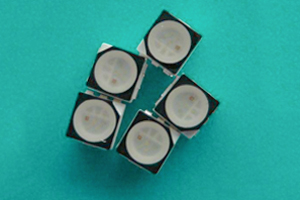
A full-color LED display pixel normally combines red, green, and blue chips. By changing the intensity of these three channels, the display can reproduce a wide range of colors. Common semiconductor material systems include gallium nitride-based materials for blue and green light and aluminum gallium indium phosphide-based materials for red light.
LED chip specifications that matter
- Wavelength and color consistency: closely matched chips help prevent visible color differences between modules.
- Luminous intensity and efficiency: these influence screen brightness and power consumption.
- Forward voltage: consistent electrical characteristics support uniform operation.
- Viewing angle and package design: these affect how brightness and color appear from different positions.
- Reliability: resistance to heat, moisture, static electricity, and current stress affects service life.
What Is an LED Driver IC?
An LED driver IC is an integrated circuit on the module PCB. It does not emit light. It receives control data and supplies precisely controlled current to the LED channels. In a typical display system, the LED receiving card sends pixel data to the module, and the driver circuitry converts that data into current pulses for the red, green, and blue LEDs.
Constant-current driver ICs are widely used because LED brightness is primarily determined by current. Display modules may also use row-decoder or scan-control ICs alongside the constant-current drivers. Their coordinated timing creates the image through rapid scanning and pulse-width modulation.
Driver IC specifications that matter
- Output channels and current range: determine how many LED channels the IC can drive and at what current.
- Grayscale depth: affects the number of brightness levels available for smooth gradients.
- Refresh rate: a suitable driver and configuration reduce scan lines and flicker in camera footage.
- Current accuracy: channel-to-channel and chip-to-chip consistency improve brightness uniformity.
- Low-grayscale performance: good drivers reduce color cast, unevenness, and detail loss in dark images.
- Power and thermal performance: lower power consumption can reduce module temperature and improve reliability.
How the Two Components Work Together
- A video source is processed by an LED video processor or controller.
- The sending system distributes image data to receiving cards inside the display cabinets.
- The receiving card passes pixel and timing data to each LED module.
- Driver ICs translate that data into controlled current pulses.
- The red, green, and blue LED chips emit light at the commanded intensity, forming the final image.
This chain explains why replacing only the LED lamp may not solve a module-level image problem. A technician must identify whether the fault comes from the light-emitting device, driver IC, scan circuitry, receiving card, power supply, cable, or configuration.
How to Identify Which Part Is Causing a Fault
- One pixel is dark or has the wrong color: inspect the LED package, solder joints, and local connection first.
- A complete row or column is abnormal: check the driver IC, scan circuit, signal path, and related solder joints.
- Flicker or scan lines appear on camera: review driver capability, refresh-rate settings, scan ratio, and receiving-card configuration.
- Dark areas look noisy or uneven: check low-grayscale driver performance, calibration data, current consistency, and module matching.
- An entire module is blank: verify power and data connections before replacing LEDs or ICs.
Always disconnect power and follow electrostatic-discharge precautions before inspecting or replacing components. Component-level repair should be performed by a qualified technician.
How to Choose LED Chips and Driver ICs
For a new LED display, choose the two parts as a matched system rather than comparing them in isolation. Start with the required pixel pitch, indoor or outdoor environment, target brightness, scan ratio, refresh rate, grayscale performance, camera-use requirements, power budget, and operating temperature.
For broadcast studios and virtual production, prioritize high refresh rate, stable low-grayscale output, and camera compatibility. For outdoor displays, brightness, efficiency, weather resistance, and thermal reliability carry more weight. Rental displays need a practical balance of image quality, durability, weight, and serviceability.
When replacing a component, do not select it by package appearance alone. Confirm the exact part number, electrical ratings, channel count, current setting, pinout, protocol, and module configuration. A physically compatible driver IC may still produce incorrect brightness or fail to communicate properly.
Frequently Asked Questions
Is an LED chip the same as an LED driver IC?
No. The LED chip emits light; the driver IC regulates current and controls when and how brightly the LED emits.
Does the driver IC determine LED display refresh rate?
It is one important factor, but not the only one. The driver IC, scan ratio, grayscale settings, receiving-card configuration, and controller timing work together to determine effective refresh performance.
Can a better driver IC improve image quality?
Yes, when the rest of the system supports it. A capable driver can improve current consistency, grayscale performance, refresh rate, and resistance to ghosting or scan artifacts. It cannot correct poor LED wavelength consistency or damaged light-emitting chips.
Which component affects LED display brightness?
Both do. The LED chip sets the light-output capability and efficiency, while the driver IC and current configuration determine how the chip is driven. Safe brightness must remain within the LED and module manufacturer’s ratings.
What does “LED IC chip” usually mean?
The phrase is ambiguous. In display repair and purchasing, ask whether it refers to the light-emitting LED die or the driver integrated circuit. Part numbers and the component’s location on the module remove the ambiguity.
Conclusion
The key difference is simple: the LED chip creates light, and the driver IC controls it. Image quality and reliability depend on both components, plus correct power, thermal design, control hardware, and configuration. If you need help matching modules, receiving cards, driver hardware, or other LED display parts, contact our team with the module model, photos, and current configuration.